
KIRCHER, ATHANASIUS. – Jesuit, scholar, and polymath, b. at Geisa (Fulda) on 2 May 1601, d. in Rome on 27 November 1680. He first taught (1629) ethics and mathematics at the University of Würzburg, also giving lessons in Hebrew and Syriac; but in 1631 he was forced by the Swedish victories in Germany to take refuge in Avignon, where he devoted himself to intensive study of the hieroglyphs and their decipherment. Called to the Collegio Romano in 1635, he taught physics, mathematics, and Oriental languages there for some time, but was subsequently left free to pursue his studies and research, surrounded by the esteem and assistance of learned men and scholars.
This resulted in a copious harvest of pamphlets and works (44 printed volumes) on the most varied subjects, to such an extent that his contemporaries called him « doctor centum artium »; yet, although he displays in them an immense erudition and an extraordinary versatility of intellect, he does not always demonstrate sound critical judgment, admitting childish interpretations and accepting information with a credulity somewhat beyond the bounds of propriety.
He devoted himself to philology, especially Egyptology, with Prodromus coptus (Rome 1636), Lingua Aegyptiaca restituta (there 1643), Oedypus Aegyptiacus (3 vols., there 1652–54)
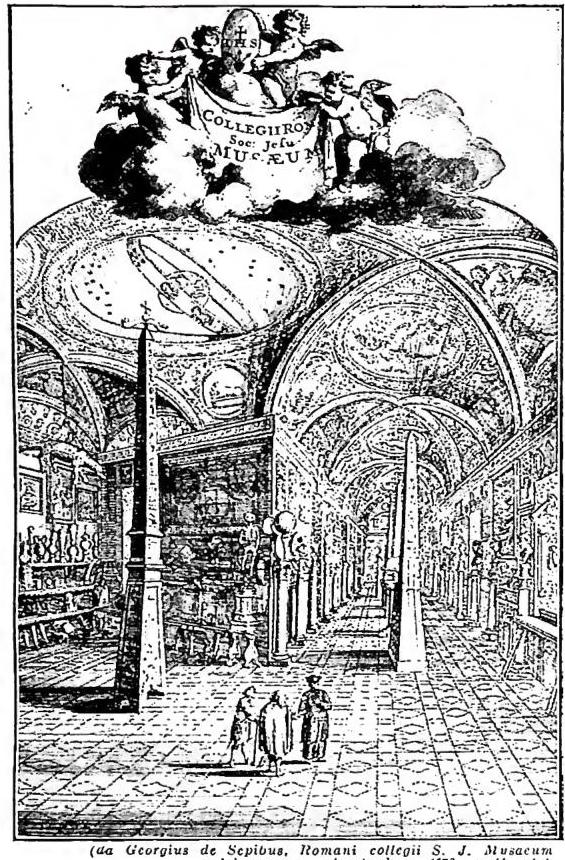
(from Georgius da Sapius, Romani collegi S. J. Musarum celscerinum, Amsterdam 1878, frontispiece)
KIRCHER, ATHANASIUS - Interno del Museo Kircheriano. Incisione in rame - Roma, esemplare della Biblioteca della Civiltà Cattolica.
pensando di avere scoperta la chiave per la lettura dei geroglifici, Obeliscus Pamphilus (ivi 1650), dove spiega i geroglifici dell'obelisco di Piazza Navona, restaurato dal Bernini sotto la direzione del K., di fisica con Ars magnesia (Würzburg 1631), Specula Melitensis (Napoli 1638), Ars magna lucis et umbrae (Roma 1645); di astronomia con Itinerarium extaticum seu opificium coeleste (ivi 1656); di geologia con Iter extaticum secundum (ivi 1657) e Mundus subterraneus in XII libros digestus (ivi 1665), dove parla di terremoti, vulcani, correnti sotterranee delle acque; di matematica con Organum mathematicum (Würzburg 1668); di medicina con Scrutinium physico-medicum contagiosae luis, quae pestis dicitur (ivi 1658), in cui è uno dei primi a parlare dei bacilli della peste; di musica con Musurgia universalis, sive ars consoni et dissoni (ivi 1650), Phonurgia nova (Kempten 1673); di corografia con Latium (Amsterdam 1771); di liturgia con Rituale ecclesiae Aegyptiacae (ivi 1647). Ancora si può consultare con frutto China monumentis qua sacris, qua profanis... illustrata (Roma 1667), dove da informazioni dei missionari e da letture raccoglie notizie di storia, arte, scienze, religione, culto dei Cinesi; non vi manca una esagerata buona fede nella interpretazione dei fatti. Le molte relazioni con i dotti del suo tempo diedero origine ad un ampio epistolario di grande utilità per la scienza, in parte edito e disperso in parecchie pubblicazioni, in parte ancora inedito (cf. Sommervogel, IV, coll. 1070-75; nell'Archivio della Università Gregoriana si conservano 114 voll. di lettere inviate al K. da eminenti scienziati).
Al K. si deve anche una preziosa raccolta, sempre più accresciuta, di strumenti di matematica e di fisica,
di macchine, di ogni sorta di oggetti interessanti l'antichità classica, cristiana, orientale e dell'America meridionale e l'etnografia, che diede origine al Museo del Collegio Romano, chiamato poi dal nome del fondatore della raccolta Museo Kircheriano.
Nei suoi ultimi anni eresse sui colli sabini il santuario mariano della Mentorella, meta di numerosi pellegrinaggi, dove, poi, fu collocato il suo cuore.