
CATHOLIC JOURNALISM. - It is journalism founded on Christian principles and imbued with them.
CONTENTS:
I. Definition
II. History
III. Contemporary Catholic journalism
IV. Journalistic technique and professional ethics.I. DEFINITION
Journalism is one of the typical aspects of modern society; although its distant origins can be traced, it remained in the past, for various intrinsic and extrinsic reasons, an episodic and particular phenomenon until the end of the 18th century. Today, however, it can rightfully be considered a "social service" of information for the individual and of formation of public opinion through the reproduction and interpretation, in the form of news and articles, of daily life simultaneously with events. Its importance has not been diminished at all by the development of other more modern means of information, such as radio broadcasting, nor will it likely be, at least for a long time, by television; however, one must not exaggerate this importance, especially where the press is legally free and thus subject to the control of public opinion and to contradiction; its influence is deeper where the press, uniformly oriented, offers no comparisons nor fears public objections.Characteristics of modern journalism are the speed and breadth of the information it provides, the rapidity of printing methods, its vast diffusion, but even more so the fact that journalists constitute a distinct class with their own way of thinking and opinions. The "journalistic style," like "journalistic circles," are common expressions that nevertheless reflect an existing reality as an element of modern society.
Catholic journalism does not differ in general characteristics from journalism to which this adjective is not applied; indeed, Catholic newspapers have the same purpose as others, use the same technical means, and maintain the same relations with readers; just as Catholic journalists are professionals no more and no less than other journalists. The fact that Catholic journalism is predominantly in the service of an idea, and thus predominantly "ideological" journalism, does not distinguish it—if anything—from purely "informative" journalism, where it exists, but aligns it in this respect with other forms of "ideological" journalism. From all these other forms, however, it is distinguished by its strict observance of the norms of a more rigorous professional and social morality, which is not generic but founded on and informed by Christian principles.
From a social perspective, Catholic journalism is part of that complex of thought and works of militant Catholics which has modernly taken the name of Azione Cattolica; and this is so even though, historically and geographically, it has sometimes preceded and sometimes followed the organized movement of Azione Cattolica, always serving as its principal auxiliary if not indeed one of its determining elements; so much so that one will see how there is no proper Catholic journalism in those countries where, for various and diverse reasons, there is no Azione Cattolica, and vice versa.
II. HISTORY
Modern Catholic journalism was born alongside that social renewal movement which emerged at the beginning of the 19th century, and whose somewhat complex characteristics have not yet been fully clarified. Like that movement, journalism was considered and called the "child of the Revolution," and as such, it was both exalted and feared. While today the journalistic relics of a century and a half ago may elicit a smile of condescension, this was not the opinion of contemporary readers. They were already deeply impressed by the mere fact of receiving relatively prompt news even from distant countries, as well as by commentaries and interpretations that appeared supremely audacious. Articles made an even greater impression than the news itself, particularly the so-called "editorials" (articoli di fondo), which presented the newspaper's—and the milieu's—opinion on political matters. Such articles began appearing in English newspapers as early as 1904, but on the Continent much later. The French and German gazettes...
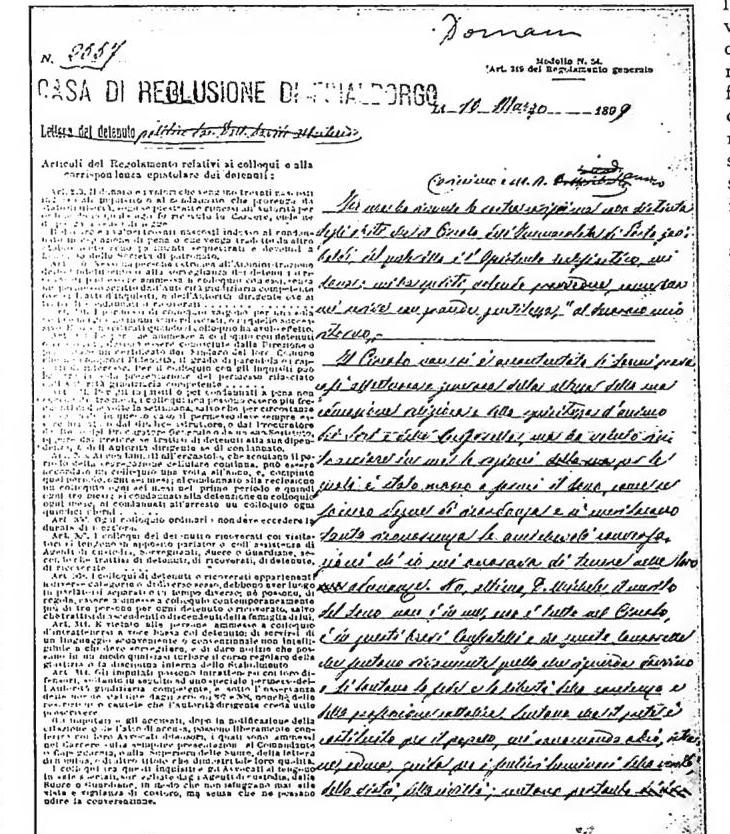
CATHOLIC JOURNALISM - A letter from Don Davide Albertario from the prison of Finalborgo (10 March 1899).
It began publication during the French Revolution; Italian newspapers followed in the period immediately preceding 1848, despite the fact that in Italy the birth of the newspaper in a form resembling today's can be traced back to the mid-17th century, whereas in other countries it came later. However, these were predominantly literary newspapers, both because other types would not have been permitted by governments and because, before democratic consciousness awakened (or reawakened) in the people, no other subjects were sought. Later, the papers became political with a revolutionary character; silenced under the Napoleonic Empire, after Napoleon's fall there was indeed a flourishing of Catholic periodicals, but the restrictive laws of the Restoration governments forced them to remain within the purely moral and religious, scientific, and literary spheres. Gradually, however, as time passed, the pressure of the press on governments grew, aiming for freedom, and this movement, as far as Catholic journalism was concerned, manifested itself especially in Italy and France.
In Italy, the first multi-weekly periodical (published three times a week) with a political-moral character appeared in Modena, where the restrictive laws on press freedom were milder, and it was La voce della verità, gazzetta dell'Italia centrale, edited by Giovanni Galvani and published from 5 July 1831 to 28 June 1841. In the following years, others of the same type were published; suffice it to say that their main collaborators were the Prince of Canosa, the magistrate Samminatelli, and Count Monaldo Leopardi; periodicals which, while animated by good intentions and entirely averse to offending religion, were primarily concerned with defending legitimist principles. In the other States of the peninsula, the press was reduced to a few official sheets, compiled and printed under the care of their respective governments, containing official communications, some foreign news usually taken from the official papers of other States, and a few articles; a few cultural, artistic, or variety weeklies; and a few scientific, religious, or legal periodicals; this was the case both in Lombardy-Venetia, where Austria vigilantly monitored every manifestation of novelty, and in the other States of the peninsula that conformed to its way of acting, as well as in the Papal States and even in the Kingdom of Sardinia, where Charles Albert, awaiting his moment, left the government to Solaro della Margherita.
The first to be published in Italy was L'armonia della religione con la civiltà (1848-70), which appeared in Turin on 14 July 1848 alongside Il risorgimento by Cavour, Il messaggero by Brofferio, and La gazzetta del popolo by Botero. The newspaper was promoted by a committee headed by Marquis Birago di Vische and Monsignor Moreno, Bishop of Ivrea; the editorship was entrusted to the theologian Guglielmo Audisio, who had as his collaborator the very young theologian Giacomo Margotti. In the same days, another Catholic daily was born in Modena, Il messaggero di Modena (1848-59), which took a conciliatory line toward the governments of the time; L'armonia, on the other hand, immediately became an extremely combative newspaper; composed, like all newspapers of the time, more of articles than of news, it immediately fought its first great battle in favor of the Jesuits against Minister Gioberti; shortly afterward, it launched another attack against the D'Azeglio cabinet, whose Minister of Justice, Siccardi, had presented the laws for the suppression of ecclesiastical property; then the Government, on 7 September 1849, summarily dismissed Audisio from his position as rector of the royal basilica of Superga. Audisio, without waiting to be expelled, left the Kingdom of Sardinia and took refuge in
Tuscany; the newspaper passed to the editorship of Margotti, who was then only 26 years old and who, moreover, accentuated its combative character. In 1857, it was this newspaper that, in reaction to Cavour's efforts to prevent the election of Catholic deputies, proposed that those elected resign and initiated the campaign for the famous formula: «neither elected nor electors», later reinforced by the non expedit. Cavour then suppressed the newspaper, which, however, resumed publication the following year. In 1863, Margotti, having lost the support of Marquis Birago and in disagreement with Monsignor Moreno, left L'armonia and founded L'unità cattolica (1863-1929).
Meanwhile, faced with the anticlerical campaign that Freemasonry, then reawakening, was fanning throughout the peninsula, Pope Pius IX had taken a stand in favor of Catholic journalism and, in the encyclical Inter multiplices (1853), had vigorously defended II. Throughout the peninsula, numerous combative and bold Catholic weeklies and dailies sprang up, but they were poor in means and therefore short-lived. Among the reviews, La civiltà cattolica (Naples 1850) immediately established itself. In that period, some of the dailies that would later have the greatest resonance were also born, including L'osservatore romano (1861), which later became, from an independent newspaper, the organ of the Holy See.
The heroic period of Catholic journalism in Italy can indeed be considered the forty years from 1861, the year of the proclamation of the Kingdom, to the end of the century. This forty-year span saw the birth of Catholic Youth and then of the Opera dei congressi e comitati cattolici, the Vatican Council, Rome as the capital of Italy, the financial stabilization laws of the new State, the fall of the Right and the governments of Depretis and Crispi, the attempts at reconciliation with the Holy See alternating with the most heated episodes of anticlericalism, the transformation of socialism from a revolutionary workers' movement into a political party, the African war, the Milan uprisings, the Pelloux reaction, and finally the assassination of King Umberto and the transition from the Left's government to the Liberal one—events that all had different but always profound repercussions on the fortunes of Catholic journalism. Indeed, during this period, Catholics, abstaining entirely from elections, had no other way to influence public opinion than through their press, to oppose a policy and a press that were vividly and often violently anticatholic and anticlerical. It should be added that not even Catholics in action were united among themselves in this battle, as some remained intransigent toward the "revolutionary" and liberal State and were fiercely defensive of the pontifical protests, especially regarding temporal power; while others gradually became less hostile to the Italian State and, while remaining faithful to pontifical directives, sought to interpret them in an increasingly conciliatory manner, thinking thus to better influence the transformation of the State from an adversary to a State for all; naturally, Catholic journalism itself was part of these two currents, both undergoing and in part determining their directions, clashes, and repercussions.
BIBL.:
G. Margotti, Memorie per la storia de' nostri tempi, Torino 1863-65; G. Martina, Pio IX (1851-1866), Roma 1986; A. Gambaro, La stampa periodica italiana, Milano 1931; G. De Rosa, Storia del movimento cattolico in Italia, Bari 1966; E. Soderini, Il pontificato di Leone XIII, Milano 1932-33; F. Fonzi, I cattolici e la società italiana dopo l'unità, Roma 1953; V. anche GIORNALE, GIORNALISMO, STAMPA CATTOLICA.
Typical representatives of the intransigent current were L'unità cattolica and L'osservatore cattolico of Milan (1864-1907), which had a highly turbulent existence, largely identified with that of its most celebrated director, Don Davide Albertario. Founded in the same year as the Syllabus, L'osservatore cattolico found itself at the heart of the battle against rationalist liberalism waged by the intransigent neo-Guelph group; Albertario took over its direction in 1869 and maintained it for thirty years, enduring all manner of hostility, even from illustrious ecclesiastics such as Don Antonio Stoppani, until his arrest and detention. While it must be acknowledged that the battle of L'osservatore cattolico was at times excessively intransigent and that it occasionally disregarded the terms of its polemics against anyone who opposed it, it must also be said that it had beneficial effects on other newspapers of the peninsula, showing them how one could face adversaries openly.
In 1874, the first congress of the Opera dei congressi e comitati cattolici recommended the dissemination of the press
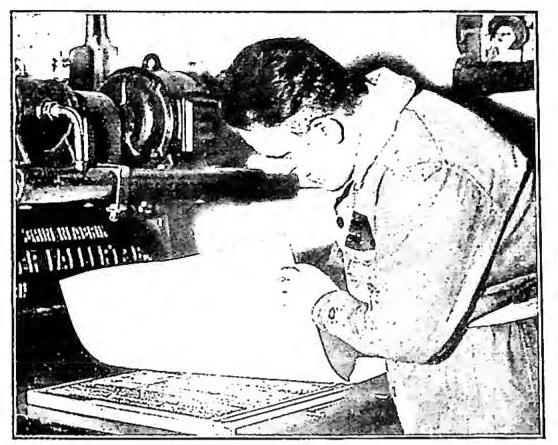
CATHOLIC JOURNALISM - Stereotyping for the transformation of the flat page into a semicylindrical page - Bologna, L'avvenire d'Italia.
The convulsive and disproportionate reaction that the Di Rudinì cabinet opposed to the unruly popular uprisings of 1898 also struck Catholic journalism: in Milan, Albertario was tried and convicted; in Florence, L'unità cattolica was suppressed for several months; elsewhere, other newspapers suffered the same fate.
The recovery after the storm also marked the opening of a new period in which so-called "intransigent" newspapers declined, and conciliatory ones asserted themselves. This change was determined by three factors: the affirmation of Toniolo's social directives, endorsed by pontifical sanction in Rerum novarum; the participation of Catholics in administrative elections and the gradual replacement of the Margottian formula "neither elected nor electors" with that of Filippo Meda, "preparation in abstention," of which Meda himself became an advocate precisely in L'osservatore cattolico when he became its director; the recognition of the need for greater unity among Catholics, both in the face of external dangers and those internal ones that were beginning to take shape: Don Romolo Murri.
To achieve unity in the journalistic field, at least among the major organs, Count Grosoli, who had been the last president of the Opera dei congressi (dissolved by Pius X in 1904), founded in 1908 the Unione editoriale romana (later italiana), tasked with administratively and editorially coordinating the adhering newspapers. Part of this organization, commonly called the "Catholic trust," were various newspapers from northern and southern Italy: Il corriere d'Italia, founded in 1903 by Gaetano De Felice under the name Corriere di Roma; L'avvenire d'Italia, then directed by Rocca d'Adria; L'Italia, directed by Paolo Mattei Gentili; Il momento of Turin, directed by Angelo Mauri; Il messaggero toscano of Pisa, founded by Cardinal Maffi; Il corriere di Sicilia of Palermo. The latter newspaper soon ceased publication following manifestations of monarchical loyalty deemed excessive at that time.
The "trust" had its advantages and disadvantages; it standardized the direction of the adhering newspapers and improved their internal and especially external services, sending Domenico Russo to Paris as the first Catholic journalist assigned abroad for this purpose. However, it also significantly hindered their editorial operations with the imposed review that the Rome office had to conduct, both of foreign correspondences and of the main collaborations, as well as the editorials of the various directors. Unity of direction was ensured, but in practice, there was only one direction, not always entrusted to competent and suitable persons, with six local sub-directorates. These drawbacks kept some newspapers outside the "trust," whose directors wished to maintain their independence, just as the conciliatory direction kept out the intransigent newspapers. These newspapers, in fact, waged a fierce battle against the "modern" newspapers (a dangerous adjective in times of anti-Modernist struggle), and the battle culminated when Pius X, in a letter to the Lombard episcopate on July 1, 1911, disapproved of the direction of "certain newspapers," among which it was not difficult to recognize those of the "trust." The disapproval became explicit on December 1 of the same year, when the issue of Acta Apostolicae Sedis published a "notice" stating: "To remove the misunderstanding that certain newspapers are creating among the clergy and the faithful, it is declared that the Holy See does not recognize as conforming to pontifical directives and to the norms of His Holiness's letter to the Lombard episcopate, dated July 1, 1911, the following newspapers: L'avvenire d'Italia, Il corriere d'Italia, Il corriere di Sicilia, L'Italia, Il momento, and others of the same kind, whatever the intentions of some distinguished persons who direct and assist them." The Congregation of Religious, interpreting the notice in the most restrictive manner, soon declared that not only subscription but even the reading of such newspapers was forbidden to religious without the authorization of their major superiors. It was a severe blow to the newspapers of the "trust," which nevertheless continued to publish, striving to conform as much as possible to pontifical directives. The measure, however, remained in force for only a short time because in 1914, Pope Benedict XV, in response to Monsignor Falcini, Bishop of San Miniato, who had inquired about the matter, had Cardinal Gasparri, Secretary of State, reply: "the aforementioned notice did not have the character of a prohibition." The newspapers of the "trust" regained vigor, while those that persisted in forms of intransigence no longer suited to the times either ended or were ending during the war of 1915-18. But even the flaws of the editorial union during the same war outweighed its advantages, and the "trust" was dissolved in 1916; each newspaper regained its autonomy.
During the war of 1915-18, Catholic dailies effectively supported the movement for the integration of Catholics into political life, which led in 1919 to the formation of the Italian People's Party. Almost all Catholic newspapers fully adhered to it, to the extent that they felt the backlash of the struggle that Fascism waged against democratic parties and then against the press that did not fully submit to its directives. Some, like L'avvenire d'Italia and Il corriere d'Italia, joined the Centro nazionale (a political organization of Catholics that supported Fascism); others ended, like Il messaggero toscano and almost all the minor ones; others continued in their line of Catholic press action, like L'Italia. The year 1929 dealt a severe blow to Catholic journalism: Il momento and Il corriere d'Italia disappeared, primarily because of the current...
Catholic journalism is journalism founded on Christian principles and dedicated to them.
During the remaining Fascist period, these few dailies remained alone in Italy to represent a press not entirely subservient to Fascist directives and sometimes—such as in the 1931 conflict between Catholic Action and Fascism—even in outright opposition. During the German occupation following the 1943 armistice, almost all temporarily ceased publication, either because they were unable to continue due to war-related destruction of their facilities (like L'avvenire d'Italia) or voluntarily to avoid submitting to the impositions of the Social Republic and the German occupiers (like L'Italia, which temporarily became a weekly). In the final Fascist period and until liberation, L'osservatore romano—whose authority and circulation had steadily grown under the direction of Count Giuseppe Dalla Torre, particularly through polemical campaigns against Nazism and Fascist abuses—remained, in fact, the only representative of Catholic journalism in Italy.
In France, after several unsuccessful attempts—one of which dates back to 1680—L'ami de la religion was founded in 1814. Later, at the urging of Monsignor Dupanloup, it transformed in 1849 from a thrice-weekly into a daily, free from political influences and of distinctly Catholic inspiration. The anticlerical revolution of 1830 led to the emergence of one of the most notable French dailies: L'avenir (1830-31), which bore the motto « Dieu et la liberté » and had as editors Lamennais, Lacordaire, and Montalembert. It was the first daily dedicated to religious thought, not without social accents. Edited with resources equal to those of the other major dailies of the time and by true journalists, it seemed destined for a brilliant future. Instead, it ran into doctrinal assertions that were disapproved by Rome. The three journalists suspended publication and left for Rome, « pilgrims of God and liberty », to receive pontifical directives. These came, but in the form of the condemnatory encyclical Mirari vos (August 1832). The newspaper never resumed publication; some provincial organs, born in the same environment, continued its ideas while more prudently containing them within orthodox lines. From one of these minor organs, at the urging of Abbé Migne (the future editor of the Patrologie), arose L'univers religieux politique, philosophique et littéraire (1833-1907), which quickly gained renown and wide circulation. This grew further when Louis Veuillot became its director in 1842. Some of the finest pages of 19th-century French literature and some of the century’s most heated polemics remain tied to the names of Veuillot and L'univers. With the 1848 revolution, all positions shifted again. Catholicism had become popular, and many newspapers drew inspiration from it, even when judging political events. However, from this moment, Catholics were divided for decades by the institutional question, and the press reflected this division. L'univers, which had sided with the Republic but in a conservative sense, was opposed by L'ère nouvelle (1849), a monarchist newspaper founded by Abbé Maret and Ozanam and initially directed by Lacordaire. Under Napoleon III, the press was strictly monitored, and in 1860 L'univers was suppressed, having first supported Napoleon and then opposed him. The newspaper resumed publication in 1867, and in the meantime, its publisher had replaced it with Le monde (1860-96), directed by Eugène Coquille, one of the finest pens of French journalism. In the same year as L'univers's rebirth, Monsignor Dupanloup, the Viscount de Melun, and Auguste Cochin succeeded in merging several small organs into a new major daily, Le français, of a rather moderate and liberal character. The Republican resurgence of 1870 divided Catholics once more—who under Napoleon had been somewhat united against him—into Republicans and monarchists of various tendencies. Thus, L'univers and Le monde supported the Count of Chambord, while other Catholics, with Édouard Hervé, backed the Count of Paris, first in Le journal de Paris and then in Le soleil (1873-1914), the first French newspaper sold for five centimes. Still others supported the Bonapartes, with Paul de Cassagnac founding L'autorité, which also ceased in 1911. Meanwhile, Le figaro defended Catholic interests with such zeal that it even provoked protests from Louis Veuillot. Among all these newspapers, Le français stood out, as it did not confuse the defense of Catholic interests with those of any dynasty. It had such a following that it could be compared in influence to Le journal des débats. However, it later became entangled with the Duke of Broglie in the actions of the Conservative Party and declined. Then, in three years, Monsignor Dupanloup raised the necessary capital to found another newspaper, La défense sociale et religieuse (1876-83). Though its intention to unite Catholics on a single line of religious defense was excellent, the writers’ pens did not match II. After an initial period of prosperity, the newspaper fell alongside Le français, following the ralliement, which it had nevertheless helped to realize.
Meanwhile, from the transformation of a small review of the same name, what is today the great religious newspaper for French Catholics was born: La Croix.
Within about twenty years, the vast majority of Catholic provincial newspapers—Le bien public of Dijon, L'express of Lyon, La liberté catholique of Toulouse, and others—abandoned the monarchist line entirely. Accepting the new directives of the encyclical to the French, they devoted themselves to the defense of Catholic interests. L'univers, after absorbing Le monde and passing through various vicissitudes with the sons and grandsons of the great Veuillot, disappeared, poorly replaced by La libre parole (1892-1924) and then by Le peuple français (1893-1910).
In the two decades between the world wars, Catholics divided their sympathies between genuinely Catholic newspapers like La Croix, with its numerous provincial editions and the mass of reviews of every kind published by La bonne presse, and newspapers such as L'éclair, La liberté, Le figaro, Le gallois, L'écho de Paris—all respectful of Catholic thought—as well as L'ami du peuple, which distinguished itself in the fight against communism, and other local papers. After La démocratie by Marc Sangnier, the newspaper that best prepared the new era was L'aube (1932) by Francisque Gay and Gaston Tessier, a newspaper of pure Christian and patriotic spirit, as well as democratic and syndicalist. Before 1940, there were 56 Catholic dailies in France, all with local circulation (except La Croix of Paris) and grouped into several « trusts » with a vast capillary organization for distribution. However, in general, French Catholic journalism, apart from some momentary exceptions, never succeeded in exerting through its dailies the influence on society that it did through its bold and profound monthly reviews.
In Austria, the first Catholic daily was Das Vaterland (1860-1912); others of regional character later emerged, numbering 12 by 1935. The entire complex drew inspiration from the Christian Social movement led by Baron Karl von Vogelsang, founder of Der Priusverein for social works and Der Priusverein for the press. In 1894, Die Reichspost was founded, which, well-edited, took first place among the Catholic press and a notable position in Austrian Catholic journalism; its most celebrated director was State Councillor Friedrich Funder, under whose leadership the newspaper gained great importance in the political field as well. A characteristic newspaper was Das kleine Volksblatt, a popular, highly illustrated organ. Widely circulated was the Catholic weekly Tiroler Volksbote, founded in 1898 in Innsbruck, suppressed by the Nazis, and reborn after liberation (1945) under the title Der Volksbote.
In Belgium, Catholic dailies existed even before 1830, the year of its establishment as an independent state; the oldest newspaper in Belgium, Le courrier de l'Escaut, is a Catholic daily. However, the first major religious and political daily was La gazette de Liège (1840), directed by a dynasty of journalists, the Demarteaus. After 1860, the Catholic press gained broader momentum: in 1884, Le patriote was born, and after the Rerum novarum, L'avenir social by Carton de Wiart. The greatest importance, however, was held by La libre Belgique, the newspaper most beloved by Belgian Catholics, which continued to appear clandestinely even during the German occupation of 1914-1918. Pronounced regionalism and linguistic differences ensured that Belgium always had numerous local dailies; about half of the total circulation of the Belgian press was accounted for by Catholic dailies.
In Czechoslovakia, before the Second World War, there were six Catholic dailies in Bohemia and Slovakia, one in Subcarpathian Ruthenia; additionally, the Polish and German minorities each had one. The most important were Lidové Listy in Prague, Die deutsche Presse, also in Prague, and Slovak in Bratislava.
In Germany, Catholics had their first organ in 1860, Die hölische Blätter of Cologne, later becoming Die hölische Volkszeitung; many other local organs followed, united in two "trusts": Der Zeno Konzern in Münster, which controlled 28 newspapers in northwestern Germany, and Die Verbo in Friedrichshafen, which controlled 19 in northern Bavaria. In 1870, simultaneously with the Prussian Zentrumspartei, the major German religious-political organ, Die Germania, was born, which fought for the same aims as the "Centre": to protect the freedom of the Church and confessional schools and to secure for Catholics their liberty independent of the will of an occasional parliamentary majority. When the Nazi regime attacked and then suppressed the Catholic press in the Reich, it numbered 61 dailies, of which about twenty had circulations exceeding 20,000 copies; the Augustinus Verein oversaw their distribution and development.
In England, no Catholic dailies existed due to the peculiar conception of the press there; indeed, a daily without political colour was inconceivable. However, Catholics had no party of their own, as they militated indifferently in any of the three traditional parties—Conservative, Liberal, and Labour—none of which were anti-Catholic. Thus, they had no dailies of their own, only a few well-made and widely circulated weeklies.
In the Netherlands, although Catholics comprised barely half the population, the Catholic press was very widely circulated and represented half of the total. Before the war, around Maasbode (1878) of Rotterdam, a well-made and widely circulated major newspaper, and Tijd (1848), there were as many as thirty local dailies.
In Poland, before the Second World War, there were as many as 53 Catholic dailies, of which only Kurier Warsawski was truly important; however, there was also a school of Catholic journalism and a Catholic news agency.
Spain was once rich in newspapers and still has one of the oldest, El diario de Barcelona, a Catholic daily founded in 1792. Generally, however, Spanish newspapers have been very lively in the past, with low circulation and short duration. Among the oldest, El católico (1840-70) and La España (1848-1868) deserve mention; among those still published are El siglo futuro (1875), El correo catalán (1875), and La voz de Valencia (1892). At the beginning of the century, the most important newspapers were born, which continue to be published: La gazeta del Norte (1901) in Bilbao, El noticiero de Zaragoza (1900), El debate in Madrid with its affiliated newspapers in various provinces, and L'A.B.C. in Madrid. El debate has a flourishing school of Catholic journalism, the only one in all of Spain.
In Switzerland, the press also struggled to secure for Catholics the place they deserved in a non-Catholic state. Between 1830 and 1870, Catholic newspapers had precisely this task, including Das Vaterland (still published) in Lucerne, founded in 1833 under the title Die Luzerner Zeitung, La voix catholique (1847), La gazette de Fribourg (1849), and L'ami du peuple (1864). After 1870, under the impetus of Mermillod (later cardinal), all Catholic activities in Switzerland gained new momentum, including the press. Those that are still the major Swiss newspapers were born: La Liberté (1871) in Fribourg, Die Ostschweiz (1873), Le courrier de Genève, Il giornale del popolo in Lugano, Die neue Zürcher Nachrichten, and ten other local newspapers.
In Luxembourg, the larger of the two existing dailies, Das luxemburger Wort (1848), is Catholic. In Portugal, Catholics have Novidades and three other dailies. Ireland has no Catholic dailies, but the principal daily, The Irish Independent, is directed by Catholics.
The European countries now under Soviet domination had their religious and political organs: Hungary had the widely circulated Nemzeti Újság (1921) in Budapest and various other dailies born and supported by the "Pázmány" organisation for Catholic writers and journalists. Lithuania had Rytas; in Yugoslavia, the Catholic press was Croatian or Slovenian. The Croats, after various vicissitudes, had retained Hrvatska Straža (born as Riječke Novine in Fiume in 1911 and transferred to Zagreb in 1914); the Slovenes had Slovence, founded in 1873, and Slovenski dom, founded in 1936.
In America, the United States never had Catholic dailies other than a small newspaper of local importance, The Catholic Daily Tribune of Dubuque (Iowa), and a few newspapers for emigrants not in English. However, there were very many periodicals, given great impetus by the Plenary Council of Baltimore (1884); even more effective was the establishment in 1919 of the N.C.W.C. News Service, which supplies Catholic news to a large number of American and European periodicals.
Canada had its first Catholic daily in 1882, L'étendard in Trois-Rivières; later came the current French-language Catholic dailies: L'action catholique (1907) in Quebec, Le devoir (1910) in Montreal, and Le droit (1913) in Ottawa.
In Argentina, after the dailies of the 19th century that actively defended religion, El pueblo (1900) arose, which is the largest Catholic daily in all of America.
In the other republics of Latin America, Catholic dailies of no great importance are published in Venezuela (La religión, Columna, and Diario católico), Ecuador (El debate), Bolivia (Alas), and Nicaragua (Diario nicaragüense).
BIBL.:
For Austria: F. Funder, Vom Gestern ins Heute, Vienna 1952; for Belgium: A. De Ridder, La presse belge, Brussels 1929; for Czechoslovakia: J. Cibulka, Katholické novinářství v Československu, Prague 1937; for Germany: K. Buchheim, Ultramontanismus und Demokratie, Munich 1963; for Spain: J. M. Desvois, La presse en Espagne, Paris 1972; for Switzerland: A. Simon, Geschichte der katholischen Presse der Schweiz, Fribourg 1957; for the United States: J. T. Ellis, The Life of James Cardinal Gibbons, Milwaukee 1952; for Latin America: J. L. Romero, Historia de la prensa latinoamericana, Buenos Aires 1943.
G. MARTINA S.I.
In the Arab states, the few daily newspapers published there are all in the hands of Catholics, though they are not strictly Catholic organs. Before the war, China had the Yi-Shih-Pao in Tientsin; India had The Catholic Herald, and the Belgian Congo had the Courier d'Afrique in Leopoldville.
III. CONTEMPORARY CATHOLIC JOURNALISM
The upheaval caused everywhere by the Second World War did not leave journalism untouched, though its impact was not profound. In the Anglo-Saxon countries and those that remained on the war’s periphery—apart from restrictions imposed by the shortage of paper due to difficulties in cellulose production and the contraction of international transport—everything remained as before. Conversely, in the countries that fell under Soviet domination—Poland, Lithuania, Romania, Czechoslovakia, Bulgaria, Hungary, Albania—and also in Yugoslavia, all existing press is government-controlled, as is characteristic of totalitarian regimes; in these countries, there is naturally no trace left of Catholic press, neither daily nor of any other periodicity. In democratic countries, there is a noticeable shift in the press toward the so-called "leftist" political and social currents.In Italy, almost all newspapers from the Fascist period resumed publication with slight modifications to their titles and, naturally, with a changed spirit. Catholic dailies are among the very few that had no reason to change their titles, as they had not compromised—or had done so only minimally—with Fascism, and none with that of the "Social Republic." There are eight of them, in addition to L'Osservatore Romano (director Giuseppe Dalla Torre), which continues to be printed in Vatican City and which, during the war, published bulletins from both sides due to the Holy See’s impartiality, suspending publication entirely from June 10, 1940 (Italy’s entry into the war) until June 6, 1944 (the Allies’ entry into Rome). In Rome, Il Quotidiano (director Federico Alessandrini) is published, derived from L'Avvenire, which spontaneously changed its title; in Bologna, L'Avvenire d'Italia (director Raimondo Manzini); in Milan, L'Italia (director Mons. Ernesto Pisoni); in Genoa, Il Nuovo Cittadino (director Don Eugenio Badino); in Como, L'Ordine (director Don Giuseppe Brusadelli); in Bergamo, L'Eco di Bergamo (director Don Andrea Spada); in Trento, Il Popolo Trentino (director Flaminio Piccoli); in Cagliari, Il Quotidiano Sardo (director Mariano Pintus). Unlike what occurred with the Italian People’s Party, to which Catholic dailies adhered by accepting its discipline, they have remained independent of Christian Democracy while supporting its work. Instead, they have accepted a connection with the central organs of Catholic Action, while preserving their editorial and administrative autonomy. For service from Rome (political and religious), they have established a single office. Christian Democracy has its own organs, edited by Catholic journalists, who naturally accept the political party’s discipline in full while disseminating and defending Christian thought.
In France, the war caused even deeper upheavals, and few newspapers retained their mastheads. Among them, La Croix resumed its role as the leading Catholic newspaper, and L'Aube became the organ of the M.R.P. Other dailies not explicitly Catholic are nonetheless widely followed by Catholics, such as Le Figaro, to which F. Mauriac contributes.
In Germany, numerous dailies are published in the two Republics, but only one is Catholic: Das Augsburger Tagesblatt (1948).
In Belgium, the Catholic dailies from before the war have been joined by Le Métropole of Antwerp, a small newspaper that has seen significant growth.
In the Netherlands, a new newspaper has been added to De Tijd and De Maasbode: De Volkskrant of Amsterdam.
International Organizations. Linking bodies in journalism include news agencies for newspapers and associations for journalists. Catholics have not neglected these two sectors. Before the Second World War, there were 19 Catholic news agencies; the most important were the N.C.W.C., the News Service, and Fides. The first, an emanation of the Catholic episcopate of the United States for "promoting, developing, and assisting the Catholic press in the United States," is gaining ever greater influence and distributes thousands of publications worldwide, with millions of copies in circulation, including news, services, articles, photographs, etc. Fides, an emanation of the Congregation of Propaganda Fide, disseminates bulletins in multiple languages to the Catholic press, containing extensive missionary news. The Congregation for the Eastern Church has organized its own agency, the "Servizio Informazioni Chiesa Orientale" (SICO), which disseminates news concerning Eastern Christianities, both Catholic and dissident. An international information organization for the press is the "Pro Deo" Information Center (CIP), which has connections in various parts of the world and disseminates Catholic and other news according to its own ideological criteria.
The international Catholic organization of journalists is threefold. In 1927, in Paris, at the initiative of Renato Delforge, director of Vers l'avenir of Namur, the "Bureau international des journalistes catholiques" was founded, now known as the "Fédération internationale," serving as a link between similar national organizations for the defense of common interests. In 1928, during the exhibition of Catholic press in Cologne, on the initiative of Giulio Stocky, director of Die kölnische Volkszeitung, the "Commission permanente des éditeurs et directeurs des journaux catholiques" was established to foster cooperation among newspapers and agencies. In 1930, in Brussels, during the first world congress of the Catholic press, the third organization was instituted, connecting the other two without undermining their autonomy: the "Union internationale de la presse catholique," a federation that groups entities and individuals. Its statute was approved in Rome in 1936 during the second International Congress of Catholic Journalists. This Congress was particularly significant as it took place during the Universal Exhibition of the Catholic Press, convened in the Vatican by Pius XI to commemorate the 75th anniversary of L'osservatore romano. The exhibition, along with the various meetings and congresses held there, saw the participation of the Catholic press from around the world, except for National Socialist Germany and Soviet Russia. Among the international organizations, the most effective and continuous was the secretariat of the "Commission permanente," directed by the Dutchman Enrico Hoeben, who, through Die katholische Wereldpost of Breda, exerted a broad influence on the press of all countries, especially in the struggle against National Socialism and communism. During the German occupation of the Netherlands in 1940, the Breda headquarters was seized by the Germans, and Dr. Hoeben was interned in retaliation; he died in a concentration camp on February 28, 1942. After the war, relations among all these organizations were resumed at the third International Congress of the Catholic Press, held in Rome (February 16–19, 1950) during the Holy Year. Journalists from 32 countries participated; the three fundamental organizations were reconstituted, along with a permanent secretariat and a Union of Press Agencies. The Count G. Dalla Torre was confirmed as president of the International Union of the Catholic Press. In almost all countries, national associations of Catholic journalists exist. In Italy, after various attempts that did not take hold, in 1940 a "Pia Unione" was established (as professional associations, except for the single unions, could not be formed during Fascism) and operated actively until 1943, that is, until the death of its founder, Mario Luzzi. In 1950, the Association of Italian Catholic Journalists was finally established, affiliated with Catholic Action through the Graduates' Movement. Schools of journalism exist in various Catholic universities; Rome has a flourishing one: the International University "Pro Deo."
IV. JOURNALISTIC TECHNIQUE AND PROFESSIONAL ETHICS
The fundamental code of professional ethics for journalists remains that passage from the encyclical Rerum omnium (26 January 1923: AAS, 5 [1923], p. 49), in which Pius XI declared St. Francis de Sales the patron of « all those Catholics who, through the publication of newspapers or other writings, illustrate, promote, and defend Christian doctrine ». That passage, which requires no commentary, states: « First and foremost, let them study with the utmost diligence and strive, as far as they can, to master Catholic doctrine; let them beware of deviating from the truth, nor, under the pretext of avoiding offense to adversaries, attenuate or conceal it; let them take care of the very form and elegance of speech, and endeavor to express their thoughts with clarity and the ornament of words, so that readers may delight in the truth; and if it should be necessary to combat adversaries, let them know how to refute errors and resist the dishonesty of the perverse, but in such a way as to show that they are animated by rectitude and above all moved by charity ». These concepts were further developed by the same Pontiff in his address to Catholic journalists on 27 June 1929 and by Cardinal Gasparri in his letter to Count Dalla Torre, president of the Association of Catholic Writers and Journalists « S. Francesco di Sales » (4 February 1925). In synthesis, they affirm how noble the Church considers the profession of the Catholic journalist, almost a mission.It is certain that journalism today must be recalled to the foundations of Christian morality, while the freedom of the press, conceived in an ever broader sense, loosens the restraints that few and inadequate laws impose upon it, and which the very speed of its production cycle barely allows time to observe. The duration of the production cycle for a newspaper edition of four or six pages (as is the case for most newspapers in Italy, France, and smaller countries, whereas in America newspapers consist of several sections, each with numerous pages) can vary from 4 to 6 hours, depending on the type of newspaper, the resources available, and the number of editors at its disposal. Today’s journalism would not be what it is if it could not rely on vast and rapid information, the veracity of which is not always easy and often impossible to verify, and on a technical-industrial complex that has reached a high degree of perfection and thus tends to dominate the intellectual work of the journalist. Press agencies, the primary source of news, pour into newsrooms every day, especially every night, an enormous quantity of news and information, of which each newspaper uses approximately one-third. The news provided by these agencies must be processed by the newspaper’s editors together with the information each daily receives from its own informants and correspondents, then sent to the print shop after a swift review by the heads of service (domestic, foreign, parliamentary, local news, religious, sports, financial, etc., depending on the newspaper) and composed into lead lines; the flat pages of mechanical composition are, within minutes, stereoscopically reproduced into semicylindrical monobloc pages and placed on the cylinders of the rotary presses. These extremely fast and precise printing machines can each produce tens of thousands of copies per hour. It is understandable that this work, condensed into a brief span of time and under the pressure of competition, is not always controlled as it should be or executed with the necessary caution. Nevertheless, in every country, precise legal provisions repress abuses of press and information freedom, which, however, can have their first control and limit only in the conscience of the journalist himself. - Vedi tav. XXXV.