
MARET, HENRI-LOUIS. — Theologian, born at Merqueis on 20 April 1805, died in Paris on 16 June 1884. Ordained in 1830, he became famous for an Essai sur le panthéisme dans les sociétés modernes (Paris 1839), which earned him the chair of dogmatic theology at the Sorbonne, and for the Théologie chrétienne (ibid. 1844).
During the Second Empire he supported the religious policy of Napoleon III, who would have liked to make him bishop of Vannes; but Pius IX limited himself to conferring upon him a titular diocese, also in view of M.’s liberal and Gallican leanings. Indeed, he took a position against the proclamation of the dogma of papal infallibility, subsequently publishing two much-debated books, Du concile général et de la paix religieuse and Le pape et les évêques (Paris 1869); and during the First Vatican Council he was among the few to vote against the dogmatic definition, although he then hastened to submit to the majority of the votes. Another battle he fought with equal vigor and likewise lost was that of obtaining recognition by the Holy See for the theological faculties established by the French government in the public universities.
Renzo U. Montini MARGARITONE da AREZZO. — Painter, mentioned in a document of 1262. Vasari also attributed to him extensive activity as an architect and sculptor, assigning to him works certainly executed by others.
(courtesy of Prof. A. O. Quintarolle)
MARGHERITA, santa — Stories of the Saint, marble relief (ca. 1180) — Fornovo di Taro, church of S. Maria Assunta.
near Terranova Bracciolini. There is also an altar frontal, partly repainted by M., in S. Maria delle Vertighe near Monte S. Savino.
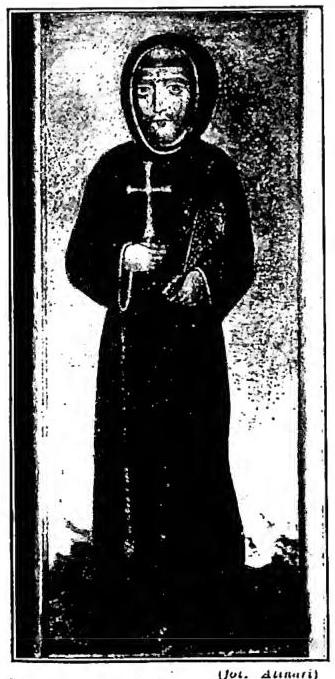
More famous, however, are his images of S. Francesco, whom he depicted frontally as an Oriental ascetic. Worth mentioning is the one in the Pinacoteca d’Arezzo (reproduced in color at V. FRANCESCO), another in the Pinacoteca Vaticana, the one in S. Francesco at Castiglion Fiorentino, another in the Museo civico of Montepulciano, and the one in Rome in S. Francesco a Ripa.