Machine translation of the 1948–1954 Italian original. The original text is authoritative.
MICHELOZZO di BARTOLOMEO. – Sculptor and architect, born in Florence in 1396, died there on 7 October 1472. His early activity unfolded in the field of sculpture, when he is found collaborating in 1420 with Lorenzo Ghiberti, who was then engaged in work on the S. Matteo of Orsammichele and the first door of the Baptistery, and with Donatello during the period when that master was working on the tabernacle for S. Lodovico outside Orsammichele (1425), on the tomb of Giovanni XXIII in the Baptistery, on another for card. Brancacci in S. Angelo a Nilo in Naples, on the Aragazzi tomb, later partly dismantled, in the cathedral of Montepulciano, and on the pulpit for the cathedral of Prato. Then, between 1433 and 1434, M. followed Cosimo dei Medici into exile in Venice, where he worked, although no trace of it remains, in the library of the convent of S. Giorgio.
A memory of this sojourn in the Veneto may nevertheless be discerned in the crowning of the portal of S. Agostino in Montepulciano, which is unmistakably Venetian in taste, and, if it can be shown that they resulted from a late completion of works begun earlier, in those of the tombs of Giovanni XXIII and card. Brancacci. In 1456 M. again collaborated with Ghiberti, this time on the second door of the Baptistery. M.’s subsequent activity, however, was devoted exclusively to architecture: it began with the reconstruction of the convent of S. Marco in Florence (1437–51), and continued with the construction of the chapels of the Novitiate
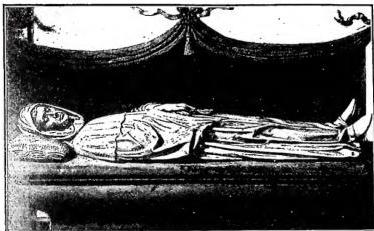
(Ist. Alinari) MICHELOZZO di BARTOLOMEO – Reclining figure from the Aragazzi monument (1427) – Montepulciano, Cathedral.and of the Medici in S. Croce, and of the tabernacles of S. Miniato al Monte and the Annunziata, while as early as 1444 he began the Palazzo dei Medici in Via Larga, later belonging to the Riccardi, which is one of the architectural masterpieces of the Italian Renaissance. In 1451 M. worked on the villas of Trebbio and Cafaggiolo in Mugello, in 1454 on arranging various rooms in the Palazzo Vecchio, and in 1459 on the villa at Careggi. In 1462 he was in Milan to erect the Portinari chapel in S. Eustorgio and the Palazzo del Banco Mediceo, of which only the portal remains, in the Milanese Archaeological Museum; two years later, in 1464, he was in Ragusa, in Dalmatia, to provide drawings for the reconstruction—subsequently carried out for the most part according to his own ideas by Giorgio di Sebenico—of that city’s Palace of the Rectors. Younger than Donatello and Brunelleschi, but not so much younger that he could not regard himself as belonging to their same generation, M. successively adopted their expressive idioms with vigor, displaying a certain greater robustness; hence, in his sculptures, he sometimes seems also to have perceived the appeal of the works of Jacopo della Quercia, while in his architecture he anticipated and accompanied the Albertian taste.
BIBL.: Venturi, XIII, 1, pp. 269-326; H. Willich, s. V. in Thieme-Becker, XXIV, pp. 530-31 (con bibl.). Emilio Lavagnino
Cite this article
“MICHELOZZO DI BARTOLOMEO.” Enciclopedia Cattolica, vol. VIII (1952), p. 579. Azione Romana digital edition, https://azioneromana.com/article/michelozzo-di-bartolomeo.