
VESPIGNANI, VIRGILIO (VIRGINIO). — Architect, born in Rome on 12 February 1828, died there on 4 December 1882.
He gained his first experience alongside Poletti, from whose cold academicism he nevertheless soon managed to free himself, evolving slowly and belatedly in relation to the times. His early works are in the provinces: at Ceprano, where he built a small palace for Msgr. Francesco Ferrari and rebuilt the façade of the collegiate church; at Viterbo, where he erected the theater; at Orvieto, where he likewise erected the theater; at Gualdo Tadino, where he provided the design for the rebuilding of the interior
(phot. Csiere)
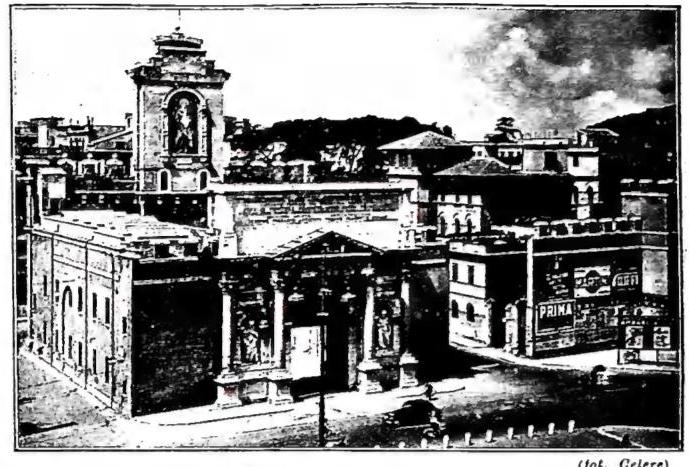
VESPIGNANI, VIRGILIO - Porta Pia, façade facing the Piazza of the same name, built by V. in 1869 - Rome.
of the cathedral. All buildings were executed with academic precision, as was the construction carried out by him in Rome of the Porta S. Pancrazio, which had been severely damaged in the bombardments of 1849.
V. appears at his best, and more freely, in the tiny sanctuary of the Madonna dell'Archetto (1851) on the street of the same name, likewise in Rome, where some time later he erected what may perhaps be considered his masterpiece: the exterior façade of Porta Pia. A solid architectural work, constructed with a fine breadth of forms and a proper balance of proportions, which would gain considerably in appearance if the road level toward the square were restored to its original state, at least one metre lower. His other Roman works include the buildings forming the entrance to the Verano cemetery, the high altar of S. Pietro in Vincoli, the confession of S. Maria Maggiore, the restoration of the basilicas of S. Lorenzo fuori le Mura and S. Lorenzo in Damaso, the rebuilding in Romanesque-Gothic forms of the little church of S. Tommaso da Canterbury, formerly in the Trinità degli Scozzesi in the Piazzetta della Rota, the continuation of the works at S. Paolo after Poletti’s death, as well as the beginning of the extensive restorations in the basilica of S. Giovanni in Laterano commissioned by Pio IX, of whom V. was the preferred architect, though most of the work was carried out during the pontificate of Leone XIII.
V. FRANCESCO, architect, son of the preceding, b. in Rome in 1842, d. there in 1899. A pupil and assistant of his father, in 1827 he built, in vaguely Tridentine forms, the church and convent of the S. Cuore on Via Marsala.
Some years later, around 1899, alongside his father Hildebrand de Hemptime he undertook the construction, in Lombardizing forms, of the church and college of S. Anselmo on the Aventine.