
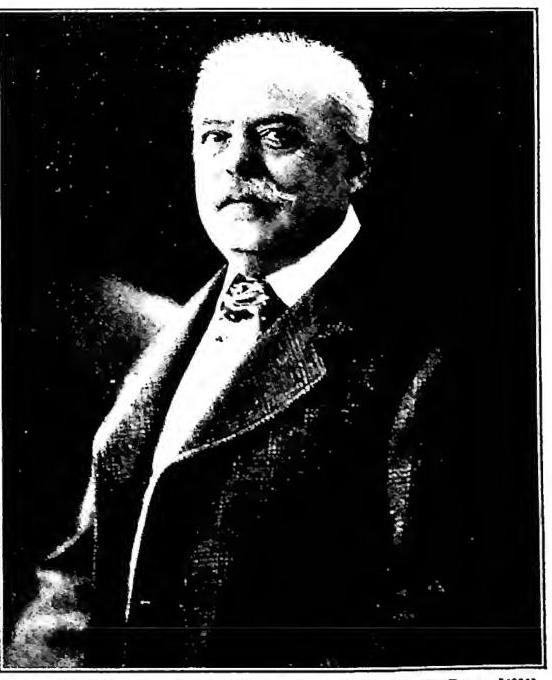
LANCIANI, RODOLFO. — Archaeologist, born at Montecelio (Rome) on 1 January 1845, died in Rome on 21 May 1929. He pursued university studies in the Faculty of Engineering and devoted himself particularly to surveying ancient monuments.
His first publication was the one included by G. B. De Rossi in his Bullettino di arch. crist. of 1866 (pp. 100–103), entitled Rapporto del sig. R. L. sulle recenti scoperte dell'edificio ripuntato lo Xenodochio di Pammachio in Porto. The major building works undertaken to transform the city after 1870 attracted his particular interest, and gradually he became an archaeologist from an engineer, methodically completing his historical, philological, and artistic training. After receiving the Royal Prize of the Accademia dei Lincei and publishing in the proceedings of that Academy his fundamental study on I commentari di Frontino intorno alle acque e agli acquedotti (vol. IV, 1880), in 1882 he obtained the chair of Roman topography, established expressly for him, and retained it until reaching the age limit in 1922.
(photo by Exit)
His principal works are written in English (translated by his first wife); he had conceived them for the numerous English and Americans who at that time came to Rome to spend the winter, in order to disseminate among them knowledge of classical and Christian Rome. But written with that profound knowledge of the sources and materials, with that clarity and methodological precision that were characteristic of him, they are in reality works of primary reference and great scientific value. Here are some of them: Ancient Rome in the light of modern discoveries (London 1888); The ruins and excavation of ancient Rome (there 1892, Boston 1908, also translated into French); New tales of old Rome (London 1901); Wandering in the Roman Campagna (there 1909; Boston 1924); Ancient and modern Rome (Boston 1925). In all these works he combined the study of antiquity with that of the Middle Ages and the Renaissance, demonstrating a great breadth of information and a particular interest in papal Rome: especially important in this regard are the two volumes Pagan and christian Rome (London 1892; Boston 1908) and The destruction of ancient Rome (London 1899, with a French translation); these volumes show the transformation undergone over the centuries by the imperial city;
the volume Wandering through ancient Roman Churches (Boston 1924) completes the works of Armellini and Hülsen on the same subject, while the volume The golden days of the Renaissance in Rome (there 1906) is a masterful sketch of the artistic and monumental life of the city in that golden period. Special mention must also be made of some of his studies relating to the topography of Christian Rome, namely the monograph: The Einsiedeln Itinerary and the Order of Benedict the Canon, in Monumenti della R. Accademia dei Lincei (I, 1891); and the articles: On the discoveries made in 1838 and 1850 near the tomb of the Apostle Paul, in Nuovo bull. di arch. crist., 23 (1917), pp. 7–27, and The memoria Apostolorum and the excavations at S. Sebastiano, in Dissert. delle Pont. accad. rom. di arch., 2nd series, 14 (1919), pp. 57–109. As a complement to the great plan of Rome, in 1902 he began the publication of a History of the Excavations of Rome, of which only 4 volumes appeared (IV, 1913), containing valuable information on discoveries made from the year 1000 AD to the year 1605. He also wrote many articles in the Atti of the Accademia dei Lincei and of the Pontifical Roman Academy of Archaeology, in the Bollettino archeologico comunale and in the Bullettino and Annali dell'Istituto di corrispondenza archeologica.