
HEREDITARY SUCCESSION. – Succession, taken in its broadest juridical sense, denotes any transfer of rights from one subject to another. It may extend to all the transferable rights of a subject, in which case there is succession by universal title, or it may be limited to some of those rights, in which case there is succession by particular title.
If it is intended to take effect while the holder of the rights is still alive, it is called succession inter vivos; if, on the other hand, it opens after the death of the holder, it is succession mortis causa. The latter may be either by particular title, the legacy (v.), or by universal title, the inheritance. Hereditary succession, in turn, in relation to the juridical cause on which it depends, is distinguished into testamentary succession (v. TESTAMENTO) and intestate or ab intestato succession.
Intestate succession occurs by operation of law, which gives effect to the presumed will of the deceased; testamentary succession, by contrast, is determined directly by the will of the deceased, duly expressed. The law establishes the manner in which that will must be expressed—that is, it determines the form of this important juridical transaction—and may require it ad validitatem.
I. SUCCESSION BY INHERITANCE IN NATURAL LAW
Succession by inheritance is undoubtedly today the most important mode of acquisition. Until Pufendorf (1632–94), all jurists recognized a natural foundation for the right of succession by inheritance, whether it concerned a will or intestate succession. The principle that guided them was the celebrated principle of Roman law: “Nothing is so consonant with natural equity as recognizing the will of the owner who wishes to transmit his goods” (De iure nat. et gent., 1, 4, c. 3). Pufendorf began by denying a natural foundation to dispositions expressing a final intention, especially to the will, while continuing to recognize it for intestate successions. There were also followers of Pufendorf’s thesis among seventeenth-century Catholics (Schwarz, Schmalagrueber, Zollinger). Today the thesis is defended by all positivists in law and is extended to the whole of inheritance law. The State is the source of all law and therefore has no limitation in regulating this matter, which concerns succession to inherited property.There has instead been continuity of doctrine among theologians. Indeed, the great majority of them, both in antiquity and today, have supported the origin of the right of succession by inheritance in natural law. For the most part, they do not address the matter directly; it is nevertheless clearly presupposed, as an unquestioned foundation, in the treatment of the thorny question of the validity or invalidity of the informal will. Some, such as s. Antonino, Molina, and Lessio, hold that an informal will creates a true natural obligation; others, such as Soto, Billuart, and Sanchez, hold it valid by virtue of the natural obligation until the judge’s decision; still others, Vasquez, Bonacina, and countless followers, consider such wills void, not because the sole source of inheritance law must be sought in positive law, but because they admit that the power of the civil legislator extends to invalidating a will for lack of form. The nature of the right of succession by inheritance is therefore beyond dispute for all these authors: it is a natural right; their views diverge concerning the extent of civil power in regulating this institution.
The doctrine of modern theologians is consonant with theirs; they are led to reaffirm this principle more forcefully in order to combat today both the enemies of private property and those of family stability, as well as, not least, those who assert an unlimited power of the State in this matter. A reference to the natural origin of the right of succession may perhaps be seen in two Pauline texts, «si... filii et heredes» (Rom. 8, 17; cf. also Gal. 4, 7); but it is in the teaching authority of the Church, and especially in the social encyclicals, that the question is addressed with a certain breadth and with arguments that reason is compelled to admit as an exigency of another natural right, property (v.). “By the inviolable law of nature,” says Leo XIII, “the father is bound to provide for the maintenance of his offspring; and by the impulse of that same nature, which causes him to discern in his children an image of himself, and almost an expansion and continuation of his person, he is moved to provide in such a way that, throughout the difficult course of life, they may honestly meet their own needs—something that cannot be achieved except through the acquisition of productive goods, which he then transmits to them as an inheritance” (Denz-U. 1938 a; cf. also Pius XI, encyclical Quadragesimo anno, no. 16: AAS, 23 [1931], p. 17; Pius XII, Messaggio di Pentecoste, 1941: AAS, 31 [1941], p. 157). Without the right of succession by inheritance, private property could not fully attain its purpose for the benefit of the family community: family stability even in successive generations, and the possibility for parents to fulfill completely their function toward their children.
II. SUCCESSION IN CANON LAW AND IN ITALIAN LAW
Since natural law is indeterminate on this subject, establishing neither the forms nor the limits of succession, it must be supplemented by positive law. Therefore, in this matter, civil laws also have moral force, provided that they do not conflict with natural law, divine law, or canon law.Canon law contains few provisions on the subject. There are only rules sacred furnishings (v.) belonging to cardinals, bishops, and clerics, insofar as certain categories of res sacrae are concerned (v. Canon Law). Canon law also still considers dispositions for pious causes valid, even when lacking the legal formalities (CIC, can. 1513). In all other matters, it is necessary to refer to civil law, except where the latter may conflict with natural law. Italian law, which, like many other modern legal systems, is based predominantly on Roman law, generally conforms to the norms of equity.
In ancient and classical Roman law, succession meant entering by operation of law into the very position of the deceased. It occurred above all in inheritance and was called successio mortis causa, and in a few other typical cases (adrogatio, conventio in manum, etc.). In Justinian law, succession meant, in general terms, the corresponding relationship of acquisition and loss in transfers. The person who acquired was called the successor, and the person who transferred, the auctor. The concept was subsequently broadened through the distinction between universal succession (successio in universum), the only form of succession known to the Romans, and particular succession (successio in dominium). Among the Romans, the calling to an inheritance, or delation, could
be of two kinds: testamentary or intestate. A third kind of delation was subsequently added to these two through praetorian activity: legitimate succession against the will, recognized in favor of certain close relatives. The latter developed as a reaction against the paterfamilias’s absolute right to make a will. Roman law encountered Germanic law and other elements of diverse origin in the countries of the Empire and was subject to their intermixture. Of great importance were the changes that took place in the fundamental principle governing the designation of the persons entitled to succession. From the eleventh century onward, the law of succession was dominated by the medieval principle of favoring agnation (already in use in ancient Roman civil law): property was to be preserved for males, who continued the family. The agnatic principle collapsed with the French Revolution and the Napoleonic Code. Today, equality of the sexes has been implemented for the most part.
The Italian Civil Code, having abolished the agnatic principle, distinguishes, with regard to intestate succession, to which this treatment is limited, two categories of persons—ascendants and descendants—which may inherit either together or separately when the other competing group is absent.
A) Where there is only one category of legitimate heirs, succession takes place according to a set of rules, which may be summarized as follows for the most ordinary cases: a) Children succeed their parents in equal shares; legitimized and adopted children are equated with legitimate children (arts. 566 ff.). b) If a person dies without issue and without brothers or sisters, the parents succeed in equal shares, or the surviving parent alone (art. 568). c) If a person dies without issue, parents, brothers, or sisters, the paternal and maternal ascendants succeed; if, however, the ascendants are of different degrees, those of the nearer degree exclude the others, without distinction of line (art. 569). d) If a person dies without issue, parents, or other ascendants, the brothers and sisters succeed in equal shares; unilateral siblings, however, are entitled to only half the share received by full siblings (art. 570). e) If a person dies leaving no relatives entitled to inherit within the fourth degree, the spouse succeeds to the whole estate (art. 583). f) A person who dies without issue, parents, other ascendants, brothers, or sisters is succeeded by the nearest relative, without distinction of line, up to the sixth degree (art. 572; for natural children, V. art. 576). g) Upon the death of a descendant, his children or descendants take his place and, pro stipite, his share; in the absence of ascendants, the right passes to collateral relatives up to the sixth degree of relationship.
B) Where legitimate heirs of different categories inherit together: a) Legitimate children inherit together with recognized or declared natural children; the latter receive half the share per head received by the legitimate children (art. 574). b) Legitimate children inherit together with the spouse: if there is only one child, the spouse has the usufruct of half the inheritance; if there are several children, the spouse has the usufruct of one third; if the children are minors, the spouse has the legal usufruct, but the entire ownership remains with the children. The spouse has the same rights when natural children inherit together with legitimate children, evidently in proportion to their share (art. 581). c) Parents inherit together with full siblings; each receives an equal share, but the parents may never receive less than one third. Unilateral siblings receive half a share (art. 571). d) Parents inherit together with the spouse; half goes to the parents and half to the spouse (art. 582). e) Parents inherit together with the spouse and siblings; half goes to the spouse and half to the others (art. 582). f) The parents of a natural child inherit together with the spouse; two thirds go to the latter (art. 579). g) The spouse inherits together with recognized natural children and other ascendants; the divisions are increasingly complex (arts. 575, 582, 583). Intestate succession does not take place except when testamentary succession is wholly or partly absent (art. 457). In modern law, unlike in ancient Roman law, there is no longer any incompatibility between the coexistence of the two forms of devolution. The will (v.) may contain only a partial disposition of the deceased’s property, in which case the remainder of the legal relationships of the de cuius is assigned to the successors called by law. This occurs under civil law even when the will as a whole, or individual testamentary dispositions, has no validity, whereas under natural law the testator’s will should prevail. Civil-law scholars dispute the basis of intestate succession: while some locate it in the presumed will of the deceased, others consider it more appropriate to attribute it to a certain domestic community.
In intestate succession, as also in testamentary succession, at least historically, three aspects may be distinguished: the beginning of the succession (opening), the delation of the inheritance, and its acquisition.
The opening of the inheritance occurs at the moment of the person’s death (art. 456): before that, the calling to inherit is merely virtual (viventis non datur hereditas). The devolution of the inheritance is the actual calling to inherit and is distinct from its acquisition. The devolution of the inheritance gives rise to a right that may be transmitted to the heirs (art. 479). The acquisition of the inheritance, which occurs either ipso iure or through the expression of intent (aditio), whether express or equivalent (pro herede gestio), takes place when someone in fact acquires the inheritance. When acquisition occurs ipso iure or by law, no expression of intent on the part of the heir is required, but the heir may reject the acquisition through an express contrary declaration of intent. An acceptance subject to a condition or term would be void, as would an acceptance pro parte (art. 475). Acceptance is irrevocable, for the same reason that acceptance subject to a term is inadmissible: semel heres semper heres. It may be challenged only when it results from violence or fraud (art. 482), and within five years from the day on which the violence ceased or the fraud was discovered. It may not, however, be challenged if tainted by error, except where specific provisions apply (art. 483). All persons, as such, have the capacity to inherit, but not all have the capacity to accept an inheritance; those lacking capacity must be represented and assisted. The intervention of the guardianship judge is provided for in certain cases of devolution of an inheritance (arts. 321, 374, 394, 424). The right to accept an inheritance, transmissible to the heirs (art. 479), is subject to a ten-year limitation period; the period runs from the day on which the succession opens (art. 480).
Acceptance may be express or tacit (art. 474): it is express not only when the person called to the inheritance declares in writing that he accepts it, but also when, in a written document, he assumes the status of heir (art. 475); it is tacit (pro herede gestio) when the person called to the inheritance performs an act that necessarily presupposes his intention to accept, and which he would have no right to perform except in the capacity of heir (arts. 476, 478). The law also presumes acceptance in certain circumstances (arts. 485, 493-94). Acceptance is therefore described as legal, compulsory, or presumed.
When the inheritance includes rights in immovable property, the acquisition, in order to be effective against third parties as well, must be registered (art. 2648). Registration also produces other consequences, however, and is useful, for example, as a basis for ten-year usucaption (art. 1159), or for validating the acquisition of a third party who, in good faith, has entered into a contract with the apparent heir (art. 534).
Alongside pure and simple acceptance, acceptance with the benefit of inventory is always admissible (art. 470); indeed, it is sometimes imposed by law, as in the case of persons lacking capacity and legal persons (arts. 471-73). The effect of the benefit of inventory consists in keeping the deceased’s estate separate from that of the heir, with the result that the heir is not liable for the payment of hereditary debts and legacies beyond the value of the assets received, and is liable for the administration of the hereditary assets only in cases of gross negligence (art. 491). The law determines the procedures by which acceptance with the benefit of inventory must take place, the manner in which the inventory must be drawn up, and so forth (arts. 484-94). If more than one person is called to the inheritance, all may benefit from the acceptance with benefit made by one of them (art. 510).
While establishing acceptance with benefit of inventory for the benefit of the heir, the law grants creditors and legatees, for the protection of their rights, the benefit of requesting the separation of the deceased’s estate from
that of the heir (arts. 512-18). Opinions are not unanimous regarding the effects of this separation. According to some, its effect would be to treat the two estates separately, so that while the deceased’s estate serves to satisfy the charges of the inheritance, the heir’s estate remains reserved for his personal creditors. Many, however, reject this theory and maintain that this separation is made solely for the convenience of the deceased’s creditors, and that consequently neither may the heir’s creditors derive any benefit from it, nor is the heir’s legal status altered. With regard to acceptance with benefit of inventory, some ask whether a person who has not made use of it is, even in conscience, obliged to satisfy debts ultra vires hereditatis. The answer is commonly negative, because the law is based on a presumption that the hereditary assets are sufficient, but that the heir has concealed them; and that he intended to bind himself ultra vires, or at least deliberately exposed himself to that danger. Now, a law founded on a presumption of fact ceases to apply when the fact does not exist. This does not, however, deprive creditors and legatees of the right to insist when there is a fear of fraud. On the other hand, even after a judgment favorable to them has been issued by the court, the heir is not, in conscience, obliged to comply with it if no fraud has occurred.
Renunciation under Italian law may not be made except after the opening of the succession (otherwise it would contravene the prohibition of agreements as to future succession). What is meant here is renunciation in the technical sense, by which one loses, as against everyone, the right to the status of heir. It must be expressly evidenced; tacit renunciation is therefore not admissible. Moreover, renunciation has no effect unless the forms required for a solemn legal transaction are observed, and the declaration must be entered in the register of successions.
Renunciation may be made until the right to accept has become time-barred, but not after acceptance. Renunciation, like acceptance, is an unconditional legal transaction, and is void if made subject to a condition or term, or only in part (art. 520). The act always has retroactive effect, and the renouncing party is treated as though he had never been called to the inheritance; this does not, however, prevent him from accepting legacies (art. 521). Unlike acceptance, renunciation is a revocable legal transaction until, following the refusal of a person called in a particular degree, a person called in a subsequent degree has in turn accepted (art. 525); and it may be challenged if it results from violence or fraud (art. 526). The assets renounced pass to the co-heirs according to specific rules: in intestate successions, the share of the person who renounces accrues (right of accrual) to those who would have inherited together with the renouncing party, subject to the right of representation (art. 522), and subject to the specific rules applicable where parents or ascendants concur with brothers and sisters (art. 571). In the absence of other successors, the inheritance devolves upon the State (art. 586). Since renunciation may cause harm to the renouncing party’s creditors, the law grants them the right—subject to a five-year limitation period beginning with the renunciation—to request authorization to accept the inheritance in the name and place of the renouncing party, solely for the purpose of satisfying their claims from the hereditary assets, up to the amount of those claims (art. 524).
An estate is said to be lying in abeyance, quae heredem nondum habet sed habere sperati. It is distinguished from a vacant estate in that here, unlike the former, there is neither an heir nor hope of one. In Roman law, for the entire period between the devolution and the acceptance, the estate was called iacens. Today, with the retroactive effect of acceptance and the immediate transfer of possession, this can no longer be maintained. In certain cases it is still possible to speak of an estate lying in abeyance, namely when the legitimate heirs have not accepted the inheritance and are not in possession of the hereditary property (art. 528). This hypothesis also includes the case in which the person called to inherit is unknown, as occurs, for example, when the deceased’s family members are unknown, or when even their place of residence is unknown; and cases in which it is known who would be called, but it cannot be known whether that person will accept the inheritance. An estate lying in abeyance is ordinarily represented and administered by a curator appointed by the praetor (arts. 528 § 42 and V. CURATELA; CURATORE). Through the curator, the estate lying in abeyance,
considered as an autonomous patrimony, enforces its rights and satisfies its obligations.
The heir continues the person of the deceased and therefore succeeds to his rights and obligations. Particular effects nevertheless arise in succession from the fact that several persons may be called to the inheritance. Although the heir continues the person of the deceased, not all rights and obligations can consequently be transmitted to him.
The following are non-transferable: a) all public rights and the rights known as family rights; b) rights of usufruct (art. 678), use, and habitation (art. 1024) (by reason of their particular nature); c) the right arising in the principal from a contract of mandate (arts. 1722, 1728); d) the right to maintenance (art. 448); e) a conditional right arising from an act mortis causa; f) obligations arising from mandate (arts. 1722, 1728); g) obligations arising from a partnership contract (art. 2284).
Nevertheless, certain family and personal rights are governed by special rules. The family name is in fact transmitted by right of blood to the descendants of the de cuius (unlike a trade title or trade name, which, as an economic entity, is transmitted by inheritance).
When several persons are called pro quota to the same inheritance, there arises between them the communio iucidens, which is governed by the general rules concerning co-ownership (arts. 1100–1116). To prevent new persons from entering the co-ownership, the Code of 1942 restored in favor of co-heirs a right of pre-emption in the purchase of a share or part of the inheritance that one of them wishes to transfer to outsiders (art. 732). But hereditary debts and credits, together with the other encumbrances, are excluded from the hereditary co-ownership; as soon as succession occurs, they are divided ipso iure among the heirs according to their respective hereditary shares (art. 752).
Hereditary co-ownership ends with the partition of the inheritance. The rules on hereditary partition (art. 713 ff.) supplement those on the dissolution of co-ownership in general (art. 1111 ff.). Since co-ownership is often a source of discord and at the same time prevents the better use of property, the law recognizes every heir’s right to request dissolution of the co-ownership, unless there is an agreement to the contrary, which in any event may not extend beyond ten years (art. 1111). Partition may be amicable or judicial. The former, carried out by agreement of all those called to inherit, is not subject to any particular formalities. The latter, however, consists of three acts: determination of the estate to be divided, determination of the shares and allocation, and approval of the act by the court. Determination of the estate requires, first of all, valuation of the property, with the rendering of accounts among the co-heirs and the preparation of a statement of the inheritance’s assets and liabilities (art. 723). The shares are determined by considering the number of heirs and the nature of the property. Special rules establish the criteria for forming the portions or govern the fate of property that is indivisible or cannot be included in the individual portions (arts. 720, 722, 726–28).
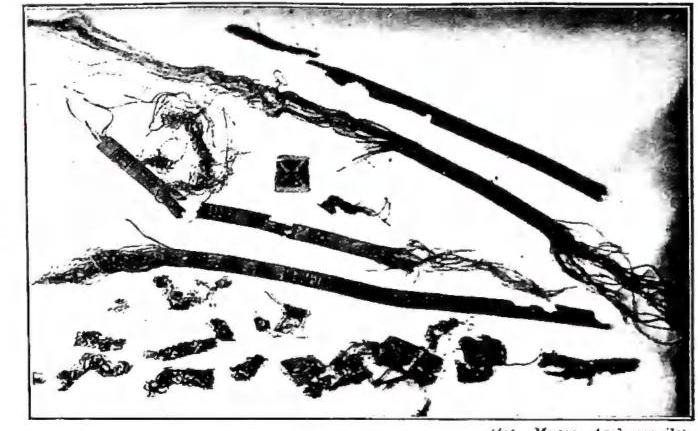
(phot. Museo Arcivescovile)
SUCCINTORIO - Frammenti di cingolo serico con frasi scritturali ricamate (vi si vede, integro, il s.), provenienti da S. Apollinare in Classe (fine sec. VII-inizio sec. VIII) - Ravenna, Museo arcivescovile.
disposizioni testamentarie e delle donazioni di computare nella propria parte legittima ciò che aveva ricevuto o per donazione o per legato dal defunto, a meno che da una tale obbligazione non l'abbia esonerato il testatore espressamente; d) dalla collazione dei debiti, con cui ciascun erede è tenuto di conferire i propri debiti; con questa collazione infatti non si aumenta la massa del relictum, perché ai debiti corrispondeva già un credito nell'attivo dalla massa. Circa il diritto di collazione poi (art. 737 sgg.) in ordine agli obblighi di coscienza occorre attendere, più che alla lettera, al fine della legge, che si basa sulla presunta volontà del defunto. Di modo che quando si è certi dell'assoluta volontà del donante, si possono ritenere i beni donati anche nei casi in cui la legge positiva non esime dall'obbligo di conferire.