Machine translation of the 1948–1954 Italian original. The original text is authoritative.
SUCCINTORIO (subcinctorium, subcingulum, perizoma; balteus, praecinctorium, semicinctium). — An ornament of the Pope in the solemn Mass. It is a strip of fabric resembling the maniple, folded in the middle, of the same color as the chasuble, decorated on one side with a golden lamb and on the other with a golden cross; it is attached to the left side of the cincture.
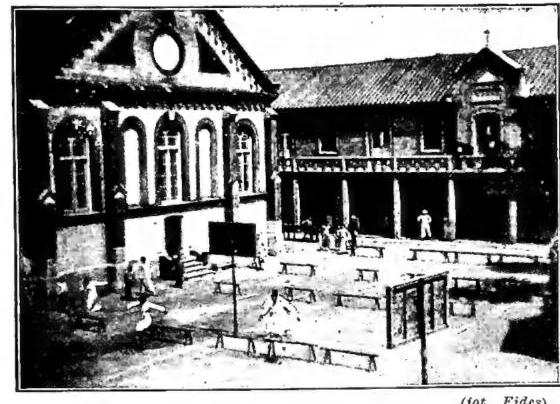
In Rome the s. was not used before the eleventh century. Bruno of Segni (d. in 1123) and Sicard of Cremona (d. in 1215) are among the first to mention II. It is not mentioned in the earliest Ordines Romani, nor by the writers of the eighth to tenth centuries (Amalarius, Rabanus, Strabo, Pseudo-Alcuin). In Ravenna, however, it was already in use in the seventh or eighth century: it was subsequently called balteus (in the Sacramentary of Ratold of Corbie), praecinctorium (in the Mass called Illyrica), and semicinctorium (in southern Italy). It is proper to bishops (Ordo XIV, 48, 53), though also granted as a privilege to other prelates; in Milan it was also worn by the cardinal-priests of the Metropolitan Chapter. The caeremoniale Episcoporum Romanum no longer mentions II. SUCHOW, DIOCESI di — Courtyard of the Seminary. (phot. Fides)Originally, it served to secure the stole, as Durandus («quo stola pontificis cum ipso cingulo colligatur», Rat., III, 1, 3) and Carlo Borromeo («subcinctorium, quo stola cum cingulo connectitur», Braun, op. cit. in bibl., p. 120, n. 5) state, because the stole was still quite long. The stole was later shortened and secured with the cincture itself; the s. became a simple ornament. According to Durandus, it symbolizes chastity of the body, just as the cincture symbolizes that of the soul. The s. never had any connection with, nor did it derive from, the Greek epigonation, which was always worn on the right and was originally an enchirion, a shroud.
BIBL.: J. Braun, Die liturgische Gewandung im Occident und Orient, Freiburg 1907, pp. 117–24; id., I paramenti sacri, Italian trans., Turin 1914, pp. 80–81; L. Eisenhofer, Handbuch der kath. Liturgik, I, Freiburg 1932, pp. 423–24; M. Righetti, Man. di star. liturg., I, Milan 1950, pp. 497–98. Pietro Siffrin
Cite this article
“SUCCINTORIO (SUBCINCTORIUM, SUBCINGULUM, PERIZOMA; BALTEUS, PRAECINCTORIUM, SEMICINCTIUM).” Enciclopedia Cattolica, vol. XI (1953), p. 901. Azione Romana digital edition, https://azioneromana.com/article/succintorio-subcinctorium-subcingulum-perizoma-balteus-praecinctorium-semicinctium.