
REGESTO. – The word regestum (from re-gero) was used chiefly, from the end of the classical age almost to the present day, as equivalent to registrum (in the sense of “treasury” it occurs three times in Gregorio di Tours, Hist., IX, 9 and 34; X, 19), though with a meaning that does not always coincide with the modern meaning of “register.”
I. It is common for the title r. to be given to books in which all or the most important documents constituting the munimina of monasteries, churches (cf., for example, the r. of Tivoli), confraternities, etc., were copied; this title, however, very often dates from a recent period: the designation Regestum is attributed to the cartulary of S. Angelo in Formis in the 15th century (ed. M. Inguanez, in Tabularium Casinense, Montecassino 1925); the name Regestum Farfense for the Liber gemmographus sive cleronomialis ecclesiae Farfensis dates from the end of the 17th or the beginning of the 18th century (ed. I. Giorgi and U. Balzani, 5 vols., Roma 1879–92 and 1914 [introduction]), etc. More commonly in the Middle Ages in these cases there was
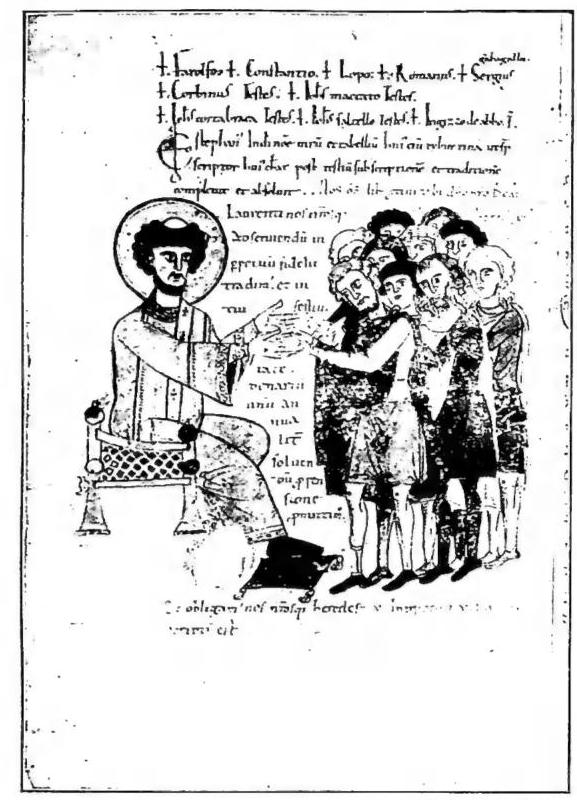
REGESTO - R. di Tivoli. Miniature depicting the people of Tivoli undertaking to offer each year, in honor of s. Lorenzo, the sum of 1 denarius on his feast days (2nd half of the 12th century) - Vatican Archive, arm. I. 3658, f. 38v.
the designation registrum, as in the famous Registro di Pietro Diacono, or in the Registro di Tommaso Decano (called r. by the editors [Montecassino 1915]: but cf. the codex at f. 1v), or else those of chronicon, cartularium, liber instrumentorum or privilegiorum, etc. On the other hand, the opposite case is frequent, namely the extension of the term r. to actual registers, that is, to collections of acts issued by the same author or drawn up by the same notary, recorded at the author’s own behest as documentation of the business being conducted in the chancery or notarial office.
Diplomatists today commonly call r. partial editions of documents in which the details considered essential are reported, with the omission of fixed formulae and rhetorical elaborations, in imitation of what was done, for practical reasons, in many chancery registers. This system, which enjoyed great success between the end of the last century and the beginning of the present one, now has few adherents; in fact, it is methodologically imperfect both because the criterion for distinguishing between essential and non-essential details always remains subjective, and because the continuity of a formula, its even minimal variations, and the lexical forms in which it may appear carry weight from the historical, juridical, and linguistic perspectives, as well as from that of diplomatics. Of a different character, since they do not intend to replace the edition but only to provide an index of documents, are the r. consisting of a very brief summary reporting the author, recipient, disposition, and sometimes also the writer of the act: arranged in chronological sequence, they closely resemble, in structure, archival catalogues (especially those of the 17th and 18th centuries). They are also placed at the beginning of editions of «codici diplomatici», before the individual documents, in order to give the reader a rapid indication of their contents.
II. The titles of several important collections are connected with the modern meaning of r., in the two senses indicated; the principal ones are:
1. REGESTA IMPERIE. An index of documents from the Imperial Chancery, begun by Johann Friedrich Böhmer in 1831 with a volume devoted to the Regesta chronologico-diplomatica regum atque imperatorum Romanorum, inde a Conrado I usque ad Heinricum VII (Frankfurt a. M. 1831), covering the period from 10 November 911 to 24 August 1313. Böhmer subsequently prefixed to it the Regesta chronologico-diplomatica Karolorum (ibid. 1833), from March 752 to May 987; he then added a third volume, Regesta imperii inde ab anno MCCCXLIII usque ad annum MCCCXLVII (ibid. 1839), in which he also collected, in separate sections, papal documents and documents from other chancelleries of particular importance for the history of Germany during that period. This volume also received three Additamenta, published respectively in 1841, 1846, and 1865 (the last printed posthumously at Innsbruck, edited by J. Ficker).
The discovery of further documents soon suggested the usefulness of a second edition which, expanded beyond the original plan, comprises several volumes, still in the course of publication. The following have appeared thus far: vol. I: Die Regesten des Kaiserreichs unter den Karolingern, 751-918, edited by E. Mühlbacher (3 parts, Innsbruck 1899-1908); II: Die Regesten des Kaiserreichs unter den Herrschern aus dem Sächsischen Hause, 919-1024, fasc. I (from 919 to 973), edited by E. von Ottenthal (ibid. 1893); fasc. II (from 973 to 983), edited by H. L. Mikoletzky (Graz 1950); III: Die Regesten des Kaiserreichs unter dem Sächsischen Hause, 1024-1125, part I, fasc. I (from 1024 to 1039), edited by H. Appelt in collaboration with N. von Bischoff (ibid. 1951); V: Die Regesten des Kaiserreichs unter Philipp, Otto IV., Friedrich II., Heinrich (VII.), Conrad IV., Heinrich Raspe, Wilhelm und Richard, 1198-1272, edited by J. Ficker and (from fasc. III) by E. Winkelmann, vol. I: Kaiser und Könige, fasc. I and II (Innsbruck 1881-82); vol. II: Päpste und Reichssachen, fasc. III and IV (ibid. 1892-94); vol. III: Einleitung und Register, fasc. V (compiled by F. Wilhelm, ibid. 1901); VI: Die Regesten des Kaiserreichs unter Rudolf, Adolf, Albrecht, Heinrich VII., 1273-1313, part I (from 1273 to 1291), edited by O. Redlich (ibid. 1898); part II, fasc. I and II (from 1291 to 1295), edited by V. Samanek (ibid. 1933-35); VIII: Die Regesten des Kaiserreichs unter Kaiser Karl IV., 1346-78, edited by A. Huber (ibid. 1877), with an Additamentum primum, edited by the same scholar (ibid. 1889); XI: Die Urkunden Kaiser Sigmunds, 1410-37, edited by W. Altmann, part 1 (from 1410 to 1424), fasc. I and II (ibid. 1896-97); part 2 (from 1425 to 1437), fasc. III-V (ibid. 1897-1900).
2. REGESTA PONTIFICUM. A collection analogous to the preceding one for documents issued by the Papal Chancery, begun by Philipp Jaffé with the volume Regesta Pontificum Romanorum ab condita Ecclesia ad annum post Christum natum MCXCVIII (Berlin 1851), now republished in 2 volumes with additions and corrections edited by S. Loewenfeld, F. Kaltenbrunner, and P. Ewald (I: a s. Petro ad a. MCXLIII, Leipzig 1885; II: ab a. MCXLIII ad a. MCXCVIII, ibid. 1888): including the false documents and supplements, it contains 18,009 r.
Jaffé’s compilation, which extends through the pontificate of Celestine III (the endpoint had been chosen on the assumption that for the subsequent period the list would prove useless, given the preservation of the papal registers [v.]: in reality, only a very small portion of the documents of the Papal Chancery is transcribed in the registers), was continued by Augusto Potthast for the popes from Innocent III to Benedict XI (that is, for the entire pre-Avignon period) in the Regesta Pontificum Romanorum inde ab a. post Christum natum MCXCVIII ad a. MCCCIV, in 2 volumes (Berlin 1874-75), which contain a total of 26,662 r.
Kehr (v.) gave the same title to two collections, still incomplete, devoted to papal documents up to Celestine III preserved in the libraries and archives of Italy, Germany, and Switzerland (the original plan also included France, the British Isles, Spain, and Portugal, but the relevant volumes were never published). For the preparatory phase of the
for the preparatory phase of the work, conceived as the basis for the complete critical edition of all papal documents up to 1198, Kehr availed himself of the collaboration of M. Klinkenberg and L. Schiaparelli for Italy, A. Brackmann for Germany and Switzerland, and W. Wiederhold for France, and presented its results successively in numerous communications to the « Gesellschaft der Wissenschaften » of Göttingen (v. le relative Nachrichten della classe storico-filologica dal 1896 in poi). The published volumes, all issued in Berlin, present the material divided by regions, dioceses, and archives, and provide valuable information on the contents of each collection, with appropriate bibliographical references. The two collections are divided as follows: Italia Pontificia, I: Roma (1906); II: Latium (1907); III: Etruria (1908); IV: Umbria, Picenum, Marsia (1909); V: Aemilia sive provincia Ravennas (1911); VI: Liguria sive provincia Mediolanensis, part 1: Lombardia (1913); part 2: Pedenantium, Liguria Maritima (1914); VII: Venetiae et Histria, part 1: Provincia Aquileiensis (1923); part 2: Respublica Venetiarum, Provincia Gradensis, Histria (1925); VIII: Regnum Normannorum, Campania (1935). Germania Pontificia, I: Provincia Salisburgensis et episcopatus Tridentinus (1911); II: Provincia Maguntinensis, part 1: Dioeceses Eichstetensis, Augustiensis, Constantiensis I (1923); part 2: Helvetia Pontificia: Dioeceses Constantiensis II et Curiensis et episcopatus Sedunensis, Genevensis, Lausanneensis, Basiliensis (1927); part 3 (erroneously indicated on the title page as vol. III): Dioeceses Strassburgensis, Spirensis, Wormatiensis, Wirzburgensis, Bambergensis (1935).
3. REGESTA CHARTARUM ITALIAE. A collection in progress, consisting of volumes (thus far 33) devoted to the publication (initially in the form of regesta, subsequently in full) of documents taken from Italian archival collections. It was begun in Rome in 1907 under the auspices of the Prussian Historical Institute and the Italian Historical Institute; the latter assumed sole responsibility for its publication from 1928 (vol. XIV), and after its division into the Italian Historical Institute for the Middle Ages and the Italian Historical Institute for the Modern and Contemporary Age (1934), transferred it to the former of the two.
4. Lists of regesta for documents issued by certain authorities have also been published outside the collections mentioned, either as appendices to historical monographs or as independent compilations. Among the best known are K. Fr. Stumpf-Brentano, Die Kaiserurkunden des X., XI. und XII. Jahrhunderts... (vols. I and II, Innsbruck 1865–83), from Henry I (elected 919) to Henry VI (September 1197), only partly superseded by the Regesta imperii; W. Behring, Regesten des normannischen Königshauses (in Sicilianische Studien, II, Elbing 1887, pp. 3–28); R. Poupardin, Les institutions politiques et administratives des principautés lombardes de l'Italie méridionale, IXe-XIe siècles (Paris 1907); R. Ries, Regesten der Kaiserin Constanze, Königin von Sizilien, Gemahlin Heinrichs VI. (in Quellen und Forschungen aus italienischen Archiven und Bibliotheken, 18 (1926), pp. 30–100), etc.