Machine translation of the 1948–1954 Italian original. The original text is authoritative.
FERRAR, GRUPPO di (FAMIGLIA 13). - Group of 13 Greek manuscripts of the Gospels (H. von Soden: $I^l$ in the introduction, then $I^1$).
They are the following: 13 (and 368); Paris, Bibl. Nat. gr. 50 (12th-13th cent.); 124 (and 1211); Vienna, Bibl. Pal. Ness.
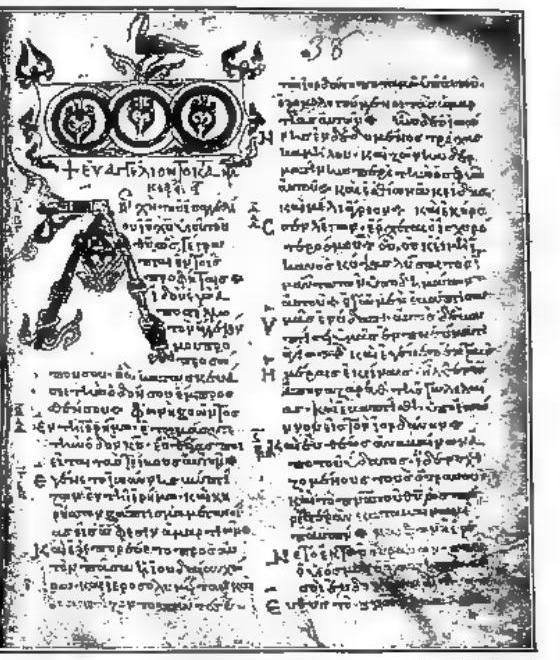
(Int. Enc. Cott.) FERRAR, GRUPPO di (FAMIGLIA 13) - Lectionary (11th cent.), Vatican Library, Vat. Gr. 2002, f. 48;188 (12th cent.); 174 (and 109); Rome, Vatic. gr. 2002 (11th cent.); 230 (and 173); Madrid, Escurial VIII, 5 (11th cent.); 346 (and 226); Milan, Ambros. S. 23 sup. (11th cent.); 543 (and 122); Michigan, Ann Arbor 15 (12th cent.); 788 (and 1033); Athens, Ethn. Bibl. 26 (10th-11th cent.); 826 (and 218); Grottaferrata A a 3 (12th cent.); 828 (and 219); ibid. A a 5 (12th cent.); 827 (and 415); Milan, Ambros. E S IV 14 (14th cent.); 983 (and 3017); Athos, Esphigm. 29 (12th cent.); 1689 (and 1054); Serrès, Prodr. 10 (9th cent.); 69 (8 505); Leicester, Libr. of the Town Council 20 (15th cent.). Number 69 contains the entire New Testament; the others only the Gospels. They are named after W. H. Ferrar because he was the first to notice the relationship existing between 13, 69, 124, 346. T. K. Abbott completed and published the work of F. P. Martin, J. R. Harris, Kirsopp-Lake, and Von Soden studied the remaining manuscripts. All scholars believe that, with the exception of 69, they originate from Calabria (124, 174, 788 bear the indication, while for 13, 346, 826, 828 it is deduced from the annexed menologies); that they depend on a common archetype; that they reproduce a text that diverges from A (Antiochian), from B (Neutral), and from D (Western), and which may be the Caesarean. However, it differs from the latter in not a few cases, for example, in the famous reading of Mt. 1, 16 $\mu \nu \eta \sigma \tau \varepsilon \nu \vartheta \varepsilon \tilde{\iota} \alpha$ (like the Siro-Curetonian). It shifts the pericope of the adulteress (Jn. 7, 53 - 8, 11) to Lk. 21, 23. It possesses all the characteristics of the Greek text used in the Greek Church in the Middle Ages. Some therefore see it as a special recension. It is not improbable that, following the influx of Greeks in the 8th century and the resurgence of studies in the Byzantine monasteries of southern Italy, a new recension of the Greek text was executed in Calabria in the 13th century utilizing the Caesarean, the Byzantine (A), and perhaps a local text.
BIBL.: T. K. Abbott, A Collation of four important manuscripts of the Gospels, Dublin 1877; J. Rendel Harris, Origin of the Leicester Codex of the N. T., London 1887; id., On the Origin of the Ferrar Group, ivi 1893; id., The Scribe of the Leicester Codex, in Journal of the Theological Studies, 3 (1904), pp. 445-47; 11 (1910), pp. 291-92; 12 (1911), pp. 465-66; K. Lake, Some new Members of the F. Group, ibid. 1 (1899), pp. 117-20; id., Codex 1 of the Gospels and its Allies, ivi 1902; id., Six Collations of N. T. Manuscripts, Cambridge 1932, etc.; H. Von Soden, Die Schriften des N. T., I. Untersuchungen, Abt. II, Göttingen 1906,
pp. 1066-1109; B. H. Streeter, The Four Gospels, London 1927; M.-J. Lagrange - St. Lyonnet, Critique textuelle, II. La critique rationnelle, Paris 1935; B. Botte, s. V. in DBs, III, coll. 272-74; etc. Bonaventura Mariani
Cite this article
“FERRAR, GRUPPO DI (FAMIOLIA 13).” Enciclopedia Cattolica, vol. V (1950), p. 711. Azione Romana digital edition, https://azioneromana.com/article/ferrar-gruppo-di-famiolia-13.