
UR. — The most ancient Mesopotamian city (Sumerian URIM⁴⁰, later URI⁴¹, Akkadian URG⁴²), mentioned in the Bible in Gen. 11:28–31; 15:7; Neh. 9:7 (Heb. ’Ur Kaidim, “Ur of the Chaldeans”). Today it is Tell al-Muqajjar (“of bitumen,” according to the technique of Ur-Nammu, who used bitumen as cement for baked bricks in his buildings), a moving ruin in a great desert 16 km west of the Euphrates. U. presents singular interest for the cultural and religious history of humanity.
When prehistory first sheds light on it, in the period of ‘Ob jd (v. SUMER), U. is already a wealthy town, bounded on one side by the Euphrates and on the other by a canal, in an extremely fertile region entirely laid out with canals; the river also constituted a danger: indeed, in an exceptionally high flood U. seems to have been buried beneath 2.50 m of river deposits—and some have wished, wrongly, to see in this proof of the Flood. With the first dynasty of U. begins the historical period of Sumer. The names have been handed down to us of Mesannepadda, king of U., of his consort Ninturnin, and of their son and successor Aannepadda. The cultural splendour of this age emerges from the “royal tombs” of U., which also provide evidence of belief in life after death; such are the tomb of Prince Meskalamdug and, still more splendid, that of the “lady” Sub-ad. Those personages (whether kings or priests is debated) entered the tomb in festive and richly adorned array, and so too did their entire court, which, in festive clothing and with musical instruments, died together with them, each in complete peace of mind and in his appointed place, as did also the animals of the chariots, to accompany their master to a happier existence in the other life. Such wealth of gold and lapis lazuli, pearls and precious stones cannot be explained without extremely extensive commercial relations. U. was already then a considerable city, with metallurgical and textile industries (a privilege it retained until the time of Abraham and perhaps beyond). Later, however, it fell under the hegemony of Lagaš under Eanatum and Entemena, that of Uruk, under Sargon of Akkad (ca. 2300 B.C.), and later under the Gutians.
U. reached its apogee when its most gifted political figure, UR-NAMMU, CODICE DI (v.), founded the III dynasty of U. (ca. 2050–1950 B.C.), fully subjugating Sumer and Akkad. At that time the magnificent temples were rebuilt, especially Ekišnugaj, with its “tower” (ziqqurat), 30 m high, consisting of three terraces with magnificent stairways. Anesti, an author of social reforms, promulgated a code of laws. The great works of Sumerian literature date from the time of the III dynasty. In the end, U. was destroyed by the Elamites and their Amorite allies; but even then the attraction of the distinguished sanctuary of Nanna or Sin (“Moon”) led to its being rebuilt, and throughout the time of the kings of Isin and Larsa it remained a noteworthy provincial city, especially favoured by the latter, until, in the wars HAMMURABI (HAMMURAPI) (v.), it was destroyed once again. C. L. Woolley has well described the appearance of the city at that time: a city above all of merchants and of a textile industry (conducted by slaves), fallen from its ancient splendour, but still a centre of
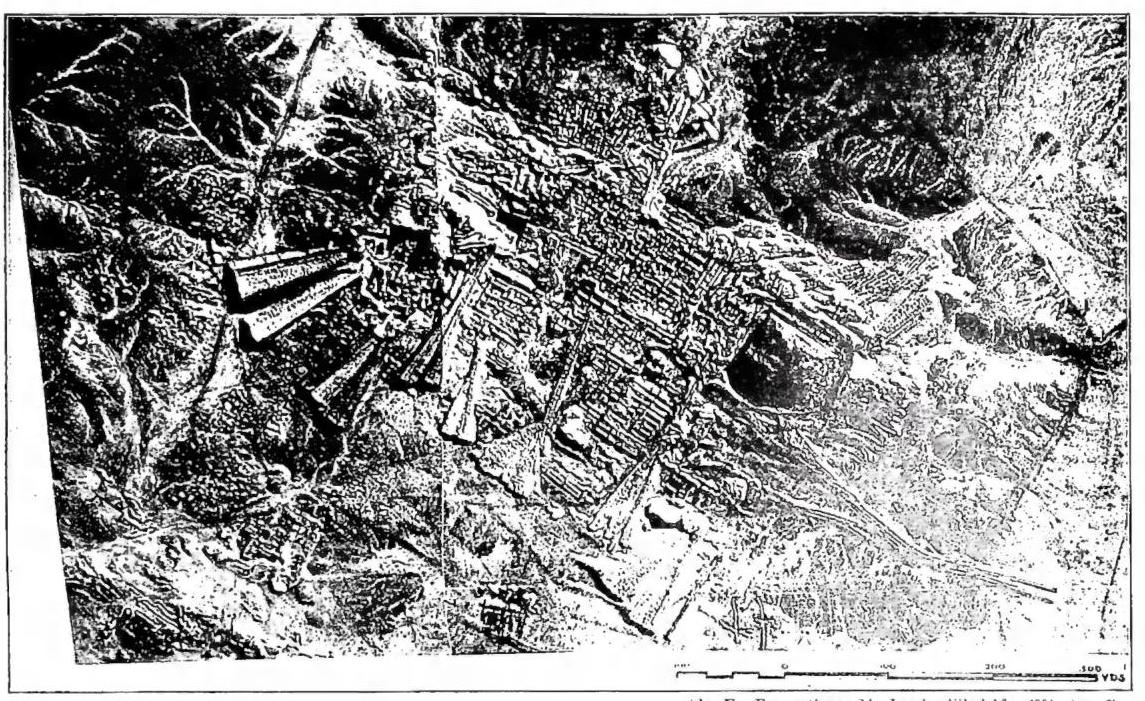
(from Ur Excavations, II, London–Philadelphia 1931, pl. 2)
It is to be supposed that, in a new flood, the Euphrates formed its present bed, blocking the entire system of canals, and that the exceptionally fertile region was then lost. It seems that priests, in very modest houses, still wished to preserve the worship of the great Moon god, but that they too had to desist. However, the Hellenistic name of the region, Camerina, seems to preserve the memory of the Moon god who, as the true king of U., had guided his people (Arabic qamar, “moon”). — Vedi tav. LXXXV.