
CANONICO. – 1. For the origin of the term and the history of the institutions in the first millennium, V. CANONICI REGOLARI DI SANT'AGOSTINO. AGOSTINO.
In 1959 Niccolò II sought to reduce the c. to the common life and to restore the communal ownership of Church property, but this was a difficult undertaking that did not succeed
in pleasing everyone, whence the distinction between regular and secular c. In the 13th century, the c. of the cathedral church formed a separate category within the clergy of the episcopal city.
2. Here we consider the secular c. The c. and dignitaries constitute the essential element of a Chapter. The CIC recalls chiefly two kinds of c.: c. simpliciter, or titular c., and c. ad honorem, or honorary c. (can. 406, § 3).
3. Titular c. are members of the Chapter and enjoy a genuine benefice which confers upon them the right to suitable resources, so much so that a special concession from the Holy See is required to establish canonries without attached emoluments (can. 393, § 3).
The number of c. must be sufficient to ensure that divine worship and the dignity of the church are provided for in a becoming manner (can. 394, § 3). The number is fixed once and for all in the so-called numbered Chapters, that is, those with a determined number: in such Chapters there are as many prebendaries as there are prebends (can. 394, § 1), whereas in unnumbered Chapters the number is not determined, and it belongs to the bishop, after consulting the Chapter, to establish how many members the benefice revenues can honestly support (can. 394, § 1).
4. In the 18th century the custom was introduced in France of appointing as honorary c. those ecclesiastics to whom bishops wished to testify particular esteem. They have no obligation to attend the choir or observe residence; but neither may they claim any canonical prebend, nor assert the right of suffrage (active or passive) in capitular assemblies. In fact, they are not members of the Chapter. The right to appoint honorary c., whether diocesan or extra-diocesan, belongs exclusively to the bishop: he must consult the Chapter and exercise this right only rarely and with prudence (can. 406, § 1).
For the appointment as honorary c. of a priest from outside the diocese, the bishop must not only consult his Chapter, but also obtain, under pain of nullity of the appointment, the consent of the priest’s own Ordinary and indicate to that Ordinary which insignia and privileges the new c. may use (can. 406, § 2). The number of honorary c. residing outside the diocese may not exceed two thirds of the number of titular c. (can. 406, § 3).
The honorary c. of a basilica or collegiate church in Rome may use their privileges and insignia only within that church and its filial churches. The honorary c. of all other churches outside Rome may use their insignia within the limits of their diocese and, exceptionally, outside it, like titular c. In addition to honorary rights, honorary c. have the right to a choir stall (can. 407, §§ 1, 2).
5. The name supernumerary c. designates those c. who are in excess of the predetermined number and consequently without a prebend, in the so-called closed or numbered Chapters. Supernumerary c. are genuine c., with the right to a choir stall, to a voice in the Chapter, and to daily distributions, and with the obligation to attend divine service.
Those who enjoy a prebend in a capitular church may obtain from the Holy See, and from it alone, an indult of merit, called an indult of jubilation, after forty years of praiseworthy choir service in the same church or in distinct churches of the same city or at least of the same diocese (can. 422, § 1). Jubilated c., even if they do not reside at the place of their benefice, receive the revenues of their prebend as well as the daily distributions, although they are dispensed from altar service (can. 422, § 2); but they do not enjoy the right of option wherever it exists (can. 422, § 3).
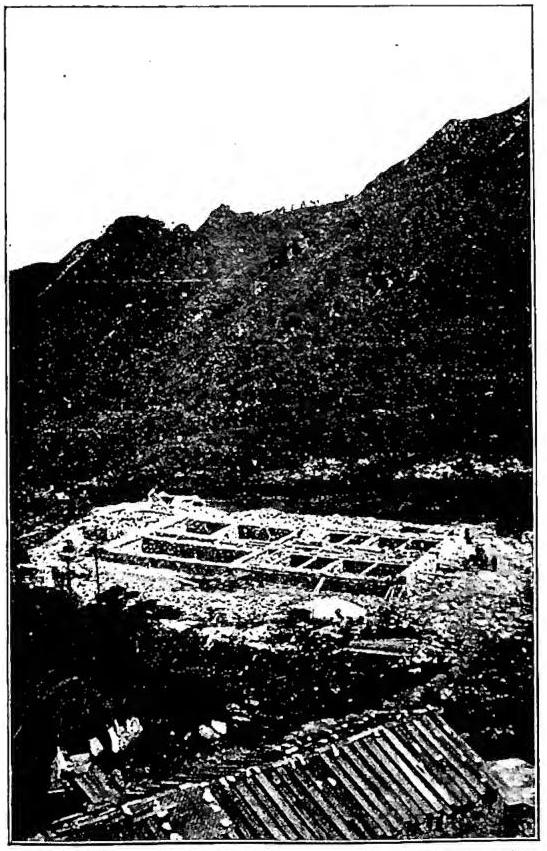
(courtesy of the Canons of the Gran S. Bernardo)
CANONS REGULAR OF S. AGOSTINO — State of the construction works (1938)
of the hospice being built on the Latsa pass, alt. 3,800 m. (Himalaya),
by the Canons of the Great S. Bernard.
6. It belongs to the bishop to confer all canonries, after consulting the Chapter, unless their collation is reserved to the Holy See or the foundation charter assigns this right to others. The bishop shall confer this title only upon priests distinguished for learning and integrity of life (can. 404, § 1); other conditions being equal, he shall take account of the degree of doctor in theology or canon law, or of merits acquired in the ministry or in teaching.
Canons must take possession of their benefice in conformity with cann. 1443–45 and previously make the profession of faith under cann. 1406–1408. After taking possession, they may use the insignia and privileges proper to them, occupy a stall in choir, and receive the revenues of their benefice (can. 405, §§ 1, 2).
7. Among the principal duties of a canon are choir service and residence. All those who hold a choral benefice are bound to the daily recitation of the Divine Office in choir. Service in rotation (servitium per turnum) is nevertheless lawful if authorized by the law of foundation of the Chapter or by the Holy See (can. 414). Canonical service includes: the psalmody of the canonical hours, the conventual Mass, and the other Masses to be celebrated in accordance with the rubrics of the missal or for several foundations (can. 413, §§ 2, 3).
The members of the Chapter are bound to reside in the place of their benefice and may enjoy only a limited period of vacation, which for canons obliged to choir service must not exceed three months each year, whether continuous or divided (can. 418, § 1). A legitimate cause and special permission from the bishop are necessary for canons to be absent during Lent and Advent or on the more solemn feasts of the year (can. 418, § 3). During vacations, they receive only the income of their prebend.
8. Canons have the right to wear a distinctive dress and special insignia, which may consist of the rochet, the mozzetta, the capua magna, the ring, and sometimes the pectoral cross. Canonical dress must be worn in choir; it may be used throughout the diocese; outside the diocese it may be used only by those who accompany the bishop or represent the Chapter at councils or at some other solemnity (can. 409, §§ 1, 2).