
SEMITO-CAMITI.—The names Semites and Hamites derive from the list of the peoples of the Bible (Gen. 10), where a certain number of peoples are presented as descendants of Shem and Ham. From the seventeenth century onward, the term “Semites” has designated the peoples of a linguistic group; from the nineteenth century, the name “Hamites” has been used to designate the peoples of another linguistic group, related to the Semitic one. The linguistic relationships also correspond to cultural relationships between the two groups of peoples.
I. RACE
Among the Semites there are representatives of different races, especially of the Oriental and Near Eastern races (Armenids). Among the Hamites there are at least three races: among the Eastern Hamites (Cushites), the Ethiopian race; among the Western Hamites (Berbers), the Mediterranean race, as well as descendants of the prehistoric Cro-Magnon race. It is therefore unjustified and erroneous to speak of a Semitic and Hamitic race. Both these groups of peoples belong to the Europid racial group, and although there are Hamites with dark pigmentation, nevertheless, in view of their other anthropological characteristics, they do not belong to the Negrid racial group.II. DIFFUSION
Setting aside the recent and very recent migrations of Semitic groups and the remote progressive spread of the Jews (v.) across all the continents, the geographical area of the Semites is reduced to south-western Asia and northern and eastern Africa. In ancient times the Babylonians, Assyrians, Aramaeans, Phoenicians, Canaanites, Jews, northern Arabs and southern Arabs (the Sabaeans, Minaeans, etc.) lived in western Asia. The commercial colonies of the Phoenicians spread as far as the western part of the Mediterranean basin. A Semitic group emigrated to Abyssinia at a very remote period; it certainly came from southern Arabia. Semitic influences in Egypt are even more ancient, where the language and culture of the emigrants became mingled with indigenous elements. With the Islamic conquest in the 7th century there was a large-scale Arab migration, as a result of which Mesopotamia, Syria, Palestine, Egypt and northern Africa were largely Arabized (at least linguistically, whereas many pre-Arab elements have remained in the culture). The total number of Arabs, understood in the broadest sense, that is, all those who speak Arabic, may today reach 60 million; that of the Jews, 13 million; while the groups speaking Aramaic in Syria and Mesopotamia number only a few tens of thousands. As regards the Hamites, there is no agreement on determining the extent of their linguistic group. For the most part, a distinction is made between the eastern Hamites (Cushites), to whom belong the Beja, then the Danakil, Somalis, Galla, Caficcio, Cunama and Baria, and the western Hamites, to whom belong the Berbers, who in ancient times were called Libyans. The ancient Egyptians occupy an intermediate position, but are closer to the Libyans. The so-called Hamitoids, called by some Nilotic-Hamites, must be linked with the eastern Hamites; they are culturally related to them but do not linguistically belong to the Hamites, e.g. the Masai, Nandi, Sue, Didinga, Lotuco, Bari and Turcani; in addition, the groups of the Great Lakes region of eastern Africa that have adopted a Bantu language, e.g. the Wa-Hima and Wa-Tussi. Influences of Hamitic culture are also found among the cattle-breeding peoples of southern and south-western Africa, e.g. among the Kaffirs, Herrero and Hottentots. These do not linguistically belong to the Hamites, whereas perhaps the Khoi-San linguistic group may be related to the Hamitic languages. The Nilotic languages and some of those of western Sudan, such as Hausa and Fulbe, have likewise been grouped by some authors with the Hamitic languages, evidently through an unwarranted extension. On the other hand, the Guanches of the Canary Islands must be culturally linked with the Berbers.III. ORIGIN
It is indisputable that there is a certain linguistic and also cultural dependence between the Semites and the Hamites; but the differing ways in which these linguistic and cultural relationships have in particular been conceived have also produced conflicting answers to the question of their origins. In general, it is held that the place where the Semitic and Hamitic languages and cultures first took shape in their characteristic forms lies within the present territory inhabited by them, and this is the only point unanimously accepted. Some scholars, especially the earlier ones, regard the Semites as a branch detached from the Hamites, which migrated from North Africa into Western Asia. Most scholars, however, seek the place of origin of the Semites somewhere in Western Asia: in Arabia, Mesopotamia, northern Syria, or regions farther north. For a long time the theory of Arabia as the “chamber of peoples” enjoyed wide acceptance; from it, it was held, four great migrations emerged one after another: Amorite-Babylonian, Canaanite, Aramaean, and Arab. The following fact, however, argues against this theory: the settlement of the interior of Arabia was possible only with the introduction of camel breeding, which occurred fairly late, as will be seen. A denser population of Arabia without camel breeding would have been possible only if those regions had once been rich in water and had later become arid. This theory is supported by some Orientalists, but vigorously contested by others. It may be that the aridification of Arabia did in fact occur, but it certainly took place in so remote a prehistoric age that it could have had no influence on the formation of the Semites. In any case, the place of origin of the Semites certainly maintained cultural relations with the pastoral peoples of Central Asia (Indo-Europeans, Turco-Mongols) and therefore should not be sought too far to the west.As for the Hamites, it is doubtful whether one can generally speak of a common place of origin. Some scholars link the Berbers with the ancient Mediterranean culture of Europe and dissociate them from any relationship with the eastern Hamites. According to new investigations, it appears impossible to reconstruct an original Hamitic language from which the individual Hamitic languages subsequently developed; the unity would rather be only secondary and attributable to the influence of the Semitic languages upon a linguistic foundation that was not in itself unitary, and this presumably must have occurred in Africa. It is not excluded, however, that some of the Hamitic peoples, as such, may have formed in Asia and then migrated to Africa under Semitic pressure.
IV. CULTURE
1. Economy and material culture
The S.-C. are regarded as nomadic pastoralists; but this can be said only of the Arab Bedouins, of a part of the Cushites and the Hamitoids, and of the Berbers (especially the Tuaregh), since a large part of the S.-C. has adopted a sedentary way of life.Among the Semites, pastoral nomadism was originally the sole or principal way of life. Given that horse breeding appears relatively insignificant, and camel breeding is attested among the Semites only in the second millennium B.C., in the most ancient times only sheep, goats, and donkeys were bred as domestic animals; cattle only in marginal areas. The dwelling is the tent, whereas the modern “black tent” became generally used with the breeding of camels. Clothing today consists of an undershirt in the form of a shirt and an outer garment in the form of a cloak, as well as a headdress (the turban among sedentary peoples); before the introduction of woven fabrics, use was made chiefly of skins and of
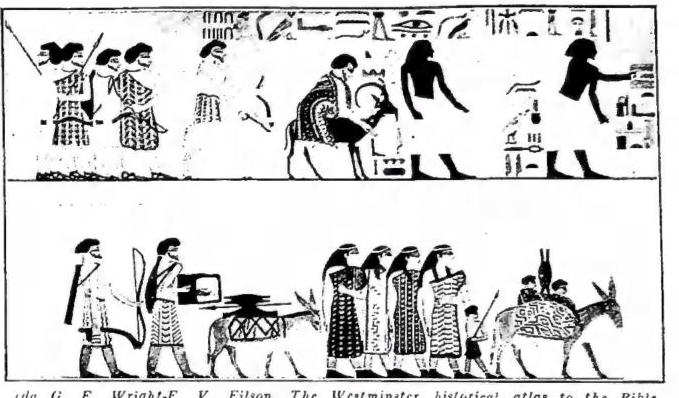
Ida G. E. Wright-F. V. Filson, The Westminster historical atlas to the Bible, London 1927, p. 21, fig. 9)
SEMITO-CAMITI - Semitic nomads of the beginning of the second millennium. Wall painting in the tomb of an Egyptian nobleman - Beni Hasan.
Leather and hide were used for clothing, as is still the case today for vessels. The principal weapons were the spear, bow, and arrow. Their nourishment is already indicated by their symbiosis with the sedentary populations: cereals and dates as supplements to meat, as well as milk and its products.
2. Sociology
The family, both among the Semites and among the Hamites, is essentially patriarchal. Matriarchal traces appear in marginal areas, such as southern Arabia, among the Baria and Cunama, and among the Berbers. Among the latter, matriarchy may have derived from a wholly matriarchal culture of an earlier period; in the other cases, however, these are merely external influences. Kinship by blood up to a certain degree (e.g., among the Arabs, up to the fifth degree in cases of blood vengeance) imposes solidarity. But a firmly constituted extended family does not exist everywhere, nor does the right of primogeniture persist everywhere. Among the Semites, closer centralization predominates among the sedentary populations, while greater individual independence prevails among the nomads. Among the Hamites, these differences appear less significant. True totemism does not exist; what has been explained as a survival of totemism either does not have this character or can be traced only to peripheral influences. Circumcision is now practiced where Islam predominates and, although it was already very widespread earlier, it was not universal (it existed among the ancient Egyptians, Arabs, and Hebrews, but not among the Assyrians and Babylonians). Today it still appears in certain places as a rite of puberty (thus among some tribes in southern Arabia), a character that seems originally to have been universal.The organization of the larger groupings (tribes among the nomads and village communities among the sedentary populations) is ordinarily democratic; the chief is markedly subject to the assembly of councillors, which may, moreover, also have an aristocratic character. Among the Cushites, social organization became more complex with the transition to agriculture (cf., e.g., the system of age classes among the southern Galla).
3. Religion
The Arabs, Berbers, and part of the Cushites are now Islamized, apart from the remnants of Christianity, once very widespread, which survive in Egypt, Palestine, Syria, and Mesopotamia. Most of the Cushites, however, still preserve a very lively sense of their own religion, with profound faith in and considerable worship of a God of heaven (abundantly demonstrated especially among the Galla). It is difficult to form an idea of the most ancient forms of religion among the Semites. The pre-Islamic religion of the nomads is little known. The high-culture religions of the Semitic area known from antiquity reveal a strong non-Semitic imprint, as, for example, in Babylonia through the influence of the Sumerians. In historical times, polytheism is generally observed, especially in the form of astral worship. The theory according to which all Semites originally worshipped the divine triad of Sun, Moon, and the planet Venus is untenable; likewise, the worship of the pair Heaven and Earth, with a strong emphasis on fertility, can scarcely be assigned to the period of Semitic nomadism. Similarly, the importance of animism in relation to the most ancient Semitic religion has been exaggerated. Kinship with the Cushites and other considerations indicate that among the Semites too belief in the God of heaven was very ancient; among other things, the same common name for God, El, denotes a supreme God anciently worshipped by all Semites.The forms of worship were in part influenced from outside. Among the Semites, unlike what seems to have been the case among the Hamites, there was originally no priestly caste. Both groups of peoples knew only burial, not cremation of the dead.