
COLOMBA. – Among the birds most frequently found in purely decorative compositions, the dove, both in literature and in early Christian art, forms part of a symbolic complex so rich in interrelationships that perhaps no other symbol has been the object of so many different meanings.
Without speaking of the many virtues whose reflections are found in the dove, one may say that most symbolic speculations, by a more or less direct route, draw their inspiration from two well-known biblical events: the story of Noah in the ark and the baptism of Christ in the Jordan. Indeed, the presence of a dove in both cases would soon make one appear as the prototype of the other.
(fol. Post. Comm. Arch. Sacra)
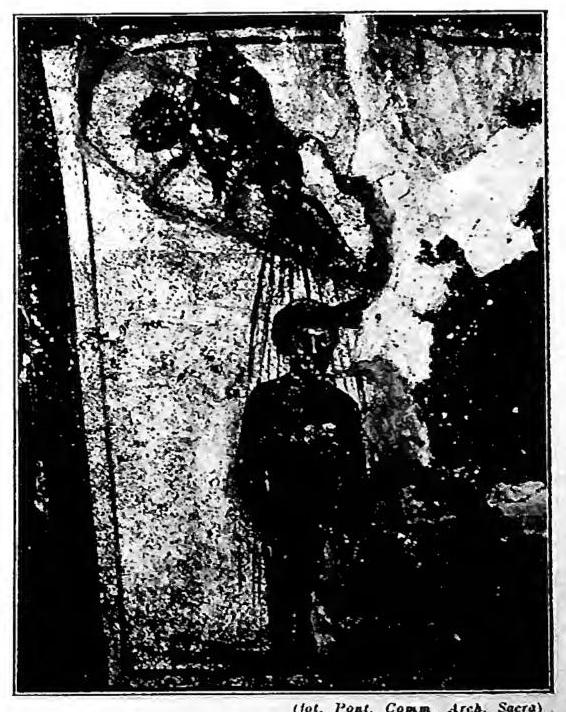
COLOMBA - Dove radiating rays of light upon the person being baptized (4th century). Rome, Cemetery of SS. Marcellino and Pietro.
in countless iconographic combinations, together with other symbols of hope or superterrestrial happiness.
The appearance of the dove at the baptism in the Jordan created, in the Christian mentality, a rich complex of concepts associated with the Holy Spirit. It is in the form of a dove that the Holy Spirit manifests itself in the Annunciation, at Pentecost, and in the various instances of divine inspiration. Through subtle deductions, the dove becomes a symbol of the Logos itself, of its Church, and of individual believers. Already the bird of peace, the dove, in this order of ideas, passes on to become the bird of the light that illuminates the soul and restores new life to it; indeed, it becomes identified with the soul itself.
All these concepts, often fused together, had their repercussions in art and explain its mystical meaning. Not only in the Baptism of Christ but also in the bath of regeneration does the dove send a ray of light upon the neophyte’s head. Not infrequently the dove appears as an isolated motif in baptisteries or is suspended above altars, eventually becoming the « Eucharistic dove ». Doves are known as symbols of the Holy Spirit above cathedrae or above volumes of Sacred Scripture, or as symbols of crucified Christ, of the Apostles (12 in number), and of the individual faithful. The souls of the faithful, which, having sometimes emerged from the body in the form of doves or having been carried by ship toward the heavenly port, enjoy eternal happiness in its various aspects, assume the form of doves drinking water from a vessel, pecking at grapes or other fruit; or, participating in Christ’s triumph, they hold a laurel branch or a crown in their beaks, or else peck at the berries of the crown supported by the triumphant cross.