
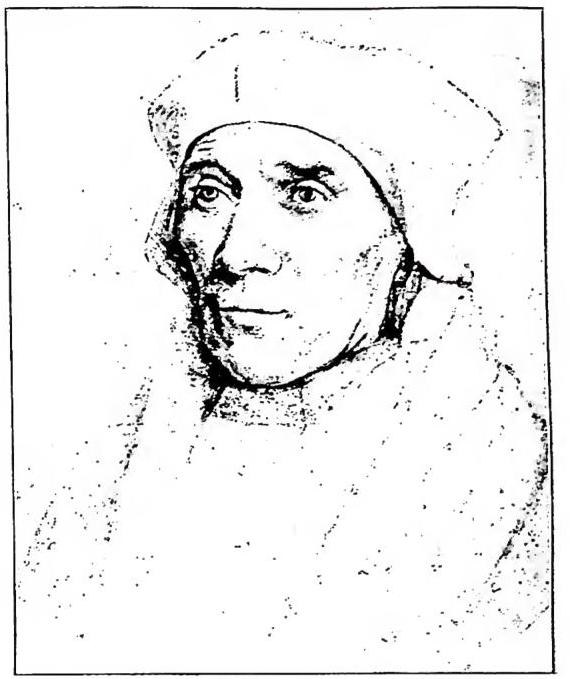
GIOVANNI FISHER, saint. — Born at Beverley (Yorkshire) around 1469, died in London on 22 June 1535. Having completed his studies at the school of Guglielmo di Melton at the University of Cambridge, he became magister artium in 1491 and shortly thereafter was ordained a priest. In 1501 he was elected vice-chancellor of the University, in 1504 chancellor, and immediately afterwards bishop of Rochester (Roffensis). With the favor of Queen Margherita, he gave the University of Cambridge a new organization, in accordance with the spirit and method of humanism. Erasmo di Rotterdam, who was honorably hosted by F., wrote: « (Cantabrigia) sic effloruit, ut cum primis huius saeculi scholis certare possit » (Ep. ad Bovillum a. 1516, ed. B. Allen, II, Oxford 1910, p. 328).
An ardent student of the Bible and the Fathers, he assembled in his episcopal palace a rich library, among the finest of the period. His writings reflect his multifaceted culture, predominantly positive, though tinged with speculations of a Scotist character, in accordance with the traditions of Cambridge. A perfect Christian humanist, he was not distracted by his high offices, nor did he take advantage of the favor of the court and the friendship of Enrico VIII, but, a rare example in those times, devoted himself to preaching in his diocese, which, although among the poorest, he never wished to abandon. Constant mortification, sustained by an exceptional fervor of spirit and combined with the hardships of study and of the apostolate first, and of imprisonment later, reduced F. to a walking skeleton, who could barely climb the scaffold of execution. A man of such mettle could not yield to the threats of Enrico VIII (v.) in the famous question of the divorce. F. resisted together with s. Tom-
He wrote: Treatyse concernynghe the fruytfull sayings of Davyd the Kunge and Prophete in the seven penytencyall Psalmes (London 1505): a series of sermons delivered at Rochester, London, and Cambridge and published at the request of Queen Margherita. This little work, inspired by s. Agostino’s treatise Super psalmos, went through many editions, was translated into Latin, and established F.’s reputation for its intimate and penetrating unction; Sermon at the funeral of Henry VII (ibid. 1509): an extensive program of civil and ecclesiastical reforms; A mornynghe remembrance had at the Moneth Mynde of Margarete countesse of Richemoude and Darbye (ibid. 1509): an exaltation of Margherita’s merits concerning the Universities of Cambridge and Oxford; De unica Magdalena (Paris 1519); Eversio munitionis quam Jodocus Clichtoveus erigere moliebatur adversus unicam Magdalenam (ibid. 1519); J. Fisher Roffensis ep. confutatio secunda I. F. Stapulensis de Magdalena (ibid. 1519): polemical works against the Parisian humanists, in which he championed the identity of the three Marys of the Gospel; The Sermon made agaynst the pernicious doctryn of Martin Luther: a closely reasoned refutation of Luther’s principal errors (indulgences, the Sacraments, the authority of the Church, the primacy of the Pope), delivered on 12 May 1521 in the square of S. Paolo in London, on the day when Luther’s works were solemnly burned; by order of Enrico VIII it was immediately translated into Latin by S. Pace; Concio in Io. 15, 26 habita Londini, eo die quo Lutheri scripta flammis commissa sunt (London 1521); Assertio septem Sacramentorum contra Martinum Lutherum (ibid. 1521); a detailed refutation of De captivitate Babylonica, which Luther himself and German historians attribute to F., whereas English authors regard it as the work of Enrico VIII, to whom F. is said to have supplied the material and given the final form; Assertio omnium articulorum per novissimam bullam Leonis X damnatorum (Paris 1523), under the title: Assertionis Lutheranae confutatio: he refutes all the articles that Luther had opposed
Posthumous works: Opusculum de fiducia et misericordia Dei (Cologne 1556); Psalmi seu preecationes (Lyons 1572); A godly treatise declaring the benefits, fruits and commodities of prayer. A spiritual consolation tho by sister Elizabeth (London 1577): an exhortation addressed to his sister from prison in 1535; His sermon upon this sentence of the Prophet Ezechiel: Lamentationes, Carmen (n. p., n. d.). The (incomplete) edition of the Opera omnia was published at Würzburg in 1597; I. E. B. Mayor published the first volume of the English works (London 1876).
These works place him among the earliest and most distinguished anti-Lutheran controversialists: his writings were cited with honor (for example, by Cardinal Mendoza) and valued throughout the sixteenth century, including at the Council of Trent. S. Carlo Borromeo, who displayed his portrait in his room, regarded him as the model of bishops; Paolo III judged him the «decus et ornamentum» of the clergy and of the English Kingdom; Pio XI canonized him (1935), invoking for the Holy See the heavenly protection of F. and Moro with the celebrated Ambrosian expression: «tales ambio defensores».
On theological thought: M. Lepin, L'idée du sacrifice de la Messe d'après les théologiens depuis les origines jusqu'à nos jours, 2nd ed., Paris 1926, pp. 254, 284; M. Alonso, El sacrificio eucarístico de la Última Cena del Señor según el Concilio Tridentino, Madrid 1929, pp. 38–40; M. De la Taille, Mysterium Fidei, 3rd ed., ibid. 1931, passim; P. Polman, L'élément historique dans la controverse religieuse du XVIe siècle, Gembloux 1932, pp. 353–356, 442–44 and passim; F. Peralta Bellabriga, De doctrina b. I. F. in operibus adversus Lutherum conscriptis, Rome 1934; F. Giancane, Il pensiero di s. G. card. F. intorno al sacrificio di Cristo, Lecce 1935; A. Humbert, s. V. in DThC, V, cols. 2555–61.