
ALLEN, WILLIAM. – Apologist, founder of the seminary of Douai and of the English College in Rome, called “the cardinal of England,” b. at Rossal (Lancashire) in 1532, d. in Rome on 16 Oct. 1594. At the age of fifteen he entered Oriel College, Oxford, where in 1554 (the year in which Maria Tudor, the legitimate daughter of Henry VIII and a Catholic, ascended the throne) he obtained a doctorate in philosophy and a chair of logic; and, having chosen an ecclesiastical career, he also received a canonry in York Cathedral, without yet having received any major Order. The accession of Elizabeth (1558) and the first menacing signs of anti-Catholic measures that immediately arose advised him to leave England and cross to the Continent. He took refuge in Louvain (1561); but as early as the following year, under the pretext of restoring his health, he secretly returned to his homeland and hid among his own people. The pusillanimity of the Catholics who, out of fear of penal sanctions, submitted to the persecutory laws and the rites of the Anglican Church aroused his zeal and his efforts to convert them and strengthen them in the faith. The effects soon became apparent and drew the suspicious attention of the government upon the Catholics of Lancashire and the neighboring counties; a pamphlet, moreover, composed while he was the secret guest of the duke of Norfolk but published at Douai, Certain brief reasons concerning catholic faith (1564), caused the police to search for him and forced him to resume the path of exile, this time to Malines (1565), where he was ordained a priest and taught theology for two years at the Benedictine college.
Upon returning from a journey to Rome (1567), he decided to found at Douai a college for English Catholics who wished to pursue their studies in peace; this plan soon gave way to a second one, namely, to train young priests for the religious salvation of England. Aided by the Pope and by the king of Spain, Filippo II, under whose rule Douai then stood, the college was opened in 1568, and as early as 1574 it was able to send the first group of priests back to their homeland. Their number increased from year to year, as did the fruitfulness and flourishing of the faith; for the spirit that A. had succeeded in instilling in the students prepared them for heroic labors and martyrdom (by the end of 1610, 135 of them had already shed their blood for the faith, and news of their deaths was received at Douai with the celebration of a solemn Mass).
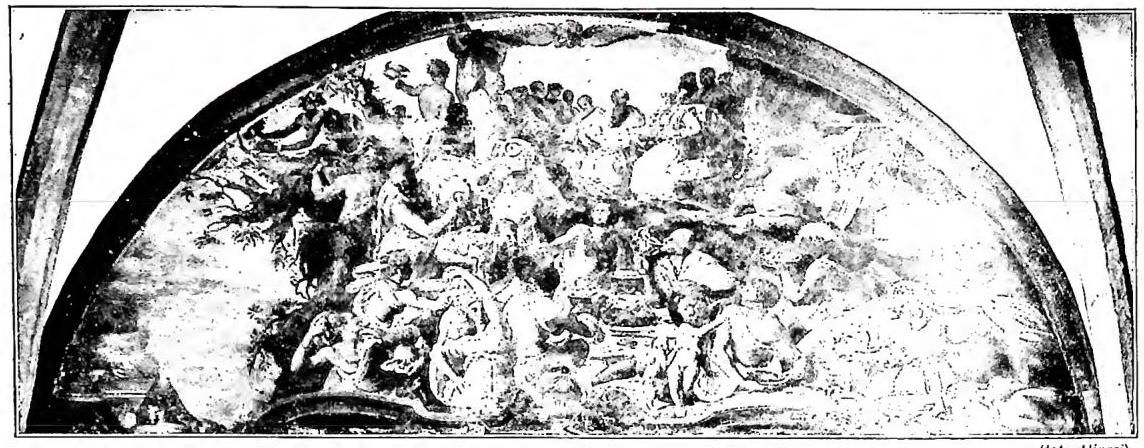
During a second journey to Rome (1575), A. had Gregory XIII convert the city’s former English hospice into a seminary, where, under the direction of the Jesuits, other fervent priests could be trained, thoroughly prepared for every kind of combat. Returning to Douai, he found that a violent storm had gathered against the college; taking advantage of the revolt in the Low Countries, Elizabeth’s anger had secured its suppression by the Spanish government. A. transferred it to Reims (1578) under the protection of the cardinal of Lorraine, prince of Guise. During a third journey to Rome (1579), he succeeded in another undertaking: namely, in obtaining that the Jesuits too should take a direct part in the conversion of England; the first expedition, Campion (v.) together with 13 other students of the English College, departed on 17 Apr. of the following year.
At this point A. was no longer content to aid his homeland with the weapons of prayer and the apostolate; he also thought of turning to political means. In agreement with the Guises, with Maria Stuarda, and with Fr. Persons, he embraced the idea of a Spanish landing in England. Filippo II, in order to increase his authority, had him named cardinal (7 Aug. 1587); after the landing, the victory, and the coronation of Filippo II as king, A. was to be appointed papal legate and archbishop of Canterbury. When everything was ready, before the “Invincible Armada” set sail, A. issued a proclamation to the English and Irish nobility and people, urging them to support Filippo II’s undertaking (28 Apr. 1588). The English Catholics did not follow him; faced with the danger to their nation, they forgot the past, joined the others against Spain, and the defeat of the “Invincible Armada” filled them with joy. Every dream of an invasion by force of arms vanished. A. remained in Rome; he helped to found two other English colleges, one at Valladolid (1589) and the other at Seville (1592); Filippo II appointed him archbishop of Malines, although the appointment was never confirmed; he was elected apostolic librarian and protector of the English people. But his dream of standing on the eve of the conversion of his homeland was not fulfilled. A., who resided at the English College in Rome, died there, as stated above, on 16 Oct. 1594.
(Alinari photograph)