
FERIANA. — This is the name of the modern village in Tunisia, a short distance from which, at the site of Medinet el Kdim, lie the ruins of ancient Thelepte. The city was important above all as a road junction in connection with the military defence of Byzacena, within whose administrative district it was included after the Diocletianic reform, and of Numidia; it still retained this function in the Byzantine period, when Justinian surrounded it with walls (Procopius, De aedif., VI, 6). Under the Empire it had the rank of a colony, probably from the time of Trajan.
In the history of Christianity it is already mentioned as an episcopal see in 256; other bishops of the city appear at the Councils of 401 (at which, in addition to a Catholic bishop, two Donatist bishops from the city seem to have been present), 418, and 484; it is finally recorded once more in the Descriptio orbi Romani of Giorgio di Cipro between the 6th and 7th centuries: its Christian community therefore survived until the time of the Arab invasions; whether it persisted afterwards cannot be said.
In addition to a small number of remains of pagan monuments (a theatre and baths) and a Byzantine fortress, the city displays the ruins of at least seven churches and four chapels, all generally reduced to a few ruins, from which the plan of the original buildings can only with difficulty be discerned: in any case, their number and the size of some of them attest to the vigour attained by Christian life in the city. Some churches have an adjoining cemetery area or isolated tombs.
The largest of them, situated on the edge of the Roman settlement, is approximately 52 m long and 25 m wide, and is preceded by a rectangular, enclosed forecourt divided into three rooms; inside, it has five aisles, the central one separated from the lateral aisles by massive quadrangular piers with engaged columns, and ending at the rear in an apse; the opening of this seems to have been closed by an architrave on columns, almost resembling an iconostasis; the fragment of the shaft of one of these columns bears very low-relief decoration, with vine branches intertwined around a monogram and a chalice between two peacocks; other architectural elements (capitals and corbels) have similar decoration. Joined to the left side of the church is a small apsidal building divided into two rooms: probably a baptistery with its consignatarium; fragments of decorative terracotta panels were found there, common in the Christian buildings of Tunisia. The building may be dated approximately to the middle of the 5th century.
Another church, situated precisely in the centre of the Roman city, seems to have been preceded by a quadrangular atrium, a very rare feature in Africa; the interior, about forty metres long, had three aisles with an apse and chapels flanking it; noteworthy is the presence of a counter-apse, constructed at a later date, probably to receive the tomb of some venerated personage. The church’s first construction might be assigned to the 4th century.
A third basilica approaches the first in size (45 × 18.65 m) and in its internal division into five aisles, the central one with columns and the lateral ones with octagonal piers. It is preceded at the front by a rectangular court, and ends in an apse that is circular on the inside and polygonal on the outside: this form of apse would suggest that the church is no earlier than the Vandal period, if not actually Byzantine.
Among the other smaller churches, mention should be made of the one situated outside the city to the south-west, amid a Christian cemetery: in the apse, a mosaic inscription bore a verse from a psalm; another similar inscription was in the presbytery before the apse, above a tomb, recalling a Tamorins et comites, certainly martyrs deposited there, perhaps the same ones whom the Hieronymian Martyrology records on 10 July. The church was perhaps built in the 4th century. A small stone column was found in the building, adapted at its upper end as a basin, perhaps for ablutions. Of the smaller chapels, the most unusual is one adjoining caves excavated in the rocky wall on the side of a torrent, which certainly served for the burial of venerated persons.
St. Fulgenzio da Ruspe (468–532) was a native of Thelepte.
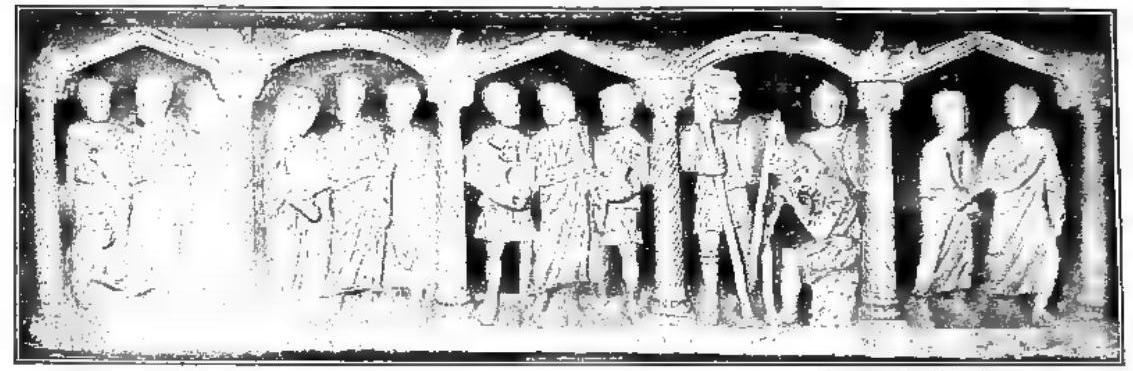
(courtesy of d. Nazareno Chiacuri) FERMO, ARCIDIOCESI di — Christian sarcophagus (4th century) — Fermo, Cathedral crypt