GANDHI, MOHANDAS KARAMACHAND. — Indian political figure, born in Potbandar (Gulf of Oman) on 2 October 1869, died in New Delhi on 30 January 1948. In 1888 he left for London to complete his studies and obtained a degree in law; three years later he returned to India. In 1893 he went to South Africa, wishing to defend the 15,000 Indian workers who had immigrated there and who were living in difficult conditions. In 1899, during the war against the Boers, he did not forget that he was a subject of England and fulfilled his duty alongside the English troops, organizing the Indian Red Cross. Almost
(for the Indian woman)
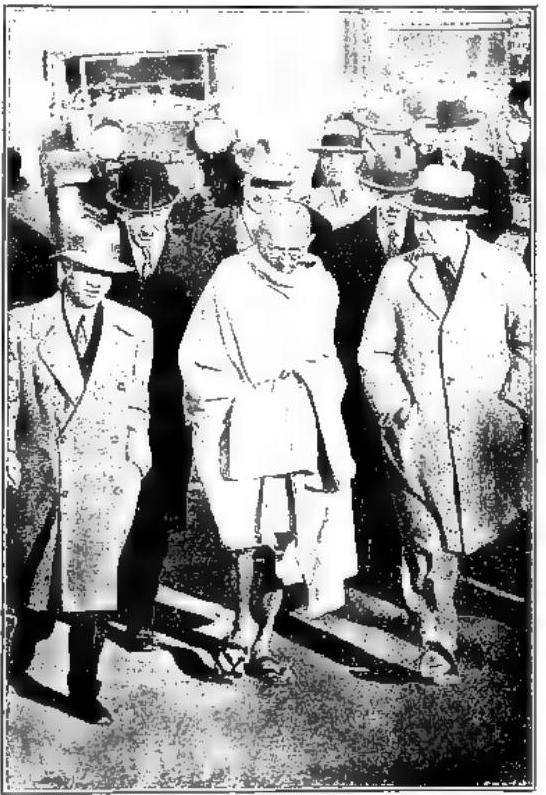
GANDHI, MOHANDAS KARAMACHAND - G. in Rome in 1931.
In 1904, at Phoenix, near Durban, he founded an agricultural colony. Indians of different castes and religions were to find, under his guidance, that understanding which he endeavored to bring about for India. In Johannesburg he opened a hospital for those afflicted by the plague. In 1906 he cooperated with the English against the rebellious Zulus; but he energetically opposed the South African government’s policy regarding the poll tax and proclaimed, for the first time, satydgrahi (insistence upon truth), inaccurately termed passive resistance.
From South Africa he returned to Ahmedabād and in the ātram (meditation) sought to carry out works of goodness and peace until 1918, when he resumed active political work in the Indian Congress and promoted, against the repressive laws of Rowlatt, the union of Hindus and Muslims. In 1920 he succeeded Tilak as head of the Congress and proclaimed non-cooperation (suadeh), which provoked rebellions, violence, repression, and G.’s repentance. In the same year, in November, he opened the University of Gujarat at Ahmedabād; elected president of the Indian National Congress at Delhi, he had civil disobedience proclaimed. Arrested in March 1922, he was sentenced to six months in prison; but on 4 February he was pardoned and, in retreat at Ahmedabād, proclaimed “the Beatitudes of the Gospel the finest pages he had ever known.”
In December 1929 he resumed political activity and, at the Congress of Lahore, advocated India’s determination to achieve complete independence; three months later he urged the peoples of India to civil disobedience without violence, setting the example with the “march of the martyrs” and the violation of the law governing the salt monopoly at Dandi on 5 April 1930. Imprisoned again, he was released on 25 January 1931 and took part in the Second Round Table Conference in London to draw up the constitution of the Indian Federation. When the conference failed, he returned to India and in January 1932 found himself once more in prison. He then began the famous fasts, which succeeded in bending the will of the English government and in calming the disagreements between Hindus and Muslims in the interests of greater social justice.
In 1934 he renounced the presidency of the Indian National Congress; but he always remained its spiritual leader.
In 1944, through fasting, he became an adviser and mediator between his people and the English government, to which, in 1942, on the occasion of the Cripps Mission, he had given a decisive refusal to cooperate.
In 1947 he affirmed India’s desire for unity; only to avert a civil war between Hindus and Muslims did he accept the proposal of Viceroy Mountbatten, wept over the division between Hindustan and Pakistan, and preached peace. On 5 August of the same year India was proclaimed independent; but, with the tragedy of his homeland, this was the tragic end of this singular agitator: on 30 January 1948, in New Delhi, he was struck down and killed by the fanatical hatred of a member of the Hindu Mahasabha.
They called him Mahātmā, the great soul, during his lifetime, and crowds went to dip handkerchiefs in his blood, as in the blood of a martyr; on the urn containing his ashes, the leaders of independent and free India had the word “God, God” engraved. Romain Rolland called him a “saint of Christianity,” while others among Christians called him its “enemy.”
G. is one of the most difficult figures to study and define. He was an authentic Hindu, an oriental mystic—