
RED CROSS SOCIETY. — The R. C. is an international organization of universal character, operating in all the States of the world, legally regulated by conventions signed by all governments, and possessing its own statutes approved at various international conferences. Its emblem, consisting of a R. C. formed by five squares on a white field, recognized as a sign of the privilege of neutrality in wartime and a symbol of human solidarity in peacetime, above all considerations of race, politics, and religious differences, is composed of the reversed colors of the flag of the Swiss Confederation, the nation that gave rise to the legal formation of this movement and currently hosts its international organizations. For Muslim countries, it has been permitted that the sign of neutrality be represented by the red crescent, or by the red lion and sun; but resolutions are being studied to achieve the unification of the symbol of neutrality in the sign of the R. C. on a white field.
I. ORIGIN
It was necessary to reach the second half of the nineteenth century for the first timid affirmations of the concept that the wounded in war could no longer be regarded as an enemy and, as such, had the right to assistance and respect. The Italian Ferdinando Palasciano, a surgeon in the Bourbon army of Naples, may be considered the first proponent of the concept of the “neutrality of the wounded in war”; a concept that he upheld at the price of personal sacrifice as early as 1848 during the siege of Messina and solemnly reaffirmed in 1861 at the Accademia Pontoniana of Naples.This idea found vigorous implementation in the Genevan Enrico Dunant, recognized as the founder of the C. R. Alongside him, mention must be made of the priest d. Lorenzo Barzizza, who headed the civic commission that, at Castiglione delle Stiviere, addressed the problems of providing medical assistance to those wounded in the battle of Solferino. Barzizza’s example and the terrifying spectacle of thousands of wounded made a profound impression on Dunant, then a tourist in that region (cf. L. Barzizza, Il dimenticato animatore della C. R., Brescia 1952). A volume by Dunant, Un souvenir de Solferino (1862), produced a great and profound echo throughout the world; its humanitarian conclusions, examined and discussed by Geneva’s philanthropic Society for Public Utility, led to the establishment of a committee whose work culminated in a meeting held from 26 to 29 October 1863 at the Athenaeum of Geneva, with the participation of representatives of 16 states. This meeting (the “Preliminary Geneva Conference”) approved, among other things, a Resolution which, having affirmed the principle of respect for and care of the sick and wounded in war, established that communications between the relief committees of the various nations should be conducted through the Geneva Committee, which thus assumed the designation of “International Committee.”
In June 1864, the Swiss government convened an international conference in Geneva, open to all states, which resulted in the “Geneva Convention” of 22 August 1864 for the amelioration of the condition of the wounded and sick in armies in the field. The Italian State, by Royal Decree no. 2514 of 23 September 1865, ordered the full and complete implementation of the aforementioned Convention.
The Geneva Convention was followed by those of The Hague of 29 July 1899 for the application to war
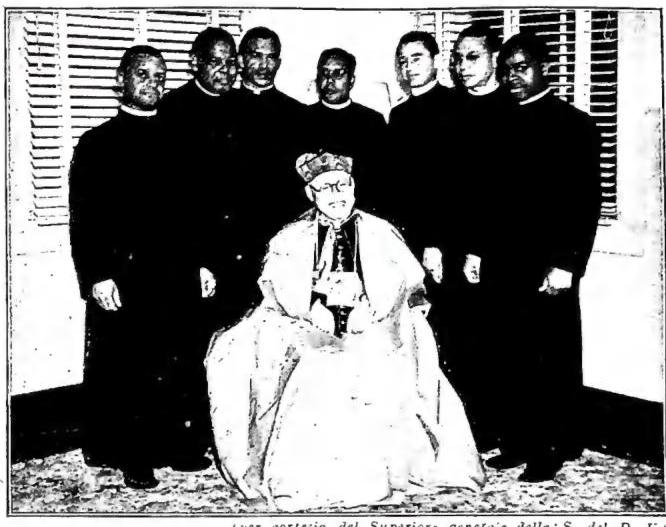
SOCIETÀ DEL DIVIN VERBO (VERBITI) — Cardinal T. Tienchensin (Verbite), guest of the Seminary of the Divine Word for Black people, in the United States (14 May 1946).
maritime application of the principles of the Convention of 22 Aug. 1864; the Hague Convention of 21 Dec. 1904, concerning hospital ships; the Geneva Convention of 6 July 1906, for the improvement of the condition of the wounded and sick in armies in the field; the Geneva Convention of 27 July 1929; and finally the four Geneva Conventions of 12 Aug. 1949, currently in force (the Convention concerning the protection of civilians in time of war having been added to the previous Conventions), which constitute a revision and updating of the Conventions already in existence. The Italian State ratified them by Law no. 1739 of 27 Oct. 1951.
II. ORGANIZATION
The structure of the C. R. comprises: the International Conference of the C. R., which is the highest deliberative authority of the C. R., composed of delegates of the International Committee of the C. R., the national Societies of the C. R., the League of Societies of the C. R., and delegates of the States participating in the Geneva Conventions. The Conference ordinarily meets every four years. During the intervening periods, a Permanent Commission of the International Conference provides for the coordination and unity of the efforts of the international C. R.The most recent International Conference of the C. R., the XVIII, was held in Toronto (Canada) in Aug. 1952. The organization also comprises: the national Societies of the C. R., the International Committee of the C. R., and the League of the S. of C. R.
The International Committee of the C. R. is composed entirely of Swiss citizens. It is the guardian of the principles of the C. R.; it supervises observance of the Geneva Conventions and acts as a neutral intermediary as such, especially in time of war. Moreover, it maintains and develops relations among the various C. R. organizations throughout the world; safeguards the fundamental and permanent principles of the C. R., namely, impartiality, apolitical character, confessional and economic independence, the universality of the C. R., and equality among the various national C. R. organizations; assumes the functions assigned to it by virtue of international Conventions; proposes and oversees the organization of a «Central Agency for Information on Prisoners of War»; and performs other important fundamental tasks.
The national Societies of the C. R. are not only the valuable auxiliaries of the armed forces in wartime, but also at all times carry out their work in every field where it is necessary to alleviate human suffering and improve health. After the end of the 1914–18 war, it was recognized that the assistance program of the C. R., already carried out in wartime, could be transferred and implemented in peacetime, as indeed was already taking place in
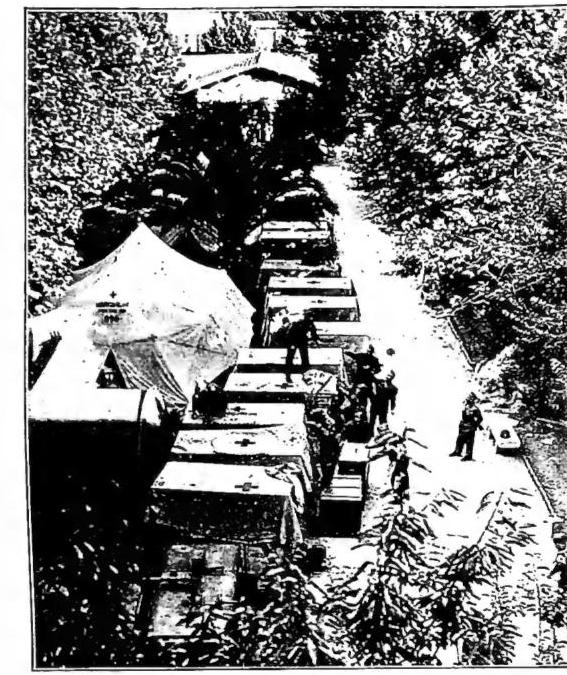
SOCIETÀ DELLA CROCE ROSSA - General view of the hospital unit, ready for departure, sent by the Italian Red Cross to Korea, with medicines manufactured in Italy, intended for civilians and prisoners of war.
in forms and fields consonant with the principles and aims of the Red Cross, through an organization founded in 1919 and called the League of Red Cross Societies. Its purpose was to help the national Red Cross Societies develop at the national level and to facilitate their international collaboration. The League serves among the national Red Cross Societies as a permanent organ of liaison and of coordination and study, intended to assist them in preparing and carrying out their activities in the national and international spheres. The League collaborates with the International Committee of the Red Cross. The international, federative, and representative character of the League is clearly affirmed by the composition of its governing bodies, namely the Council of Governors and the Executive Committee. The Secretariat of the League, moreover, is the organ responsible for putting the League’s decisions into effect.
At its session of 19 Nov. 1946, the General Assembly of the UN unanimously approved a resolution inviting all governments to support and encourage the creation, development, and cooperation of Red Cross organizations. This recommendation was reaffirmed in a letter from the Secretary-General of the UN dated 30 Nov. 1949, addressed to the member governments of the United Nations.
III. LA C. R. ITALIANA. — The Geneva Convention of 22 Aug. 1864 led to the establishment in Italy of a central committee in Milan of the Association for the Relief of Sick and Wounded Military Personnel. After taking part with its medical organizations in the campaign of 1866, this committee relinquished its prerogative as the central body to the Committee established in Rome following the events that had led to the unification of Italy.
Established as a juridical body by R. D. of 7 Feb. 1884, no. 1243, it is governed by numerous legislative provisions that determine its internal and institutional organization. The Association, represented by a general president and administered by a Central Committee, is organized peripherally into provincial committees—some of which function as regional committees and mobilization centers—subcommittees and municipal delegations, as well as delegations abroad for each state.
1. The Italian C. R. in peacetime. — Its purpose (v. Decreto Capo provvisorio dello Stato of 13 Nov. 1947, no. 1256) is to provide assistance to the civilian population, especially its needy classes, supplementing through its own means, institutions, formations and services the direct action of the State and local authorities against disease and public calamities. To this end, it promotes and organizes the country’s voluntary resources and private activities, and also channels aid from abroad in order to secure the necessary financial and other means. In particular, the following supplementary tasks are entrusted to the Italian C. R.: a) to establish and, in the event of emergencies and public calamities, operate tented and requisitioned hospitals, infirmaries, hospital trains and ships, motorized medical units, railway and port first-aid stations, and territorial medical formations; b) to organize and carry out, on a national level, first aid and the transport of the sick and injured through its own directly managed services and also by coordinating and regulating those provided by other local associations, with the aim of achieving maximum service efficiency, including in cases of general emergency; c) to contribute to the technical and professional training of auxiliary health-care personnel through instructional and training courses at special schools; d) to cooperate in disseminating notions of hygiene and first aid among every social category, especially in schools. The Association is authorized, according to its financial and organizational possibilities and with the prior consent of the supervisory and protective authority, to extend its activities: a) to the establishment and management of permanent welfare institutions for particular social needs; b) to supplement the action for protecting children’s health carried out by the bodies specifically entrusted with this task, through periodic and permanent colonies with school medical assistance provided by school clinics; c) to distribute aid to the civilian population and to charitable and welfare institutions; d) to intervene in all cases and circumstances in which its services are requested by the competent supervisory and protective authorities.
2. The Italian C. R. in wartime. — It must contribute (v. R. D. L. of 12 Feb. 1930, no. 84), with its own personnel and resources, to the evacuation and care of the sick and wounded of war; organize and carry out anti-aircraft and anti-gas medical defense; and perform prisoner-of-war services in accordance with the International Geneva Convention.
Except for the evacuation of the sick and wounded in war, the implementation of these tasks is, as a general rule, limited to territory outside the zone of the active army; but it may also be extended to localities within that zone, as determined by the military authority. In the zone of the active army (v. R. D. of 30 Dec. 1940, no. 2024), the Italian C. R. contributes to the evacuation of the sick and wounded by establishing tented ambulance units, tented hospitals and lagoon ambulances, and by organizing first-aid stations at railway stations and ports.
In the territorial zone, the Italian C. R. contributes to the organization of the medical service through: a) the establishment and operation of first-aid stations at railway stations; b) the establishment and operation of military hospitals; c) the establishment and operation of anti-aircraft protection facilities (central directorate, first-aid squads, initial-treatment and triage facilities, specialized-treatment facilities, human decontamination squads and squads for the decontamination of infected areas).
For the operation of its peacetime and wartime services, the Italian C. R. recruits its own directing personnel (officers) and care personnel (noncommissioned officers and enlisted men), who constitute a special voluntary corps serving as an auxiliary to the armed forces of the State (R. D. of 10 Feb. 1936, no. 484).
Equal in rank to the Association’s military directing personnel are the Italian C. R.’s volunteer nurses. Their corps, established in 1908, forms part of the Association’s personnel and is governed by special regulations (approved by R. D. of 12 May 1942, no. 918). Since its foundation, the corps has included approximately 20,000 volunteer nurses, and more than 12,000 are still on its rolls. Twenty of them died in service; 200 were awarded military valor decorations, and 600 received the Cross of Merit for War Service.
The Italian C. R. also runs residential schools for the professional training of professional nurses and specialized schools for the professional training of Assistenti sanitarie visitatrici. The residential schools have graduated several thousand professional nurses and Assistenti sanitarie visitatrici.
In 1889 the Italian C. R. accompanied the troops to Eritrea, and in 1905 and 1908 it effectively assisted the victims of the earthquake in Calabria and of the Sicilian-Calabrian earthquake. It took part in the Libyan War (1911–13), receiving the Silver Medal for Military Valor, as well as in the Balkan campaign; in 1915 it came to the aid of the victims of the Marsica earthquake. It was awarded another Silver Medal for Military Valor for its conduct during the 1915–18 World War, in which it took part on a large scale with a corps of more than 22,000 men and 10,000 nurses, making a considerable contribution, including in bloodshed.
The 1920 earthquake in Garfagnana and Lunigiana, the fire of Smyrna and the terrible Russian famine in 1922, as well as the Japanese earthquake of 1923, found the Italian C. R. ready to intervene with its emergency organization to aid the victims of such grave disasters. Particularly deserving of recognition is also the work carried out by the Italian C. R. in combating malaria in the Pontine Marshes, Sardinia, Sicily and southern Italy.
During the last war, it undertook tasks of the greatest importance, once again committing, at the cost of a heavy toll of blood, approximately 12,000 men and 5,000 volunteer nurses to anti-aircraft medical-protection services, assistance to wounded and sick military personnel, and prisoner services. It also carried out delicate international missions for the repatriation of Italians who had remained in East Africa and for the exchange of sick prisoners with Greece and England.
The Italian C. R. did not escape the repercussions of the tragic events that followed in Sept. 1943; despite its status as a neutral body, recognized by the international Conventions, it was not respected even in its material resources, still less in its personnel. It was in June 1944 that the Rome Committee resumed its function as the central headquarters.
857 SOCIETÀ DELLA CROCE ROSSA — SOC. DELLE FIGLIE DI S. F. DI SALES 858
The Italian Red Cross carries out an activity whose structure comprises the following elements: ambulances for first aid and the transport of the sick, sanatoriums and institutes for the treatment of tuberculosis, hospital institutes, general preventive institutions, supervised preventive institutions, permanent colonies, temporary colonies, and convalescent homes for children. The means necessary for the intervention of the Italian Red Cross Military Volunteer Corps, with its emergency service, are collected and prepared in regional and secondary warehouses, which ensure the proper safekeeping of its mobile units. The Italian Red Cross has tented hospital trains, tented first-aid stations, tented ambulances, units of various kinds, and assorted relief equipment with which to confront possible disasters. Other activities of the Italian Red Cross are: International Social Service, which assists, without distinction of nationality, religion, or race, all those who have problems to resolve in at least two different nations; Legal Assistance to Foreigners (AGIUS), which handles special and miscellaneous personal and family matters for foreigners in Italy (refugees, stateless persons, etc.); Madrinato, which has assisted and continues to assist children who are victims of war, by providing accommodation and through other forms of aid; and finally, the Italian Red Cross Youth, an extracurricular institution that carries out educational, social, hygienic, and welfare work in schools and which, through international interschool correspondence, unites children of every natio-
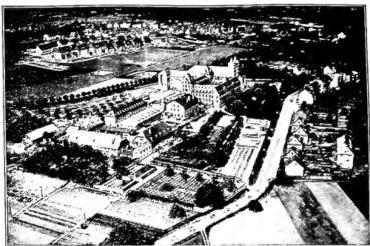
SOCIETÀ DELL'APOSTOLATO CATTOLICO (PALLOTTINI) - Mother House of the Province of Limburg. A complex comprising printing establishments, an agricultural and livestock enterprise, the provincial superior’s residence, and a novitiate for lay brothers.
nationality, race, and religion. The Italian Youth Red Cross has 130,000 collective member classes, 600,000 individual student members, and 5,000,000 organized children.
In addition to health and first-aid education, welfare and social activities, and educational and cultural programs, the Italian Youth Red Cross conducts courses for colony supervisors and for Pionieri della fraternità, its direct offshoot. - Vedi tav. LIV.