Machine translation of the 1948–1954 Italian original. The original text is authoritative.
BAHR, HERMANN. - Austrian writer and critic, born in Linz on July 19, 1863, and died January 15, 1934. A subtle novelist and lively playwright, he linked his name to all the literary movements of the time, making himself known in his homeland by turns as a severe critic: a fervent supporter of naturalism, he would later be the first to turn his back on it (cf.
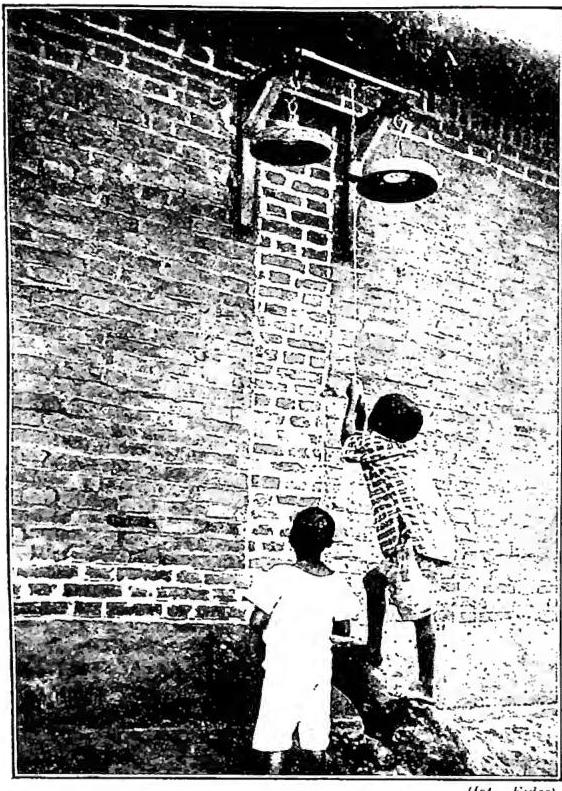
BAHR el-ĠEBEL - Bells of the Isoke Mission (Anglo-Egyptian Sudan).Die Überwindung des Naturalismus, 1891) to announce first the new Impressionist theories and Maeterlinckian symbolism, and later Expressionism (cf. Expressionismus, 1916). Having declared himself outside of any religious confession in 1895, at the time of his first marriage, he later arrived—through a long spiritual crisis of which he tells us in the Tagebuch (1917-25) and in Selbstbildnis (1923)—at the full certainty of the Catholic faith: of his conversion, which likely took place in 1912, he gave explicit notice only in 1917. While his work as a critic has European value and is a continuous transcendence of acquired positions, his literary work, typically Austrian, offers a fairly unitary character. The manner in which he addressed the problems of Austrian civilization in his later works (Himmelfahrt, 1916; Die Rotte Noah, 1920; Der innwendige Garten, 1917) is influenced by his new attitude as a Catholic.
BIBL.: W. Handl, H. B., Berlin 1913. Alda Manghi
Cite this article
“BAHR, HERMANN.” Enciclopedia Cattolica, vol. II (1949), p. 413. Azione Romana digital edition, https://azioneromana.com/article/bahr-hermann.