Also known as:
Valvisciolo Abbey;
Italian: Abbazia di Valvisciolo, Monastero di Valvisciolo
VALVISCIOLO. - Monastery situated at the foot of Monte Corvino, almost halfway between Norma and Sermoneta in the diocese of Terracina, province of Latina. It is dedicated to Sts. Peter and Stephen.
It was inhabited from the 7th-8th century by Basilian monks; later by the Templars, and following their suppression Clement V granted it to the Cistercian monks of the abbey of V. of Carpineto, who with their goods and possessions also brought there the title, and the abbey, until then called of Sermoneta, was named of V. The Cistercians were succeeded by the Augustinians, who abandoned it very soon because of the wars in 1548; in 1471, reduced to a commendam, it was assigned to Cardinal Orsini, bishop of Frascati. In 1612 the reformed Cistercians known as Feuillants were called there, and they returned to abandon it in 1619, when the commendatory abbot Bonifacio Gaetani, who had recalled them, died, and they were succeeded by the religious of St. Francis of Paola. Onorato Gaetani recalled the Cistercians there in 1633, and they came to inhabit it only on 17 July 1635 and remained there until the suppression by Napoleon I (c. 1809). The last commendatory abbot was Filippo Gaetani, who resigned the abbey to the pope
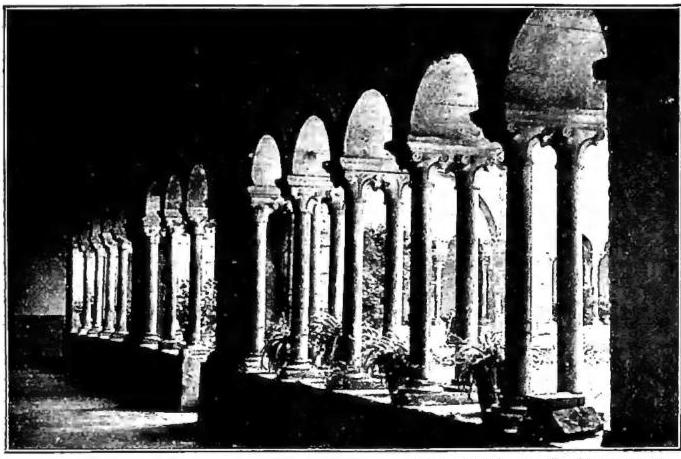
VALVISCIOLO - Cloister (13th century).(courtesy of F. Mastrojanni)
Pius IX, who on March 6, 1864, recalled there the monks of the abbey of Casamari, who still reside there.
The architecture of the church and of the monastery, of Cistercian type, is Gothic-Lombard (after 1240). The interior has three naves; of great artistic effect is the circular window above the entrance door, which dominates the very elegant facade, much admired by the historians of the Abbey. In the church are preserved valuable works by Pomarancio, by Muziano and by Girolamo Siciolante of Sermoneta (d. 1541). Elegant too is the architecture of the cloister, adorned with a double row of marble columns that support the four side facades.
Bibliography8 worksC. Marozzo, Cistercio reflorescente, Turin 1690, pp. 28, 203-204; A. Lubin, Notitia abbattarum Italiae, Rome 1693, p. 365; L. Angeloni, Cenn
BIBL.: C. Marozzo, Cistercio reflorescente, Turin 1690, pp. 28, 203-204; A. Lubin, Notitia abbattarum Italiae, Rome 1693, p. 365; L. Angeloni, Cenni stor. topogr. sulla badia di V., in Giorn. Arcadico, nuova serie, 31 (1862), pp. 86-89; id., Viaggio di S. S. Papa Pio IX nella città e prov. di Velletri, Velletri 1863, pp. 28-35; B. De Lazzaro, Mem. stor. sulla badia di V. di Pietro Pantanelli ora per la prima volta pubbl. ed annot., ivi 1863; Q. Benini, Illustraz. cattoliche..., in Palestra del Clero, 3 (1888), pp. 398-413; M. Raimondi, La badia di V., Velletri 1905, p. 196; P. Pantanelli, Notizie stor. della terra di Sermoneta, editi da Leone Gaetani, Rome 1911, pp. 223-30, 289-95.
Mastrojanni, Fortunato. “Valvisciolo.” In Enciclopedia Cattolica, vol. XII, coll. 1010–1011. Città del Vaticano: Ente per l’Enciclopedia Cattolica e per il Libro Cattolico, 1954. https://azioneromana.com/article/valvisciolo.
MLA
Mastrojanni, Fortunato. “Valvisciolo.” Enciclopedia Cattolica, vol. XII, Ente per l’Enciclopedia Cattolica e per il Libro Cattolico, 1954, coll. 1010–1011. Azione Romana, https://azioneromana.com/article/valvisciolo.
BibTeX
@incollection{ec12_valvisciolo,
  author    = {Mastrojanni, Fortunato},
  title     = {Valvisciolo},
  booktitle = {Enciclopedia Cattolica},
  volume    = {XII},
  pages     = {1010--1011},
  note      = {Cited by column},
  publisher = {Ente per l’Enciclopedia Cattolica e per il Libro Cattolico},
  address   = {Città del Vaticano},
  year      = {1954},
  url       = {https://azioneromana.com/article/valvisciolo}
}
One of some 20,000 entries brought back from the twelve printed volumes (1948–54). Spotted something? Help us improve it.
Click or scroll to zoom · drag to pan · Esc to close