
Xylographic Books (Fr. Livres xylographiques; Eng. Blockbooks; Ger. Blockbücher)

XILOGRAFICI, LIBRI (fr. Livres xylographiques; ingl. Blochbooks; ted. Blochbücher). — A bibliographical term designating small books composed of woodcuts with figures and a brief explanatory text, printed on several sheets on one side only, pasted together on the unprinted side and assembled so as to form a sort of illustrated booklet. Sometimes the woodcuts contain only the figure or, less often, only the text; in older copies the text (caption) is found written by hand, and for this reason they are called «libri xilochirografici». There are also copies of l. X. with captions printed in movable type.
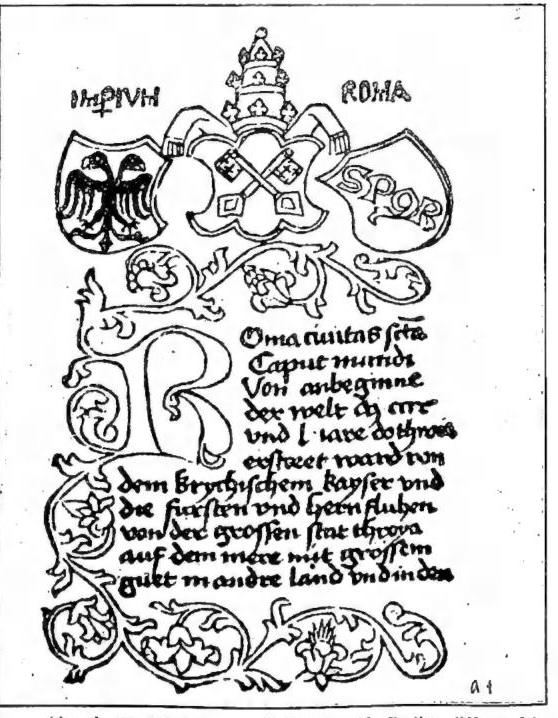
Article illustration
The l. x., also called tabular printing (the page in a single block), intended for popular use and consumption, were commonly believed to predate the invention of movable type and to be closely connected with the earliest products of printing. They are instead an independent production, contemporary with, parallel to, and also later than the printed book. The oldest copies known to date go back to about 1450. Attempts to assign them earlier dates are scarcely convincing, except in the case of isolated sheets, which constitute a similar but structurally different product and cannot be called books. It is likewise impossible to determine their chronological sequence.

The l. x., produced especially in the Netherlands and Germany, contain, for the most part, sacred representations, but there are also copies with profane representations or didactic texts; among the former are to be remembered the Speculum humanae salvationis, the Ars moriendi, the Apocalypse, the Symbolum Apostolicum, the Defensorium virginitatis Mariae, the Exercitium super Pater noster and, the most famous of all, the Biblia pauperum, a kind of summary of the Old and New Testaments in 40 or 50 woodcuts. The second group includes the Mirabilia Romae, the Dance of Death (Der Totentanz), several Calendars, the series of the Planets, and a small group of «Donati», elementary Latin grammars.

The l. X. met with only scant and sporadic success in Italy. The best-known Italian copies are: Mirabilia Romae (about 1450), the Berlin Passio (Venice 1460), Opera nova contemplativa, a variant of the Biblia pauperum (there 1510), Operina da imparare di scrivere littera cancelleresca by Ludovico degli Arrighi «Vicentino» (Rome 1522), perhaps the last book of the genre. The l. X. known to date comprise more than thirty texts, with a total of just over one hundred copies, nearly all of them very rare or known in a single copy.

BIBL.: most l. X. have been described by W. L. Schreiber, Catalogue des livres xylographiques et xylochirographiques, in Manuel de l'amateur de la gravure sur bois et sur métal au XVe siècle, IV, Leipzig 1902; VII, Berlin 1895; VIII, there 1900; new ed., VII, Leipzig 1929, pp. 24–30; and by W. A. Pollard, Xilographica. Blochbooks, in Catalogue of Books printed in the XVth century now in the British Museum, I, London 1928, pp. 1–11. For general information, see also: L. Donati, Quale parte abbia avuto l'arte xilografica nell'invenzione della tipografia, in Il libro e le biblioteche. Atti del I Congresso bibliologico francescano internazionale, I, Rome 1930, pp. 105–22, and G. Avanzi, L'illustrazione libraria, ibid., pp. 132–34, and particularly pp. 154–55 for the bibliography on individual l. X. Giannetto Avanzi
Cite this article

“XILOGRAFICI, LIBRI (FR. LIVRES XYLOGRAPHIQUES; INGL. BLOCHBOOKS; TED. BLOCHBÜCHER).” Enciclopedia Cattolica, vol. XII (1954), p. 1066. Azione Romana digital edition, https://azioneromana.com/article/xilografici-libri-fr-livres-xylographiques-ingl-blochbooks-ted-blochbucher.