
QUITO, ARCIDIOCESI di. — Archdiocese and capital city of Ecuador, at 2,850 m above sea level. It has an area of 21,362 sq km and a population of 543,735, of whom 542,000 are Catholics; it has 70 parishes served by 129 diocesan priests and 185 religious priests; it has 34 male and 54 female religious communities (Ann. Pont., 1952, p. 333).
The diocese was created by Pope Paul III on 28 Jan. 1545 as a suffragan of Lima; Pope Pius IX raised it to a metropolitan see on 13 Jan. 1848.
Q., a city already existing at the end of the 11th century, was conquered by the Cara, who founded a kingdom there, later occupied in the mid-15th century by the Incas. The Spaniards entered it by force in 1533, while the inhabitants set it on fire; the city was rebuilt immediately afterward, and Charles V enriched it with privileges and made it the capital of the region dependent on the viceroyalty of Peru; in 1718, however, it was annexed to that of S. Fè of Bogotá. From 1809 to 1812, the independence of Ecuador was unsuccessfully attempted; from 1822 to 1830 it formed part of the Republic of Greater Colombia, until it became an autonomous state in 1830. The oldest church in Q. is the cathedral of S. Francesco, begun by the architect Iodoco Ricke as early as 1534, but completed more than a century later by Antonio Rodríguez, together with the adjoining convent. The interior has three naves divided by pillars; the Baroque façade was damaged by an earthquake. The church, convent, and cloister of La Mercede are the work of J. Jacine Ortiz; the Dominican church contains a statue of the Madonna donated to Q. by Charles V. The Jesuit church is artistically noteworthy; its façade has six vine-shaped columns. Also worthy of mention are the churches of Carmen antiquo, S. Agostino, and S. Chiara.
The archdiocese today comprises the provinces of Pichinche, León, and Tunguragna. Sixtus V, by a bull dated 20 Aug. 1586, established the university, which was opened by the Jesuits in 1621 (J. Toribio Medina, La impronta en Q., Santiago 1924). On 6 Aug. 1875, President G. García
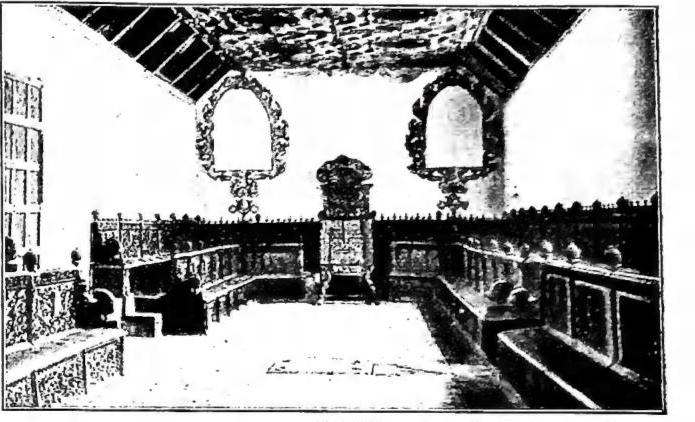
(photograph by the Istituto geografico De Agostini, Novara)
The Universidad Central del Ecuador in Q. was founded by the Dominicans at the end of the 18th century. Besides the National Library, the libraries of the monasteries of S. Francesco and La Mercede are substantial. The Ecuadorian Academy and the National Academy of History are based in Q.