
LAPIDARY ABBREVIATIONS — 1) Bolsena, Inscription of the reliquary of S. Cristina: i(c) r(e)g(ui)es(cit) c(or)p(us) b(eat(ae) X(ristinae) m(ar(yris). 2) Inscription of Vibius Fimus from the year 290, at Calliato: Vibiu(s) Fimus r(eddi) VII ha(lendas) sep(tembres) Di(o)c(letiano) IIII et Max(imiano) co(n)s(ulibus). 3) Coin of the Emperor Constantius II: d(ominus) n(oster) Constantius p(us) f(elix) Aug(ustus). - felix temp(orum) reparatio. - Tr(everi)s. 4) Dolium stamp: Χ(ριατὸς) Ν(ιγαὴλ) Γ(αβριήλ) Ι(τ). Καπ(ων). Χρ(ιστς). 5) Epitaph of Pope Gaius: Γαίου ἐπιση(απου). Κατ(εκτῶ) πρὸ ΓΚαλ(ανδῶν) μαίων (died in 296). 6) Donor’s inscription in a floor mosaic: Urs(u)s v(ir) s(anctus) cum com(uge) s(u)a Ursina pro (v)oto s(us)c(epi)o fecer(u)nt hec. 7. Last line of the Damasian epitaph for Proiecta: vixit ann(os) XVI m(enses) IX dies XXV, dep(asita) III ha(lendas) ian(uarias) Fl(avio) Merobaude et Fl(avio) Saturnin(o) cons(ulibus).
| 1. A· -÷: ἀλλ' = ἀλλὰ; πολλ'κ' = πολλάκις; πα'ν = πάντα; κ'τ', κ'τ', κ'τ' = κατὰ. | 17. ECTI· / / / / / EICI· // // // EINAI· \ ~ ~ |
| 2. AI· κ' = καὶ; -π' = -ται; διδ'σ' = διδ'σ'ναι. | 18. ΗΓΟΥΝ· Η'γ' Η'γ' Η' Ή |
| 3. AIC· " Ξ' = ταῖς; κ'Ψ'Ψ = κυε(ιακ)αῖς. | 19. I· "χήμ'Ψ = σχήματι; δ' = ὅτι; μ'Ψ' = μηνί. |
| 4. AN· ∠ ∠ C G G | 20. INA· ʈ |
| 5. ΑΤΟ· ʷ V V; Ψ'Ψ = ἀπὸ τῆς | 21. ΚΑΙ· κ' ʃ |
| 6. ΑΡΑ· ∠ | 22. ΚΑΤΑ· ʃ |
| ΠΑΡΑ· ῥ'; ῥ' = παρὰ; ἥνομία = παρανομία. | 23. OIC· → → → |
| ΠΕΡΙ· ῥ' ῥ' | 24. ΟΝ· \ ; \ \ \ \ = ὄν; Ψτως = ὄντως. |
| 7. AC· J ✓ J | 25. ΟC· °; λογ' = λόγος; λεοντ' = λέοντος; κ' = μον = κόσμον. |
| 8. ΓΑΡ· Γ' β' Γ' γ' γ' γ' γ' | 26. ΟΤΙ· σ' β' σ' γ' |
| 9. ΔΙ· γ' γ' γ' γ'; ουγ' = οὐδὲ; γζ' = δεξιὸς. | 27. ΟΥ· ʷ γ'; -τ' = -του; τ' τ' = τούτου; τ', τ' = τοῦ. |
| 10. ΔΙΑ· Δ' Δ' Δ' | 28. ΟΥΝ· ϑ; καλ'ϑνται = καλοῦνται; ἀγνορ'τ' = ἀγνοοῦντας |
| 11. Ε· μ'τ' = μετὰ; -μ'τ' = -μενος; μ'τ' = -μένων. | 29. ΟΥC· ϑ ϑ; τέλ' = τέλους; ἵππ' = ἵππους |
| 12. ΕΙΝ· // // // " | 30. ΠΡΟ· α (=πεῶτος); α'βατ' = πρόβατον; α'σωπ' = πρόσωπον; α'αεδ'ε' = πρωτοπρόεδρος; α' = μοναχός. |
| ΗΝ· ^ ^ ^ ^ ΙΝ· ϧ Ϩ ϩ Ϫ | 31. ΨΝ· ~; ~ = ὤν; ~, ~ = ὤν. |
| 13. ΕΙC· ss | 32. ΨC· ϑ ϑ ϑ; οὔτ' = οὕτως; ϑπεε = ὥσπεε. |
| ΗC· ʃ ʃ; Ϛ = ῄʃ | |
| ΙC· ʃ ʃ | |
| 14. ΕΝ· ∠ ∠ ∠ | |
| 15. ΕΠΙ· ῇ ῆ; ῇ' θψμ' = ἐπιθυμίαν. | |
| 16. ΕC· ϩ ϩ ϩ |
(drawing, Enc. Catt.)
GREEK PALEOGRAPHIC ABBREVIATIONS - Table I: Reproduction of the most common abbreviation signs in use in Greek paleography, and of the corresponding forms in the full transcription. For some of them (nos. 1, 2, 3, 5, 6, 9, 11, 15, 19, 24, 25, 27, 28, 29, 30, 32), a few examples that occur most frequently in manuscripts are also given.
| T A B L E II | T A B L E III | ||
|---|---|---|---|
| Κ^{ζ} | = κεφάλαιον | ξ, ξ^{ζ} | = ἀειθμός, ἀειθμοί |
| Θ | = σημείωσαι, σημειωτέον | ψ ψ | = ἄγουσα |
| Φ^{α} | = φασί | ϰ | = ἀστήν |
| Φ^{π} | = φησί | Ϝ | = δεαχμή |
| Κ^{τ} | = κατά | L | = ἔτος, ἔτους, ἐτῶν |
| Λ^{ζ} | = λέγειν | σ | = ἥλιος |
| Τ^{τ} | = τρόπος | δ | = ἡμέσα |
| Δ | = λόγος | ϝ | = νύξ |
| ϵ | = ὅσιος | Θ | = κόσμος |
| Π^{τ} | = πόνος | Θ | = κύκλος |
| σ^{στ} | = Σεβαστός | ⊙ | = λαβύεινθος |
| τ^{πκ} | = τυπικόν | -, -, ÷ | = ὀβολόν |
| Ⲡ | = πτός | = | = διωβέλιον |
| ϰ | = χεόνος, Χριστός | ϝ | = τειώβολον |
| ϕ | = ὥσα, ὥσαϊον | ϝ | = τετρώβολον |
| πα^{δδ} | = παῖδες | ϝ | = πεντώβολον |
| στ^{τχ} | = στίχοι | □□ | = ὄνομα |
| Φ^{λλ} | = φλάουιοι | ϱϱ | = ὀφθαλμοί |
| Δ^{ππ} | = ἀποστόλων | Ϛ | = σιλήνη |
| μ^{ϱ} | = μαθηταί | ΛΛΤ | = τάλαντον |
| μ^{ϱ} | = μάγτους | ∇ | = τείγωνον |
| ν^{ϱ} | = νομίσματα |
(drawing Enc. Cott.)
PALEOGRAPHIC GREEK ABBREVIATIONS - Table II: Characteristic examples of abbreviations by suspension or truncation. Reproduction of some monograms typical of paleographic usage. Examples of abbreviations indicating plurals. - Table III: Reproduction of some of the more frequent or characteristic symbols.
1) q. = que (more rarely quae)
quib. = quibus
nob. = nobis
id. = idem (or also idus)
scriptim. = scripsimus
·n. = enim
·f. = scilicet
·e. = est
·c. = caput
ḥ = hoc
ṷ = ut
2) n̄ = non
s̄ = est
an̄ = anno (anni)
nat̄ = natus
lib = liber
pon̄ = pontifices
qm̄ = quoniam
nr̄ = noster
tpe = tempore
aia = anima
ee = esse
eni = enim
cu = cum
codicioe = condicione
iperiu = imperium
nom̄ = nomen
mse = mense
tam̄ = tamen
propt = propter
dix = dixit
aum = autem
dicit = dicitur
lib = liber
t = vel
nob = nobis
pp = propter
notu = notum
n̄is = nostris
ao = actio
3) p' = post
c' = cum
e' = eius
s' = sed
t' = tur
δ' = dem (dum)
4) atq: = atque
neq: = neque
q:d = quid
quib: = quibus
ufq: = usque
quod: = quodque
m̄f: = mensis
omnib: = omnibus
q̄nq: = quinque
habz = habet
lz = licet
naz = nam
oz = oportet
q̄lqz = quisque
caz = causam
5) d = die
d̄ = dixi
α = autem
k = legitur
oe = omnis
fiatt = frater
tutf = tutis
inl = inluster
er = erit
et = etiam
dioc = diocesis
eor = eorum
scor = sanctorum
6) tra = terra
bvi = brevi
ctici = clerici
cdt = credunl
ubv = verbum
fuit = fuerit
funt = fuerunt
7) dict = dicuntur
ag = agitur
nuat = numeratur
ceto = cetero
gf = generis
cr'e = currere
8) 7 = et
7 = etiam
deb7 = debet
l7 = licet
z = cum (con-)
z̄ = contra
z̄t̄ = continentia
circ = circum
ʔ = -us
tit̄ = titulus
legim = legimus
p' = post
h' = huius
T A B L E II
h̄ = hoc
ū = unde
ū = vero
m̄ = mihi
ḡ = ergo
q̄dam = quodammodo
sigctm = signaculum
incrit = incurrit
q̄cz = quicumque
T A B L E III
p = per
p̄ = prae (pre)
p̄ = pro
q = qui
q̄ = que (quae)
q = quod
qz = quia
q̄ = quantum
q̄ = quam
q̄ = quem
T A B L E IV
ɔ = eius
H = enim
h̄ = autem
ɔɔ = contra
= = esse
÷ = est
·i = id est
(dis. Enc. Catt.)
LATIN PALEOGRAPHIC ABBREVIATIONS - Table I: Examples of Latin p. abbreviations classified according to the abbreviation sign. (1. point; 2. horizontal line; 3. apostrophe; 4. colon or semicolon; 5. oblique line; 6 and 7. wavy line;
8. tachygraphic signs)
Table II: Characteristic A. with a superscript letter. - Table III: Compendia of «p» and «q». - Table IV: Irish signs in use on the Continent.Two points + are added to this line (this sign, however, was formerly used to indicate the syllable τα); it is therefore expressed simply by the two points:
3) The a. of αις is the doubling of that of ες, which has identical pronunciation.
8) The a. of γάρ is the combination of a γ with an inverted ρ.
12) The sign for the a. of ειν is initially the same as that of ην or ιν (distinguished only by having two dots above it), two phonetically corresponding syllables; then, for purposes of distinction, the sign is found doubled or with the addition of a diagonal stroke; and finally it is indicated only by two diagonal strokes running from right to left.
13) The sign for the a. of εις is likewise the doubling of that of ης or ις (which, as in ιν, has two dots for distinction).
15) The sign η is the cursive form of π.
16) The normal a. of ες is Ϙ, but two dots are often added to it, which in tachygraphic usage indicated τ in the endings -τες; thus the sign Ϙ ultimately remained, like the simple Ϙ, to indicate only ες.
17) A single diagonal stroke, or one between two dots, meant δστι; δστιν was indicated by the a. of ιν in variously deformed forms. The a. of the plural ειοι is a doubling of that of the singular.
24) An oblique line running from left to right is the a. of ον; two of equal length, or with the second shorter, indicate the same ending with the grave accent.
27) The sign ζ is a monogram resulting from the union of the two vowels.
30) A simple α is frequently found as the a. of προ- or πρωτο-, occasionally with another meaning.
TABLE II. — We give separately a few other examples of abbreviations using the system of suspension.
Certain words were indicated by adding to the initial letter the most important of the omitted letters; or by reversing the order of the letters; or by means of a monogram (a combination of the first two letters of a word). The plural was occasionally indicated by doubling the last letter written or by variously repeating the abbreviation.
TABLE III. — In papyri and manuscripts there are found, moreover, not only a., but also symbols, that is, signs that replace an entire word. We reproduce some of the many that were used.
III. LATIN PALEOGRAPHIC ABBREVIATIONS
In the Roman period and up to the fourth and fifth centuries, codices of literary or historical content had very few abbreviations, derived, as is well known, from epigraphic usage.The endings -bus and -que are encountered, indicated respectively by B. and Q., and the final -m expressed by a small horizontal stroke placed above a vowel or over it; indeed, at first the abbreviated final -m is found at the end of a line, and only in the sixth century does its use extend also to words within the lines. In codices of scientific content, however, such as juridical works, in which technical terms well known to the reader are repeated very frequently, abbreviations were much more numerous, constituting a complex system (notae iuris); likewise, in Christian texts, beginning in the fourth and fifth centuries, certain words of sacred significance are regularly found abbreviated (nomina sacra),
(Latin, Vatican Library)
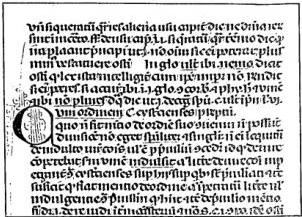
LATIN PALAEOGRAPHIC ABBREVIATIONS – A. legal abbreviations in a Bolognese manuscript of the 14th century. Bibl. Vaticana: Cod. Vat. lat. 1456, fol. 13'. Novella Johannis Andreae super Decretalibus.
TRANSCRIPTION: un(de) si queratu(r) q(ua)r(e) res ahena usu capit(ur), dic ne d(omi)nia ver(um) | sint i(n) ince(r)to. ff. [= Digestum] de usu cap(ione) l(ex) I. Si q(ue)ratu(r) q(ua)r(e) t(r)e(n)nio, dic q(uod) | ita placuit p(r)incipi, ut l(ex) « No(n) o(mn)iu(m) », sic e(n)(m) poterat plus | min(us)ve statuere. Osti(ensis). In glo(sa) ult(ima) ibi « Nemo » dicit Osti(ensis) q(uod) lex ista intelligit(ur) cum ip(s)e imp(erato)r non r(espo)udit | s(ed) ei(us) p(ro)ceres, s(ecundum) Accur(sium), ibi in I glo(sa). (Con)vor(dant) B(eruardus) et Phy(lippus) h(ic) (et) Vin(entius). | (Et) ibi « No(n) plures », d(e) q(u)o dic ut i(ufra), de cog(na- tione) sp(irit)u(all), c(apitulo) ult(imo) i(n) p(r)in(cipio) l(ibri) VI. C u m o r d i n e m. C(assa) Cyst(er)cienses p(er) r(escri)ptu(m), | quo n(on) fit m(en)tio de ordi(n)e sua, (con) veniri n(on) possu(n)t. | Divisio(n)e no(n) eget sp(ect)oliter et sing(u)(l)urite)r. N(on) e(n)(m) loquitu(r) | de indulto iur(is) co(mmun)is, v(e)l c(um) p(er) p(r)ivil(eg)iu(m) (con) cedit(ur) id q(uod) de iure | co(m)petebat s(ecundu)m Vin- c(entium). « Indulist » a(u) litt(er)e de iure co(mmun)i imp- | etrant(ur) (contro) Cyst(er)cienses sup(er) hiis sup(er) q(ui)b(us) s(un)t p(r)ivil(eg)iati, (et) t(un)c | sufficit q(uod) fiat mentio de ordine. A(u) t(m)petra « n » tu(r) litt(er)e v(e)l | indulgentie (contro) p(r)ivill(eg)iu(m) q(uod) h(abe)ut (et) t(un)c de p(r)ivil(eg)io m(en)tio | f(er)i d(eb)et; i(ufra) de re iudic(ata) « I(n)t(er) mo(n)asteriu(m) » (et) no(to) s(upra) c(aput) I (Com)po(stellanus). Ide(m) Osti(ensis).
Whereas in documents the a. generally comprise only a few technical terms (e.g.: heredes, successores, actum, subscripti). Examples of abbreviated nomina sacra, however, are already found in Christian papyri of the 2nd and 3rd centuries (v. BEATTY CHESTER; NOMINA SACRA).
After the use of notae iuris had ceased on the European continent as a result of the repeated prohibitions by the senate and the emperor against using them in books to be submitted in legal proceedings, the Roman system of abbreviation continued to develop in a particular way in the Irish schools, where new forms were coined; some of these, beginning in the 8th century, spread throughout the rest of Europe in manuscripts of every kind. From that time onward the a. became increasingly numerous, reaching their maximum frequency in the Gothic script of the 14th century, and especially in juridical, theological, philosophical, and medical texts.
The study of the a. thus has a twofold purpose: a practical one, in order to read ancient texts accurately, and a scientific one, as an important element in the criticism of manuscripts through observation of the typical local forms found in certain specific writing centers and of their diffusion. Often, through the study of abbreviated forms (and of the systematic errors resulting from their misinterpretation), it is also possible to determine the time and place of writ-