
CORSIVA, SCRITTURA. – By s. c. is meant writing traced rapidly, currenti calamo, as opposed to upright or formal writing.
I. IN GREEK PALEOGRAPHY
In Greek antiquity, from the 3rd century B.C. onward, alongside the uncial (v.) there is a more cursive type of writing, which was used for ordinary correspondence, contracts, wills, receipts, notes and, in short, for all the affairs of daily life. This type of writing, called c., is distinguished from uncial by the fact that the letters display certain characteristics resulting either from the scribe’s carelessness or from the desire to raise the pen as little as possible, in order to write with greater speed; thus some letters are drawn with fewer strokes than their corresponding uncial forms (eta in two strokes instead of three: h for H; tau in a single stroke instead of two: v for T); others are joined together by a stroke connecting the last part of one letter with the first of the following one; the angles are sometimes rounded, sometimes narrowed or made to disappear; certain strokes are simplified, shortened or even suppressed altogether. But, leaving aside the distortions that logically result from this, the fundamental form of the letters in c. w. remains the same as in uncial writing: it is essential,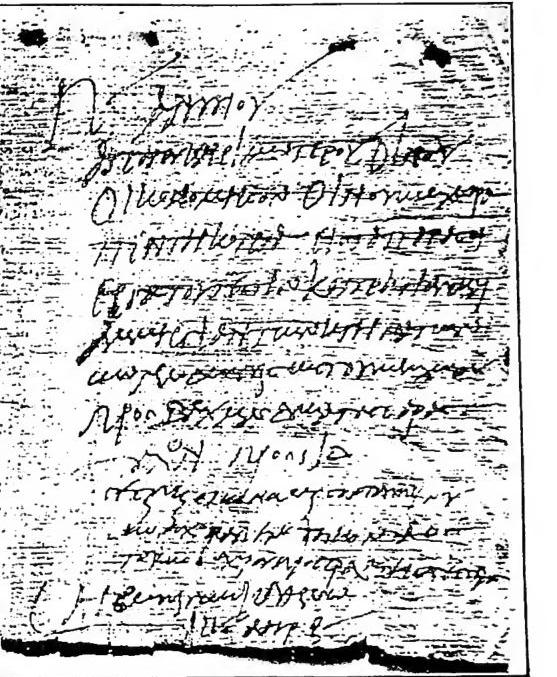
therefore, not to confuse c. w. with minuscule (v.), which is a distinctly Byzantine product.
The oldest datable examples of Greek c. w. that have come down to us date approximately from the middle of the 3rd century B.C.; but it is extremely difficult, if not actually impossible, to establish a clear dividing line between uncial and c. w., since the transition between the two types is imperceptible. Some uncial papyri of the 3rd century B.C. also display characteristics of c. w.: H and T in the form already mentioned (h and v), and various ligatures between the letters. It can therefore only be stated that in the 3rd century B.C. c. w. was fully developed.
As found in papyri, ostraca, wax tablets, etc., c. w. is usually divided into three phases, corresponding to the three different dominations that Egypt underwent after the fall of the ancient Egyptian empire: the Ptolemaic, from 323 to 30 B.C.; the Roman, from Augustus’s conquest to the end of the 3rd century; and the Byzantine, up to and beyond the date of the Arab conquest (640–43). Each change of domination corresponds to a change in the general character of c. w., owing to the influence of the official writing of the period (cf. E. M. Thompson, p. 151). Attempting, however, to classify c. w. from the 3rd century B.C. to the 8th century A.D. is an almost futile undertaking, as is the case with the writings of our own day, because cursive writing, except in official acts, is naturally too subjective in other documents; consequently, even in the more recent centuries, alongside new forms of the letters, ancient ones are encountered. In any event, in very general terms, the c. w. of the Ptolemaic age, as seen in papyri of the 3rd and 2nd centuries B.C. (there is no material with which to judge the general characteristics of that of the 1st century B.C.), displays very simple and unmistakable forms in comparison with those of the Roman period, which are rounded and flexible. The c. w. of the Byzantine period, on the other hand, is characterized by an artificiality of forms, revealed in the exaggerated length of the strokes of certain letters, projected upward or downward into the spaces between the lines: in those who wrote, one observes an effort toward originality. The minuscule would subsequently arise from Byzantine-style c. w.
II. NELLA PALEOGRAFIA LATINA
S'incontrano formecorsive quasi per ogni tipo di scrittura. Si rinvia perciò alle singole voci, e, in particolare, a minuscola c.