
ONCIALE e SEMIONCIALE, SCRITTURE. — The term “uncial” is first found in use by St. Jerome (preface to the Book of Job: PL 28, 1142), apparently to indicate in general the large-sized majuscule script. With this meaning it is still encountered in the ninth century, in a letter of Lupus of Ferrières (PL 119, 448), then in an anonymous commentary on Donatus’s Ars from the tenth century (cf. H. Hagen, Anecdota Helvetica [Gramm. lat. ex recens. Keilii, Supplement], Leipzig 1870, p. 221 ff.; cf. L. Traube, Vorlesungen und Abhandlungen, III, Munich 1920, p. 116 ff.), and in a passage of the anonymous biography of St. Severus, bishop of Ravenna, from the eleventh century (cf. Rostagno [V. BIBLICA.], p. 167).
For the ancients, then, it is probable that the word uncial did not designate a script very different from capital script. Modern palaeographers, however, do not agree on the origin and true meaning of the term: some derive it from uncia (the twelfth part of a foot), which would have given its name to the script because of the height of the letters, or because they occupy one-twelfth of a column (Hatch); others derive it from uncus, or even from uncinus, on account of the curved form of some of the letters (Allen), or from the form of the ancient conventional sign for the ounce (Barone); still others maintain that, in the formation of the term from uncia, the similarity between the form of certain letters and an uncus may have exerted an influence (Madan). In reality, even the most recent studies have not reached a satisfactory conclusion. In any case, from the work of the Maurists (Nouveau traité de diplomatique, II, Paris 1755) onward, the term “uncial” has conventionally designated a type of script in which certain capital letters have rounded their square forms. It would therefore be more accurate to speak of “uncial letters” than of “uncial script.” It should nevertheless be borne in mind that, in relation to Greek palaeography, the word “uncial” designated the majuscule script of papyri and parchments, as opposed to the epigraphic type, while in relation to Latin palaeography it designated the majuscule book script (which does not, however, exclude lapidary examples), tending toward rounded forms, as opposed to capital script.
The term “semi-uncial,” likewise established by the Maurists for a script found only in Latin palaeography, was intended to indicate a dimensional and genetic relationship between this script and uncial; and although the genetic relationship is now rejected, the word is traditionally preferred to other terms proposed by various scholars, which lend themselves to new misunderstandings.
I. IN GREEK PALAEOGRAPHY
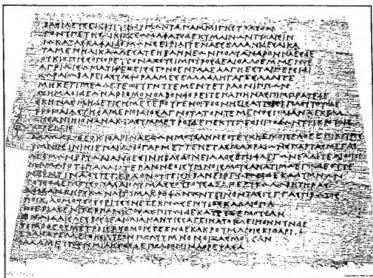
The uncial script arose or developed when writing passed from the materials proper to epigraphy to papyrus, and from the chisel to the reed pen; its principal centre of formation appears to have been Alexandria. It is considered separately according to whether it was written on papyrus or on parchment, because the writing material considerably influences the form of the letters; papyrus does not permit strokes to be rounded as well as parchment does; moreover, on papyrus they are more or less of the same thickness, whereas parchment favours the contrast between thick and thin lines.Ade U. Widemanitz-Mulendorf, Der Timotheus Papyrus [Wissenschaftliche Veröffentlichungen der deutschen Orient. Gesellschaft, 2], Lipsia 1901, no. 21
ONCIAL AND SEMI-UNCIAL SCRIPTS - Greek uncial on papyrus (4th century B.C.): Timotheus, The Persians, col. V.
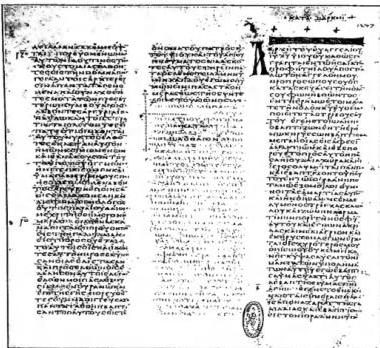
On parchment, the oldest manuscript in uncial is the Ambrosian Iliad (3rd century A.D.), of which, however, only a little more than fifty fragments remain, written on the reverse of as many miniatures, cut from the original codex by some vandalistic collector. Immediately following are three manuscripts of the Bible—the Vaticanus, the Sinaiticus, and the Alexandrinus—and one of the Old Testament, the Sarravianus or Colbertinus. The oldest among these appears to be the Vaticanus, to be assigned to the first half of the 4th century; then comes the Sinaiticus, in all probability from the second half of the same century; the Alexandrinus and the Sarravianus belong to the 5th century.
In the oldest manuscripts uncial is extremely pure and regular; almost all the letters can be contained within a circle or a square, whose side is more or less equal in length to the diameter of the circle. Later, however, uncial is transformed and deformed: the squares take the form of rectangles; the circles flatten and become smaller or expand disproportionately; the angles are rounded, the strokes gradually lose their rigidity, and some occasionally extend almost in an attempt to join the adjacent letter. At the same time as this transformation of ancient uncial, the practice of accenting texts begins. Finally, in the 9th century, minuscule script (v.) into books, uncial begins to fall out of common use and in subsequent centuries is employed almost exclusively in liturgical texts: through a return to archaism, it then once again becomes upright, elegant, and stylized, proceeding with a certain uniformity.
II. IN LATIN PALEOGRAPHY
I. Origin. — The lively discussions concerning the origin of Latin uncial cannot yet be said to have reached a conclusion. Traube, presenting it as “Christian script,” reduced it to a direct imitation of Greek uncial, through the earliest Latin versions of Holy Scripture. Schiaparelli, having noted the presence of rounded forms of a, d, e, and m (the “characteristic” letters of Latin uncial) in third-century documents in which the alphabet has capital forms alongside cursive forms, denied this direct derivation and, classifying this mixed script under the name of “archaic half-uncial,” identified in it a transitional type which, in the age of Diocletian, a period of maximum expansion of Latin culture and of closer contact with the Greek spiritual world, would have given rise to uncial and half-uncial. Finally, Marichal, summarizing the theses of the latest French palaeographical school concerning the “primitive minuscule” (that is, the book minuscule which is supposed to have developed from the “degenerated capital” and which in practice is identified with half-uncial), derives uncial from this script, as an artificial product that restores to the “familiar” forms of the minuscule the solemnity of the capital.In truth, none of the theories mentioned above possesses the force of proof. Schiaparelli’s observations rule out the direct derivation of Latin uncial from Greek uncial; nevertheless, the fact remains that there were undeniable contacts between the two scripts and that uncial was used markedly more often for sacred or liturgical texts. On the other hand, archaic half-uncial
[Ist. Ent. Coll.]
ONCIALE E SEMIONCIALE, SCRIPTS - Greek uncial on parchment (4th century). End of the Gospel of Matthew, beginning of the Gospel of Mark - Vatican Library, cod. Vat. gr. 1209, p. 1277.
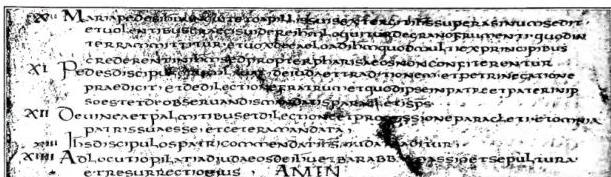
2. Characteristics. - Uncial appears as a majuscule script, in which, however, bilinearity is not as rigorous as in capital script. Most of the letters retain the capital form, with a somewhat freer and rounder ductus; a, d, e, m appear in the characteristic form recognized by the treatises as proper to uncial; h and q are minuscule in form. Semuncial, on the other hand, is a minuscule script that retains some majuscule elements (almost always n: sometimes g and e [in the o form]; rarely r and s). The a now assumes the open form, already found in cursive, now the closed form, considered characteristic; the g, alongside the characteristic form (derived from cursive), also displays a tailed majuscule form; the i is sometimes tall; the m has its first two strokes straight and the third bent back; r and s, when not in majuscule form, display a form reminiscent of cursive; t has a rounded descending stroke.
(from Monumenta paleographica sacra. Allente paleografico-artistico... edited by F. Carta, C. Cipolla and C. Frati, Torino 1926, pl. III)
ONCIALE E SEMIONCIALE, SCRITTURE - Scrittura o. latina su pergamena (sec. VI-VII). Evangelario e Lezionario - Torino, Biblioteca nazionale, cod. F. VI. I, 61.
3. Datazione
I criteri fissati per la datazione dell'o. dallo Chatelain e dal Lowe, e della s. dallo Chatelain, hanno un valore relativo, in quanto si basano su un gruppo piuttosto scarso di codici sicuramente datati e prescindono dalla localizzazione.Per l'o. in genere i codici del sec. IV e v presentano nelle lettere aste che superano il rigo inferiore ma non quello superiore; la b ha l'anello superiore appena accennato; l'inferiore assai pronunciato; f, p, t sono molto strette (la t ha il tratto superiore ondulato); l ha la base piccolissima e senza coda; m, n, u sono molto larghe (la m ha la prima asta quasi dritta, la n l'asta obliqua assai marcata); la p ha la pancia piccola e aperta. Nel sec. VI la f ha i tratti orizzontali di uguale lunghezza; la l ha la base con una piccola coda; la t ha il tratto superiore più lungo, talora incurvato a sinistra; la n ha un trattino di coronamento sull'asta di destra; la p e la r hanno la pancia ancora aperta, ma più larga. Nel sec. VII si sviluppano i trattini di coronamento (h, l, n [anche sull'asta di sinistra]; la base della l è molto sviluppata); la pancia della p è quasi sempre chiusa; la t incurva il tratto superiore anche a destra. Nel sec. VIII i trattini di coronamento si allungano; la m ha la prima gamba incurvata fino a chiudersi sull'asta di mezzo; questa poggia su una lineetta orizzontale; la n ha il tratto intermedio quasi orizzontale; la pancia della r scende oltre la metà dell'asta verticale.
Per la s. nel sec. V la a è di dimensioni più piccole delle altre lettere; la e è di forma onciale, la n è maiuscola e con la prima gamba alquanto più lunga; la pancia della q è sviluppata in larghezza più che in altezza; mancano tratti di coronamento; frequenti i legamenti li e ci. Nel sec. VI la e ha talora forma minuscola; la g e la n forma maiuscola o minuscola; la t ha il tratto inferiore rotondo; li non sono in legamento. Nel sec. VII si portano sulle aste ascendenti e discendenti i trattini di coronamento; la m lo ha sempre nella gamba mediana, talvolta anche nella prima; la t si trova a volte di forma alta. Nel sec. VIII si sviluppano ancor più le tendenze notate nell'età precedente; l'asta inferiore della r è dritta. - Vedi tav. VIII.
papiri, in Miscell. G. Mercati, VI (Studi e testi, 126), Città del Vaticano 1946, pp. 105-21; G. Cencetti, Vecchi e nuovi orientamenti nello studio della paleogr., in La Bibliofilia, 30 (1948), pp. 4-23 (particolarmente pp. 14-17); R. Marichal, De la capitale romaine à la minuscule, in M. Audin, Somme typographique, I, Parigi 1948, pp. 63-111 (particolarmente pp. 67-70 e 93); G. Battelli, Lezioni di paleografia, 3ª ed., Città del Vaticano 1949, pp. 72-87; R. Marichal, L'écriture latine et l'écriture grecque du Ier au VIe siècle, in L'antiquité classique, 19 (1950), pp. 113-142 (soprattutto pp. 123-33); A. R. Natale, Il codice e la scrittura, in Problemi e orientamenti critici di lingua e letteratura classica, a cura di F. Bignone, Milano 1951, pp. 255-59 (greca), 290-300 (latina).