
MALANKARESI

MALANKARA. — The word is in itself synonymous with Malabarese, but it is used to signify the Catholics of the Syro-Western rite on the Malabar coast to distinguish them from those of the Syro-Eastern rite, Malabarese (v.). Both are of the same origin. The term Malankara is applied to those faithful who, since 1930, have converted from Monophysitism to the Catholic Church.

The Monophysites or Jacobites of India derive from a schism that took place in 1653 among the Malabarese. In that year, nearly all the Eastern Catholics of India, dissatisfied with the severe regime of the Jesuit Latin bishops, temporarily separated themselves from the Catholic Church. Those who, under the leadership of the archdeacon Thomas de Campo, persisted in separation passed under the obedience of the Jacobite patriarch of Antioch. The archdeacon sought help from him, and in 1665 the latter sent a Jacobite bishop. Thomas was consecrated bishop and was obliged to anathematize Nestorius and accept the strict Monophysitism of Severus. His followers also adopted the rite of the patriarch of Antioch, that is, the Syro-Western rite. A portion of the Jacobites of India reunited with the Anglicans at the beginning of the 19th century. Their clear separation from their coreligionists occurred in 1837. At the beginning of the 20th century, another division struck the Jacobites of India. About half of them withdrew in 1909 from obedience to the patriarch of Antioch to declare themselves independent and subsequently gave their own metropolitan the title of katholikos. From this latter group come the Catholic Malankara. To escape the impasse caused by the rupture with Antioch, negotiations with Rome were initiated and concluded in 1930. Two bishops converted: Mar Ivanios, bishop of Bethany, and Mar Theophilos, bishop of Tiruvalla. By the end of 1931, already 35 priests, 19 religious, 6 seminarians, 39 sisters, and 470 faithful had passed to the Catholic Church. On June 11, 1932, Pius XI, with the apostolic constitution Christo Pastorum Principi, erected an ecclesiastical province immediately subject to the Holy See. Mar Ivanios was appointed metropolitan of Trivandrum and Mar Theophilos his suffragan as bishop of Tiruvalla. In 1937, another bishop, Mar Severios, became Catholic.

The Malankara Church has had rapid development. Today it numbers 58,537 faithful, 113 priests, 34 religious (Confraternity of the Imitation of Christ of Bethany), 291 churches and chapels. There are two congregations of sisters: that of Bethany for the education of young women with 18 members, and that of the Daughters of Mary for teaching catechism to the poor with 18 sisters and 24 novices.

There are 66 schools and a small seminary of St. Louis for the formation of the clergy. The theologians study in interritual seminaries; 12 Carmelites and 8 Franciscans collaborate with the indigenous clergy. The Jacobites still number about 300,000, and 100,000 “reformed,” a group that originated in the second half of the last century.
Bibl.: M. Ivanios, The Malabar reunion, in *Pax*, 114 (1931); Placida a S. Joseph, *De fontibus iuris ecclesiastici syro-malankarensium commentarius historico-canonicus* (Sacred Congregation for the Eastern Church, Oriental Canon Law Codification, Sources, 2nd series, 8), Vatican City 1937; E. Tisserant, *Syro-Malabare* (Edilie), in *DTC*, XIV, 11, cols. 3089-3162; G. Ettumano Karam, in *L'Oriente cristiano e l'unità della Chiesa*, Rome 1942, p. 34 ff.; Guglielmo de Vries.

THE MALANKARA RITE. — It is nothing other than the rite of the Syro-Westerners adopted in India by the Malabarese who had separated from union with Rome. In 1665, Thomas Parambil received episcopal ordination from Mar Gregorios, Syro-Jacobite archbishop of Jerusalem.

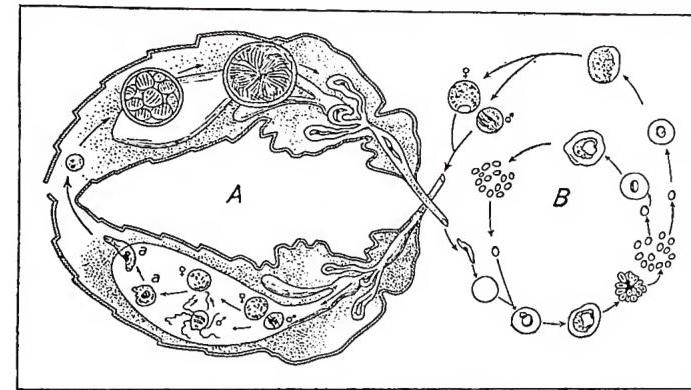
The parasites causing human malaria belong to the genus *Plasmodium* of the family Plasmodiidae. The Plasmodiidae may be defined as parasites of the blood cells and other cells of the organism, in whose life cycle there occurs an asexual phase (schizogony), which takes place in a vertebrate host, and a sexual phase (gamogony), which occurs in an insect vector. Some species of *Plasmodium* cause, in addition to human malaria, malaria in monkeys, bats, birds, reptiles, and even amphibians. Those specific to humans are *Plasmodium vivax*, *P. malariae*, and *P. falciparum* (immaculatum), which cause tertian fever, quartan fever, and malignant or estivo-autumnal tertian fever, respectively.

Malaria infection in humans manifests with various types of fever, splenic enlargement, and anemia. During estivo-autumnal malaria, and more rarely in tertian and quartan infections, hemoglobinuric attacks may occur with the emission of urine containing albumin and hemoglobin; this is frequent in tropical countries. In all species of malaria, relapses occur with the reappearance of clinical symptoms and parasites that may have disappeared from the blood.

Article illustration

Relapses are distinguished from recrudescence, a term often used for attacks that occur within two months of the primary infection, while the term "recurrence" refers to attacks that occur after an interval of 7-8 months. Following a greater or lesser number of relapses, but also due to repeated infections, the picture of chronic malaria emerges, characterized by splenic enlargement, alterations of the liver, kidneys, bone marrow, and culminating in cachexia accompanied by extreme debility and severe anemia.

The epidemiology of malaria is linked to numerous and variable factors. In general, the persistence of malaria in a given locality is necessarily connected to interdependent factors, namely:
a) the presence of gametocyte carriers exposed to the bite of anopheline mosquitoes susceptible to malarial parasites;
b) the presence of anopheline vectors sufficiently numerous and sufficiently associated with humans;
c) environmental conditions, particularly temperature and humidity, suitable for the survival of the malarial parasite in the anopheline mosquito;
d) the presence of healthy individuals exposed to the bite of infected anophelines.
Consequently, malarial infection in a given locality may assume different aspects depending on the variations that may occur in one or more of the above factors.

IV. ANTIMALARIAL STRUGGLE

For this struggle, of paramount importance was the discovery that *Anopheles maculipennis*, the principal vector of malaria in Europe, was not a homogeneous species, but a group of species and races, namely: *A. maculipennis maculipennis*, the typical form of the group, which was indicated by the simple denomination *typicus*; *A. messeae*; *A. melanoon melanoon*; *A. melanoon subalpinus*; *A. labranchiae labranchiae*; and *A. labranchiae* var. *arvus*, which can bite humans only under particular conditions, so that malaria was consistently absent or only mildly endemic. However, where *A. labranchiae* (sacharo-vì) and *A. labranchiae labranchiae*, a species strictly associated with humans and which feeds

Article illustration
(photo: Istituto Superiore di Sanità) Malaria - *Anopheles gambiae*.

Article illustration

repeatedly on human blood, malaria was always in an endemic state, more or less severe. The prevalence of one or another species or race of the *maculipennis* group was linked above all to the characteristics of the water collections where larval life took place. *A. elutus* (sacharos) and *A. labranchiae labranchiae*, tolerating a certain degree of salinity in the water, prevailed in regions rich in brackish waters where malaria, consequently, reached the greatest intensity.

Integral reclamation restored malarial zones even without inducing a significant reduction in the number of anophelines, which could even increase, because in the drained and returned to agriculture lands the percentage of chlorides in the water gradually decreased following cultivation and irrigation. The aquatic environments thus became favorable for the development of species and races of the *maculipennis* group, which were poorly adapted to transmit malaria and which eventually came to predominate over the two most dangerous species, *labranchiae* and *elutus*. The regression of malaria in the Agro Romano and Pontino was therefore due, in addition to other factors (improved economic and hygienic conditions of workers, prophylactic measures, new therapeutic means), to the gradual disappearance of the principal malarial vector, *labranchiae*, following integral reclamation. With such reclamation, the malarial problem in Italy was not resolved, especially for southern Italy and the islands where *A. labranchiae* prevailed over other species of the *maculipennis* group, both in fresh and brackish waters. Moreover, the Second World War destroyed what human effort had accomplished in the redeemed Agro Pontino. Due to the flooding caused for military purposes along the Tyrrhenian coast, many areas reverted to a marshy state, the water in the flooded zones again presented a certain degree of salinity due to the spread of sodium chloride from the underlying soil, and the pernicious *A. labranchiae* reappeared, reaching the outskirts of Rome, and malaria flared up anew.

The discovery of D.D.T. (p-p'-dichlorodiphenyltrichloroethane) and its long residual action made it possible to overcome the malaria that was threateningly spreading in Italy. The anti-anopheline campaign conducted in the Agro Pontino between 1945 and 1947, which consisted of treating the inhabitants with D.D.T., resulted in the disappearance of *A. labranchiae* and, in parallel, the disappearance of malaria. Along with the anophelines, other dangerous domestic insects (flies, fleas, bedbugs, lice, etc.), insidious propagators of pathogenic germs for humans, also disappeared. With D.D.T., the antimalarial struggle entered a new phase due to its rapidity and independence from other auxiliary means, such as integral reclamation, which are not always feasible.

Sardinia and other regions of Italy soon followed the Agro Pontino in the redemption from malaria, which will long remain, for Italy, a sad memory of the past.