
MALARIA. — The generic term malaria denotes a group of infections in humans and animals caused by protozoa of the genus Plasmodium.
SUMMARY:
I. Historical and social aspects
II. Geographical distribution
III. Epidemiology and pathology
IV. The fight against malaria.I. HISTORICAL AND SOCIAL ASPECTS
From the most remote periods onward, malaria has always constituted a grave obstacle to human progress, both with regard to population and with regard to the economy and agriculture.In the 4th century B.C., the depopulation of Latium and Etruria caused by malaria had come to gravely undermine the military strength of Rome. Having abated during the imperial period, malaria later became Rome’s greatest ally against the barbarian invasions and the subsequent imperial encroachment. Ostrogoths and Huns were decimated by malaria at the gates of Rome, and a similar fate befell the Germanic armies between 964 and 1167. In modern times, several of the Napoleonic wars were influenced by malaria. In the First World War, on the Piave front alone, from April to August 1918, 22,671 cases of malaria were recorded, and the troops of other nations suffered greatly from the same cause, especially in the Balkan countries and in Africa. In the Second World War, malaria did not fail to disrupt military plans, by causing a decline in troop morale. In many areas, especially during the early stages of the war, more men were destroyed by malaria than by enemy action. The agricultural development of many regions was for a long time impeded by malaria. Italy may now be said to have been freed from this scourge, but little more than half a century ago conditions in this regard were such as to lead G. B. Grassi to write that the unity of Italy had been achieved materially, but that in reality there were still two Italies: one prosperous, non-malarial Italy, and the other declining, malarial Italy. Colonial enterprises have always found in malaria one of their gravest obstacles. The opening of the Panama Canal encountered one of its greatest difficulties, besides yellow fever, in malaria. At the time of the French colonization of Algeria, mortality from malaria had reached such figures that, in 1835, abandonment of the colony was proposed.
Even in our own day, extensive areas of Africa, India, tropical America, and many islands of the Pacific cannot be exploited because of malaria, which still prevails endemically there, annually reaping millions of human lives, keeping the populations in a state of general organic debility and psychic inertia, lowering the working capacity of individuals, and hindering the spread of the faith.
II. GEOGRAPHICAL DISTRIBUTION
The geographical distribution of human malaria is closely linked to that of mosquitoes of the genus Anopheles, which transmit II. At present malaria extends from 32° south latitude (Argentina) to 60° north latitude (Russia). Extensive areas of endemic malaria are found between 45° north latitude and 30° south latitude, in Central America, in the northernmost part of South America, in Central Africa, in southeastern Europe, in Mesopotamia, Persia, India, Ceylon, China, Indochina, Siam, Malaysia, the Philippines, and many other islands of the Pacific. A vast zone free from malaria extends through the central and southern Pacific Ocean, including the Isole Caroline, Marshall, Ellice, Samoa, Figi, Marquessa, Nuova Caledonia, and Nuova Islanda. It is noteworthy that the Isole Figi and Nuova Caledonia are free from malaria, whereas the nearby Nuove Ebridi are intensely malarial. The spread of malaria in relation to altitude is linked to the influence exerted by this factor on the life of anopheline mosquitoes. The anopheline species capable of living at considerable elevations above sea level are relatively few. In general, malaria is found at considerable elevations more often in tropical regions than in temperate ones, but the limits of its distribution from the standpoint of altitude are very broad. From the lowest area of the globe, represented by the valley of the Mar Morto, 400 m. below sea level, one reaches elevated heights such as El Tungo near Quito in the Equatore (2460 m.), and it appears that cases of autochthonous malaria have occurred in Quito itself (2850 m.). In Bolivia endemic malaria is common at an altitude of 2500–2600 m. and is found as high as 2770 m. in the region of Cochabamba. In the Andes, too, malaria reaches considerable elevations. In Africa malaria is present in the Atlantean range up to 2500 m., in regions covered with snow for more than half the year. Autochthonous cases have been reported in Ethiopia, at Addis Abeba (2450 m.), and at Londiani, in Kenia (2600 m.). In the Imalaia, malaria reaches an altitude of 2300 m. In Europe it has rarely been found above 1000 m.III. EPIDEMIOLOGY AND PATHOLOGY
The struggle against m. was for a long time a struggle against an unknown enemy, until Laveran, in 1880, first discovered the presence of protozoa of the genus Plasmodium in the blood of persons afflicted with m. and gave the parasite the name Oscillaria malariae. To Golgi, Marchiafava, and Celli is owed the discovery of different species of malarial parasites, responsible for different types of malarial infection (tertians, quartans, pernicious), and of their development in the red blood cells. In 1898 G. B. Grassi succeeded in proving, together with his collaborators Bignami and Bastianelli, that human m. is transmitted exclusively by mosquitoes of the genus Anopheles, and that the struggle against the onset and spread of the disease had therefore to be directed against them.The parasites responsible for human m. belong to the genus Plasmodium of the family Plasmodidae. Plasmodidae may be defined as parasites of blood cells and of other cells of the organism whose life cycle includes an asexual phase (schizogony), which takes place in a vertebrate host, and a sexual phase (amphigony), which occurs in a vector insect. In addition to human m., some species of Plasmodidae cause malaria in monkeys, bats, birds, reptiles, and also amphibians. Those specific to humans are Plasmodium vivax, P. malariae, and P. falciparum (immaculatum-), responsible respectively for benign tertian, quartan, and malignant or summer-autumn tertian malaria.
Malarial infection manifests itself in humans through the various febrile types, enlargement of the spleen, and anemia. In summer-autumn malaria, and more rarely in tertian and quartan infections, hemoglobinuric attacks may occur, with the emission of urine containing albumin and hemoglobin; this is frequent in tropical countries. Relapses occur in all species of m., with the reappearance of clinical symptoms and of parasites that may have disappeared from the blood.
Relapses are distinguished from recrudescences, a term often used for attacks occurring within two months of the primary infection, whereas the term recurrences indicates attacks occurring after an interval of 7–8 months. Following a greater or lesser number of relapses, but also as a result of repeated infections, the condition of chronic malaria emerges, characterized by enlargement of the spleen and alterations of the liver, kidneys, and bone marrow, culminating in cachexia accompanied by extreme loss of strength and intense anemia.
The epidemiology of m. is linked to numerous and variable factors. In general, the persistence of m. in a given locality is necessarily connected with interdependent factors, namely: a) the presence of gametocyte carriers exposed to the bites of anopheles susceptible to malarial parasites; b) the presence of sufficiently numerous vector anopheles, in sufficiently close association with humans; c) environmental conditions, particularly temperature and humidity, suitable for the survival of the malarial parasite in the anopheles; d) the presence of healthy individuals exposed to the bites of infected anopheles. Consequently, malarial infection in a given locality may assume different forms depending on the variations that may occur in one or more of the factors listed above.
IV. ANTI-MALARIA CONTROL
Of capital importance for this campaign was the discovery that Anopheles maculipennis, the principal vector of m. in Europe, was not a homogeneous species, but a group of species and races,namely: A. maculipennis maculipennis, the typical form of the group, which was designated simply by the name typicus; A. messeae; A. melanoon melanoon; A. melanoon subalpinus; A. labranchiae labranchiae; A. labranchiae var. atroparvus; and A. elutus (syn. sacharovi). It was found that these species and races were biologically different and therefore did not transmit m. to an equal degree. It thus became possible to explain the regression of m. that had occurred in certain regions, the phenomenon, which had remained inexplicable for many years,
of anophelism without m., and new foundations were provided for anti-malaria control. Where A. maculipennis typicus, which does not bite humans, A. messeae, A. melanoon melanoon, and A. labranchiae var. atroparvus predominated—all of which can bite humans only under particular conditions—m. was absent, did not persist in an intensive form, or was only mildly endemic. But where A. elutus (sacharovi) and A. labranchiae labranchiae predominated, species closely associated with humans and therefore repeatedly feeding on human blood, m. was always present in a more or less severe endemic form. The prevalence of one or another species or race of the maculipennis group depended above all on the characteristics of the water bodies in which the larval stage took place. A. elutus (sacharovi) and A. labranchiae labranchiae, tolerating a certain degree of water salinity, predominated in regions rich in salt water, where m. consequently reached its greatest intensity.
Comprehensive land reclamation sanitized malarial areas even without causing a substantial reduction in the number of anopheline mosquitoes, which could even increase, because in the drained lands restored to agriculture the percentage of chlorides in the water gradually decreased as a result of cultivation and irrigation. The aquatic environments thus became favorable to the development of the species and races of the maculipennis group that were poorly adapted to transmitting m. and eventually gained the upper hand over the two most dangerous species, labranchiae and elutus. The regression of m. in the Agro Romano and Agro Pontino was therefore due, in addition to other factors (improved economic and hygienic conditions among the workers, prophylactic measures, and new therapeutic methods), to the gradual disappearance of the principal malarial vector, labranchiae, following comprehensive land reclamation. Such reclamation in the Agro Pontino did not, however, resolve the malarial problem in Italy, particularly in southern Italy and the islands, where A. labranchiae predominated over the other species of the maculipennis group both in fresh and in salt water. Moreover, the Second World War destroyed what human effort had achieved in the reclaimed Agro. Because of the flooding carried out for military purposes along the Tyrrhenian coast, many areas returned to a marshy state; the water in the flooded areas once again acquired a certain degree of salinity owing to the spread of sodium chloride from the underlying soil; the dreaded A. labranchiae reappeared, reaching the outskirts of Rome, and m. flared up again.
The discovery of D.D.T. (p-p²-dichlorodiphenyltrichloroethane) and its prolonged residual action made it possible to overcome the m. that was spreading threateningly through Italy. The anti-anopheline campaign conducted in the Agro Pontino between 1945 and 1947, consisting in treating inhabited areas with D.D.T., resulted in the disappearance of A. labranchiae and, in parallel, in the disappearance of m. Along with the anopheline mosquitoes, other dangerous domestic insects also disappeared (flies, fleas, bedbugs, lice, etc.), covert transmitters of pathogenic germs harmful to humans. With D.D.T., anti-malaria control entered a new phase, owing to its speed and its independence from other auxiliary means, such as comprehensive land reclamation, which could not always be implemented.
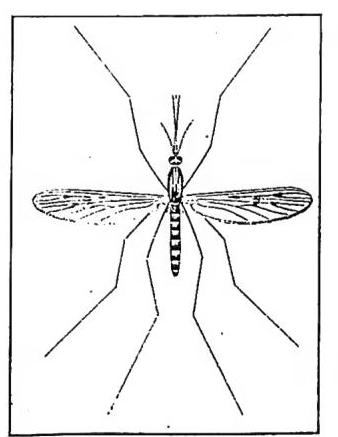
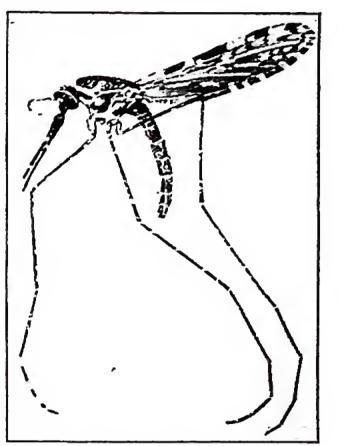
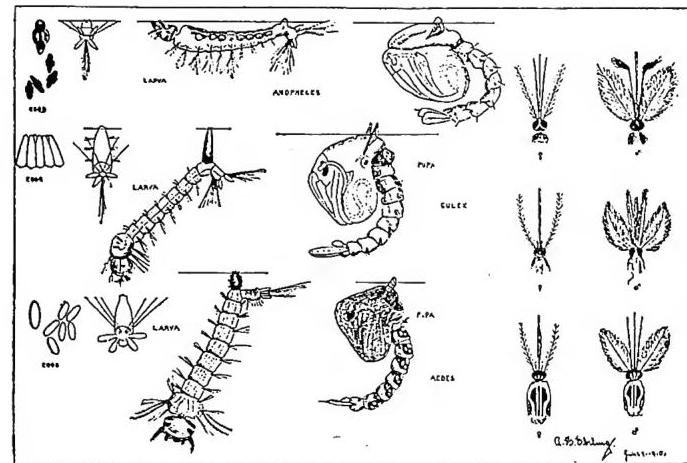
MALARIA - Developmental studies of the genera Anopheles, Culex, Aedes. Note the different positions assumed by the larvae of the three genera with respect to the surface of the water. On the right: various aspects of the palps in the males (♂) and females (♀) of the three genera.
Important successes in the fight against malaria through the use of D.D.T. are being reported from all parts of the world. In Greece, the region of Europe most severely affected by malaria, this disease no longer constitutes a serious problem for the health authorities. In Argentina, Bolivia, Brazil, Peru, Venezuela, and India, the curve of malaria cases and of the related mortality is declining. The African continent, too, is on the right track.
BIRL.: G. B. Grassi, Studi di uno zoologo sulla m., in Atti della R. Acc. dei Lincei (Mem. Classe scienze fis. matem. e natur., 5ª serie), 1900, p. 3; A. Celli, La m., Torino 1934; L. La Face, Le malattie trasmesse dagli arropodi e i recenti sviluppi della entomologia medica, in Rend. Ist. Sup. di Sanità, 5 (1942), pp. 335-341; R. R. Strong, Stitt's diagnosis, prevention and treatment of tropical diseases, Londra 1945; A. Masirolli, E. Mosna, M. Alessandrini, La lotta antianofetica nell'Agro Pontino. Rapporto per gli anni 1945-47, in Rend. dell'Ist. Sup. di Sanità, 11 (1948, III), pp. 759-90; G. Gramiccia, Sulle recenti scoperte relative ad alcune forme di sviluppo degli sprozoiti di Plasmodium cynomolgi e di Plasmodium vivax, ibid., 11 (1948, IV), pp. 841-57; M. P. Boyd, Malariology, Filadelfia e Londra 1949; E. J. Pampana, Lutte antipaludique par les insecticides à action permanente. Résultats des grandes campagnes, in Bull. Org. Mond. de la Santé, 3 (1951), pp. 557-618. Lidia La Face