GONÇALVES DA SILVEIRA, GONÇALO, Venerable. – Jesuit, missionary, and martyr, born into a noble family at Almeirim (diocese of Lisbon) on 23 February 1526, died at Monomotapa (Zambezi) on 15 March 1561.
He entered the Society in 1543 and was sent to Goa as provincial of the Indian mission in 1556. He so vigorously promoted missionary activity that, during the three years he remained there, 7,000 pagans were baptised in the city alone. His success led to his being chosen for an even more unexplored field in south-eastern Africa, the region of Mozambique, in present-day Rhodesia, where missionaries had been requested by the son of a Cafre king, who had been baptised at Mozambique. Gonçalves da Silveira, having disembarked on 11 March 1560 at Sofala, pushed inland as far as Otongwe, where Gamba, king of the Maharanga, resided. Within seven weeks, he succeeded in baptising the king, his entire court, and many other pagans, numbering up to 400. He then left Otongwe in the care of his companion, Fr. Fernandez, and proceeded to the kingdom of the “king of gold,” Monomotapa, on the banks of the Zambezi, to bring it to the faith. He succeeded in this, even with the cooperation of the Portuguese, and by the end of 1561 had baptised the king and his court; by the following March, the number of Christians had risen to 300. This aroused the envy of the Muslims, who feared that their trade would be taken over by the Portuguese. They easily induced the king, still weak in faith, to believe the most absurd calumnies against Gonçalves da Silveira, portraying him as a sorcerer who had killed all and as an advance spy of the Portuguese army. Frightened, the king had the missionary strangled outright. The expedition sent to avenge his death
SILVEIRA GONÇALVES – SILVESTRI FRANCESCO
594
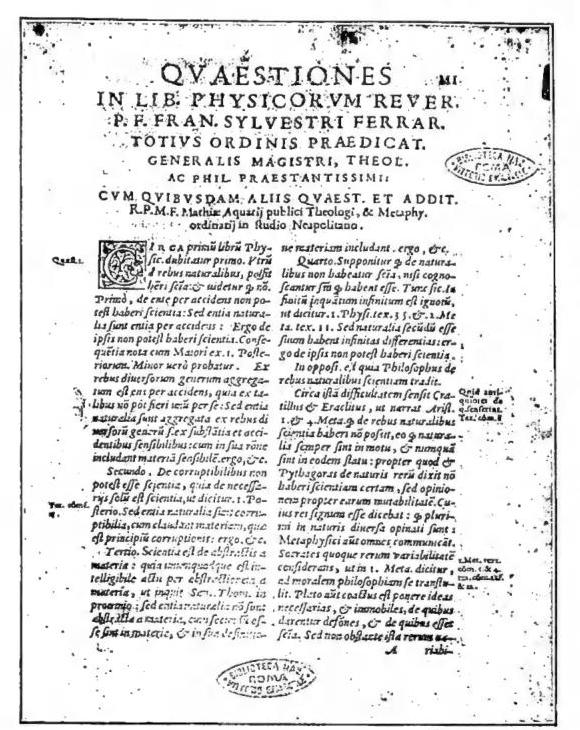
QUESTIONS
ON THE BOOKS OF THE PHYSICISTS
BY THE MOST REV.
P. FRANCISCO SYLVESTER OF FERRARA
OF THE WHOLE ORDER OF PREACHERS,
A MOST DISTINGUISHED THEOLOGIAN AND PHILOSOPHER:
WITH OTHER QUESTIONS AND ADDITIONS
BY THE VERY REV. MATTHEW OF AUGULI, PUBLIC PROFESSOR OF THEOLOGY, AND OTHERS
Silvestri, Francesco, called “il Ferrarese” (Ferrariensis) – Beginning of the Quaestiones in libros physicorum, Rome, printed by A. Blado, 1576. Copy from the Biblioteca Nazionale – Rome.
He never reached his destination, and the mission had to be interrupted for lack of missionaries who at that moment could continue the work begun by St.
Silveiro, Pope St. — Born in Frosinone, son of Pope Hormisdas, he was elected pope in June 536 through the intervention of the Gothic king Theodahad, despite being a subdeacon and despite the opposition of the clergy.
His brief pontificate was embroiled and troubled by the political and religious struggles that were disturbing Italy at the time, and St. Silveiro fell victim to them. Shortly after his election, his protector Theodahad died, and Belisarius occupied Rome (q.v.) on behalf of the Byzantine emperor, driving out the Gothic king Vitiges. The latter returned in the following February, laying siege to Rome for about a year, during which he devastated churches and cemeteries, especially in the region of the Salarian Way, where he had encamped.
Meanwhile, during the siege, the deacon Vigilius arrived in Rome from Constantinople, where he was apocrisiarius, with letters from Empress Theodora recommending to Belisarius that he work to have Vigilius elected to the papal see. It appears that Vigilius had promised Theodora to restore to the Church of Constantinople the patriarch Anthimus, already deposed by Pope Agatho, and especially to annul the decisions of the Council of Chalcedon. Belisarius, eager to obey the empress but at the same time unable to depose the legitimate pope, who had in fact welcomed him, summoned St. Silveiro to his palace and tried to persuade him to accede to the imperial requests. Naturally the pope refused; recourse was then had to calumny, and a supposed letter of St. Silveiro to Vitiges was circulated, in which he allegedly promised to deliver Rome by opening the Asinarian Gate near the Lateran to him. Belisarius summoned St. Silveiro again, who easily cleared himself of the calumny, and to remove all suspicion and pretext from his enemies he went to live near the church of St. Sabina. The intrigues against him, however, did not cease; in March 537 he was summoned for the third time to Belisarius’s palace, and while his clerics were detained in the anteroom, St. Silveiro was brought in accompanied only by Vigilius. Suddenly a deacon stripped him of his pallium, while two others clad him in a monastic habit. The waiting clerics were then told that St. Silveiro was no longer pope and that they should think of electing a successor—naturally Vigilius was the one chosen! St. Silveiro was sent into exile at Patara in Lycia; there he was able to inform the local bishop of the true state of affairs, and the latter, boldly acting as a saint, went to reproach Justinian for the atrocious crime. The emperor then ordered that St. Silveiro be brought back to Rome and subjected to a regular trial, but on his arrival in Italy he was handed over to Vigilius, who had him confined on the island of Palmaria, where he died of hardship and hunger. His tomb became a place of pilgrimage, and the Lord also worked miracles there. In the Roman Martyrology St. Silveiro is commemorated on 20 June, but this is an arbitrary date established by Ado.
Agostino Amore
Silvester, Lebedinski. — A Russian ecclesiastical theologian and writer of the 18th century. Born on an unknown date in southern Russia, he died at Astrakhan on 5 November 1808.
He studied at the ecclesiastical academy of Kiev. In 1791 he was elected rector of the seminary at Astrakhan, in 1794 of the seminary at Kazan, and on 25 July 1797 the first rector of the ecclesiastical academy at Kazan. In 1799 he became bishop of Poltava and Pereyaslavl, and in 1807 archbishop of Astrakhan.
S. composed in Latin a manual of theology for seminaries: Compendium theologiae dogmaticae (1st ed., St. Petersburg 1799; 2nd ed., much enlarged, Moscow 1805). In theology he follows the Protestantizing direction of Theophan Prokopovich, admitting for faith only Holy Scripture, while councils cannot establish unchangeable dogmas and oral tradition is not necessary; the deuterocanonical books are excluded from the canon, etc. Other notable works (in Russian): The Incorruptible Food, 1st ed., Moscow 1789, 3rd ed. 1843; Evangelical Interpreter of the Proverbs (an interpretation of Proverbs with parallel texts of Holy Scripture for each verse), 1st ed., Moscow 1796, 4th ed. 1894.
Silvestri, Francesco, called il Ferrarese (Ferrariensis). — A Dominican theologian and philosopher, born in Ferrara in 1474, died at Rennes on 19 September 1528. At the age of fourteen he entered the religious life in his native city. After completing his studies he taught in Mantua (where he spiritually directed the blessed Osanna Andreassi), in Milan, and in Bologna. By 1516 he was already master in theology, and in 1518 vicar of the Lombard congregation.
A few years later, while he was prior, regent of studies, and inquisitor in Bologna, he was named by Clement VII vicar general of his Order (1524), and the following year was unanimously elected master general in Rome. Immediately devoting himself with great zeal to the governance of the Order and to the visitation of convents, he died three years later of an illness contracted in a river accident.
His principal work: In libros s. Thomae Aquinatis contra Gentes commentaria. It was already finished in 1517 but was not printed immediately. In 1518 Cardinal Cajetan, passing through Bologna, saw the commentary, praised it most highly, and strongly urged his confreres to publish it (1st ed., Venice 1524 [not Paris 1552, as stated in D.Ch. XIV, col. 2087]); among the ancient editions, the principal one is the Piana edition, made by order of St. Pius V (Opera omnia s. Thomae Aquinatis, Rome 1570-71). The first of the modern editions is that edited by G. Sestili (4 vols., ibid. 1897-1901), but above all the Leonine edition, made by order of Leo XIII (Opera omnia s. Thomae Aquinatis, XIII-XV, ibid. 1918-26-30).
He wrote other works, mainly philosophical: Annotationes in libros Posteriorum Aristotelis e s. Thomae (Venice 1535); Quaestionum libri de anima quam subtilissimae et praeclarissimae decisiones (Venice 1535); Apologia de convenientia institutorum Romanae Ecclesiae cum evangelica libertate tractatus adversus Lutherum (Rome 1525; 2nd ed., Rome 1900, edited by G. Sestili).
Michele Pio reports that S. had undertaken a commentary on the Summa Theologica as well but desisted from it when he became aware of Cajetan’s commentary. And this was a loss, because although the Ferrarese is inferior to Cajetan in speculative power, he remains nonetheless an acute, intelligent, and broad-minded Thomist, though also a personal one, dissenting often openly from his illustrious confrere (e.g., on the nature of the intellect, of analogy, of individual signation, and of the possibility of more than one angel of the same species).
The Ferrarese also shows a personal note on less important questions, such as, for example, on the natural desire for beatitude, on how the relations in God are distinguished from the essence, and what meaning is to be given to the statement of Aquinas that “Relatio (in divinis) non constituit personam in quantum est relatio.”
All these details reveal in ST. a refined scientific sensibility and a great love for objective truth. Posterity has assigned him second place in the noble ranks of commentators on St. Thomas; a position which he holds with great honour above all for his fidelity to the master, the correct understanding of his doctrines, the clarity of his exposition, and the just historical-critical method of his research.