
GIUSTI, GIUSEPPE. – Poet, b. at Monsummano on 12 May 1809, d. at Florence on 31 March 1850. Educated in his early years by a priest and subsequently at the Seminary of Pistoia and the Collegio dei nobili of Lucca, in 1834 he graduated in law from the University of Pisa. He spent almost his entire short life in Tuscany, with some periods of residence in Naples and Milan, where he was a guest of Manzoni, to whom he always felt bound by respectful friendship.
He lived the history of his time intensely and, owing to the sad privilege of acute intelligence combined with an extremely sincere character, hastened its movement by contradicting and satirizing II. Foreign domination, Italian servility, police methods, wavering consciences, and political opportunism found in him an irrepressible mocker and scourge, because he was enamoured of the idea of a homeland redeemable only through sincerely pursued motives of freedom and political morality.
A poet by instinct, he began writing verses at the age of twelve, acquiring an early reputation as a lyric poet of the “melancholy smile,” as he liked to define himself, and eliciting sympathetic approval as well as insidious criticism. Guerrazzi and Tommaseo were bitter opponents of his; his verses nevertheless circulated throughout Italy, exciting and triumphing in the popular imagination. In 1848, at the proposal of G. Capponi, he was made a resident member of the Accademia della Crusca; that same year he was appointed major of the Civic Guard and, by the electors of Borgo a Buggiano, sent as a deputy to the Tuscan Assembly. Politics, which had nevertheless animated the writer, disappointed and embittered the parliamentarian: he lacked the capacity for adaptation and the skill, required of the active politician, to move among partisan interests and egoisms.
What remains of G. is the poet and prose writer; there remain the satirical Poesie, or “jests” (dominated by the satirical note, in which the polemicist emerges, and by the elegiac note, which expresses his emotional world), and the brilliant, immediate, perfect prose works (Epistolario, Memorie inedite, I proverbi toscani, Discorso su G. Parini, etc.). Death cut short his further study of Dante.
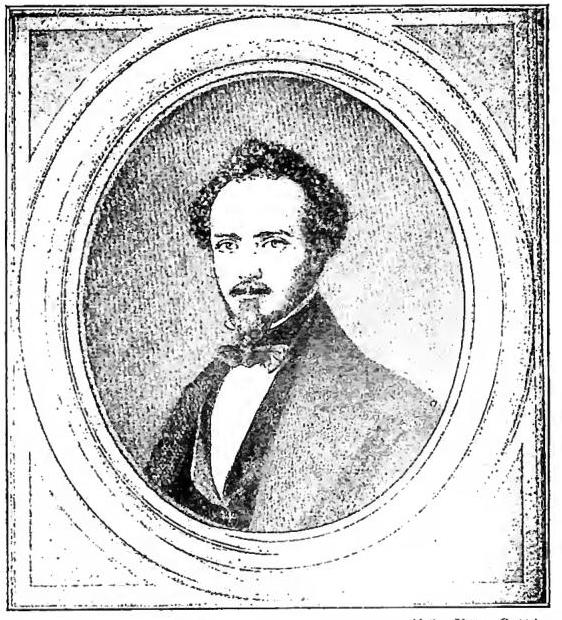
(Ist. Enc. Catt.)
GIUSTI, GIUSEPPE. — Portrait in an engraving contemporary with the poet — Rome, Museo del Risorgimento.
When G. occasionally expressed the insights of his moral world, he revealed a profound sensibility and an intellect capable of rendering in artistic synthesis the longings, sorrows, and aspirations that in the human soul are always connected with the sense of the divine. In S. Ambrogio, G., the awakener of national consciousness, rises to a conception that brings the subjugated and the subjugators together, leading them toward a Christian will to love one another under the impulse of “a desire for peace and love,” “a melancholy thought of the dear mother,” and “a dread of distant exile.” Several sonnets, such as La fiducia in Dio, Il sospiro dell'anima, and All'amica lontana, attest to that essential religiosity which, above the bewilderments of earthly experience, offers each person the redemption of moral personality.