
SESTO AL RÉGHENA, ABBAZIA di. – S. al R. is a small town (3,500 inhabitants) in the province of Udine, in the diocese of Concordia, from which it is six miles distant; hence the original name Sextus in silvi.
The Roman origin of the site is attested by various finds, such as mosaic fragments, terracotta elements, coins, and inscriptions. The Réghena River flows through it, and on its western bank the Lombard brothers Erfo, Anto, and Marco, sons of Pietro, duke of Friuli, and Piltrude, founded the Benedictine abbey (foundation charter, 3 May 762). The traces of the Benedictine work to cultivate the marshy land, clear the forests, and establish new centres of habitation are still evident. From the outset the abbey was endowed with a rich patrimony and received donations from Charlemagne, Lothair, Berengar, and other princes and faithful; it reached its greatest splendour from the 11th to the 14th century, when fifty villages and castles scattered throughout Friuli and the territories of Treviso, Verona, Vicenza, Belluno, Ancona, Trieste, and Istria depended upon II. During the 10th century, together with the bishopric of Concordia, it passed under the feudal dominion of the patriarch of Aquileia, and, like the bishopric, from the 13th century onward it had a seat in the Parliament of the Patria del Friuli, among the prelates, sharing its fortunes. Its life gradually declined until, in 1441, it was granted in commendam to Cardinal Pietro Barbo.
Today, only parts of the ancient monastery remain: buildings altered and adapted for use as the town hall, chapter house, and nursery school, as well as a tower (15th century) at the entrance to the monastic enclosure.
MONUMENTS. – Of the Basilica, attributable to the second half of the 8th century, various fragments of sculpture are preserved;
Now, beside the entrance, rooms belonging to the church and cloister have been restored and are undergoing further restoration; they contain frescoes from various periods, including the 10th–12th centuries (scenes of the Crusades). Above the entrance-atrium, a hall houses ancient sculptures and fragments and bears on its walls traces of frescoes (13th–14th centuries) that suggest the existence of a chapel perhaps dedicated to s. Michele.
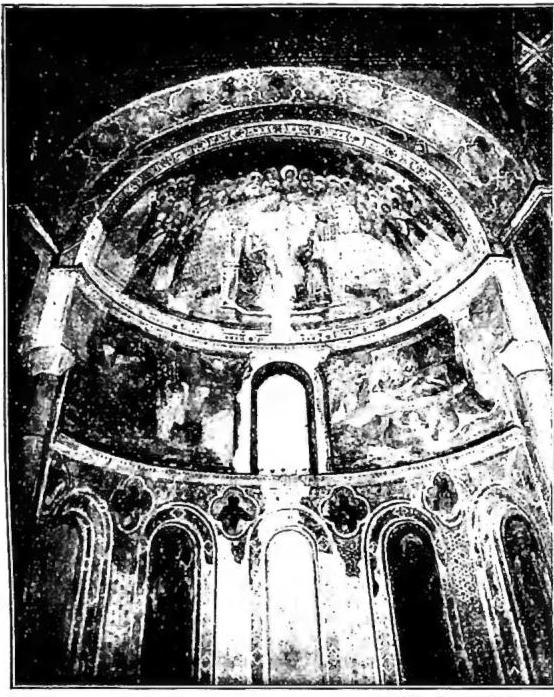
The entire Basilica was decorated with frescoes dating from the 12th to the 14th century. In the central apse is the Coronation of the Virgin, with scenes of the Annunciation of the Nativity and the washing of the Child, and below, in niches and quatrefoils, figures and busts of saints: the colour, line, chiaroscuro effect, and figures recall Giottesque models under the influence of the Bolognese school of Romagna (first half of the 14th century). In the lofty tower are episodes depicting the Virgin, s. Giuseppe, s. Giovanni Evangelista, s. Benedetto, and s. Scolastica; on the wall of the right-hand nave, beside the presbytery, scenes of s. Pietro and s. Paolo and the Tree of the Cross, whose branches bear saints of the Church and of the Benedictine Order: frescoes reflecting the taste and characteristics of the Giottesque school.
On the wall of the Basilica’s façade is a scene of the Three Living and the Three Dead, recalling a similar fresco in the cemetery of Pisa (early 14th century), as well as Renaissance frescoes (with Ferrarese influences and those of Pellegrino da S. Daniele) depicting the SS. Pietro e Paolo e Tommaso. On the wall
to the right of the entrance is Paradise, a grand and luminous fresco attributable to a narrative artist influenced by the Tuscan manner of Benozzo and Angelico (second half of the 15th century); on the opposite wall is Hell, with the drama of the damned in the most varied attitudes and divided into sections that recall Dante’s Inferno; on the wall opposite is the Archangel Gabriel, who weighs the souls on a scale while other angels usher them into paradise; schemes and scenes that revive the taste and luminosity of the primitive painters. Worthy of mention is the Gothic sculpture of the Annunciation, based on a Romanesque-Byzantine scheme (13th century).