Machine translation of the 1948–1954 Italian original. The original text is authoritative.
SESTO, SENTENZE di. - A collection of sentences that goes under the name of S.
The author is mentioned for the first time by Origen (Contra Cels., VIII, 30, p. 345, 12, ed. P. Kötschau [CB, 2], and Comm. in Matth., XV, III, p. 354, 19 sq., 25 sq., ed. E. Klostermann [CB, 11]). A Latin translation of 451 sentences was made by Rufinus, who reports a tradition according to which the author of the collection was the bishop and martyr Sixtus of Rome (Sixtus II [257-58]). St. Jerome expressed himself against this attribution, considering S. to be a Pythagorean and pagan (Ep. ad Ctesiphontem, 133, 3: PL 22, 1152; In Jeremiam, IV, 22: ibid., 24, 817 A), which, however, did not prevent him from quoting a sentence of S. with approval twice (Adv. Jervin., I, 49: PL 23, 293 C; In Ezechiel., VI, 18: ibid. 25, 173 C). The sentences of S. enjoyed a certain authority in antiquity and in the Middle Ages. In the Regola of St. Benedict, chap. 7 (p. 39 and 184, ed. Butler), a sentence is quoted. The author of the collection was certainly a Christian (probably Egyptian), endowed with a broad understanding also of Greek wisdom, and probably acquainted with similar pagan collections. That the author was a member of the Jewish sect of the Essenes is to be excluded. An ascetic tendency is undeniable.
BIBL.: in addition to the Latin translation, there are two Syriac translations, V. A. Baumstark, Gesch. der syrisch. Literatur, Bonn 1922, p. 170 and n. 6, and a translation into the Armenian language, V. T. Hermann in Zeitschr. für Kirchengesch., 1938, p. 217 sq. The Latin text and the Syriac translations (translated into Latin) were published by J. Gildemeister,
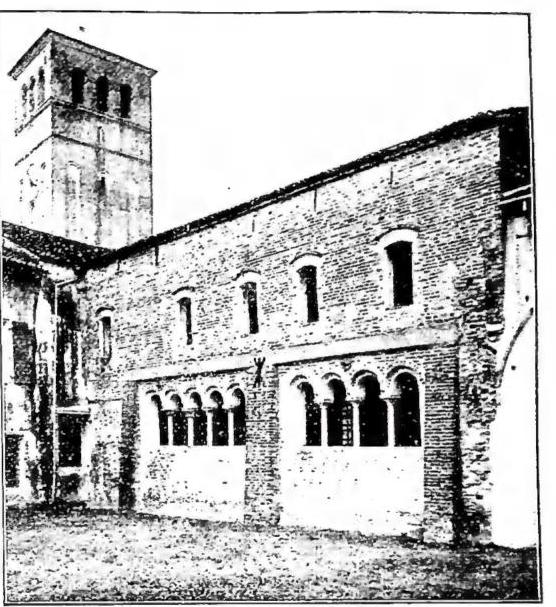
SESTO AL RÉGHENA, ABBAZIA di - Romanesque bell tower and right flank of the atrium-quadriporticus of the abbey. (photo Soprintendenza ai Monumenti di Udine)Sexti sententiarum recensiones, Bonn 1873. The Greek text was discovered and published by A. Elter, Onomica, I. Sexti Pythagorici, Clitorchi, Evagrii Pontici sententiae, Leipzig 1892. On S. in the Regola of St. Benedict, V. P. Courcelle, Les lettres gr. en Occident, Paris 1943, p. 313 and S. Brechter, in Benedictus, Vater des Abendlandes, Munich 1947, p. 135 sg. On S. in Jonas of Orléans and Sedulius Scottus, V. Manitius, II, p. 804. S. in the Summa of Praepositinus, V. Landgraf, in Collect. Francis., 1 (1931), p. 289 sg. On the attitude of St. Augustine, V. B. Altaner, in Anal. Bolland., 67 (1949), p. 236 sg. V. also W. Kroll, s. v., in Pauly-Wissowa, 2nd series, II, p. 2061 sg., ed. J. Kroll in Edg. Henneche, Neustentamentl. Apokryphen, 2nd ed., Tübingen 1924, p. 625 sg. V. also: Le S. di S. with introduction, text, and translation by F. de Paola, Milan 1937. This author affirmed that S. was an Essene.
Erik Peterson
Cite this article
“SESTO, SENTENZE DI.” Enciclopedia Cattolica, vol. XI (1953), p. 271. Azione Romana digital edition, https://azioneromana.com/article/sesto-sentenze-di.