
TINO DI CAMAINO DI CRESCENZIO DI DIOTISALVI. – Sculptor and architect, b. in Siena around 1280, d. in Naples in 1336 or 1337.
The earliest evidence of his activity is found in Pisa, where T. went, presumably as an assistant to Giovanni Pisano in the work on the pulpit of the Cathedral, and where in 1312 he sculpted the reliefs of the baptismal font. In 1315, after he had already for some time received the commission for the tomb of Enrico VII, to be erected beneath the vault of that same great church, and after having been appointed master builder of the construction, he was forced to leave the city because he had taken the side of the Guelfs and fought against the Pisans at Montecatini. In 1318 T. was in Siena, engaged, together with his father, who was also a sculptor, and others, in the construction of the Cathedral, of which he was appointed master builder between 1319 and 1320; he then went to Florence, but by 1325 he was already in Naples, where he remained until his death.
Among T.’s earliest works is the urn formerly on the altar of s. Ranieri in the cathedral of Pisa and subsequently transferred to the Camposanto. The sculpture perhaps belongs to the same period in which the young master was collaborating with Giovanni on the pulpit, and the date 1306 seems the most probable. The clear evolution of T.’s sculptural style can then be understood by comparing that marble, in which, through measured rhythms and compact forms, the figures crowd together, almost laboriously detaching themselves from the background, with his later works, such as the surviving fragments of the baptismal font and the tomb of Enrico VII. The latter, now disassembled between the Cathedral, where the sarcophagus with the recumbent figure is located, and the Museo dell’Opera, should be counted among the most significant sculptures of our fourteenth century for the vigorous, commanding vitality of its figures, especially those of the five councillors surrounding the emperor seated on his throne. Here T. introduced sculptural modes clearly distinct from those of his teacher Giovanni; in them, the figures—synthetic, rounded, defined within massive forms whose sudden changes of planes are emphasized by deep, straight recesses—have affinities with those painted by Ambrogio Lorenzetti (Toesca). Similar modes appear in the tomb of Cardinal Petroni in the Cathedral of Siena (1319–20), and in that of Gastone della Torre in the cloister of S. Croce in Florence, while in the sarcophagus of Bishop Orso, which is also in the Cathedral at Florence, the sculptor’s evolution in a refined Gothic direction is clear, leading him to individual investigations of linear rhythms that accentuate the sculptural ones and at times merge with them
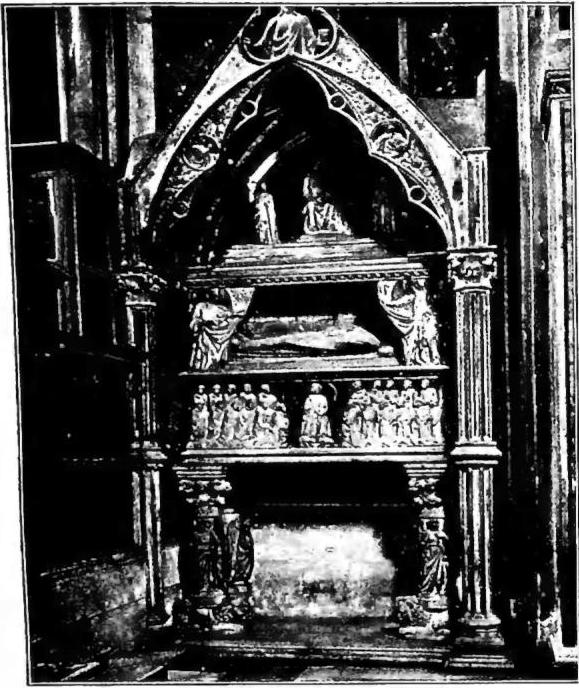
In 1324 T. was in Naples and initially collaborated on the tomb of Caterina d'Austria in S. Lorenzo Maggiore; then, together with the architect Gagliardo Primario, he erected the tomb of Maria d'Ungheria in S. Maria Donna-regina (1325). Later he sculpted the tomb of Carlo di Calabria (1335) and that of Maria di Valois in S. Chiara, both partly destroyed in the fire that consumed the church following the bombardments of 1943. In these works, as in the other works of the same period that may be attributed to him, such as the tomb of Giovanni di Durazzo in S. Domenico, one observes a stronger accentuation of Gothic inflections and a more evident search for pictorial effects in the figures that stand out against dark backgrounds.
T.'s architectural works in Naples included the cloister of S. Martino, the immense fortifications of the adjacent castle of S. Elmo, and work in the harbor.
Breaking away from the lineage of Giovanni Pisano, T., a highly original sculptor, disseminated the new forms of fourteenth-century Tuscan sculpture throughout southern Italy, while partially renewing his style there. Indeed, during his Neapolitan period, T., reacting to the artistic climate of a region that had already been open for at least half a century to French culture and art, accentuated the fluidity of the linear rhythms, which were superimposed with subtle elegance upon the coarseness of the rounded volumes of his marble works, and brought forth a series of works that rank among the most significant achievements of Italian sculpture of his time.