
SAINT-FLOUR, DIOCESI di. – City and diocese, subprefecture of the department of Cantal in France. The diocese has the same boundaries as the department, with an area of 5741 sq. km and a population of 190,888 inhabitants, all Catholics; they are distributed among 317 parishes, served by 332 diocesan priests and 60 religious priests; it has a major and a minor seminary, 7 male and 78 female religious communities (Ann. Pont. 1952,
The Convention sought to change the name of St-F., first to Fort-Cantal and then to Fort-Libre. The settlement of St-F. gradually arose on Monte Indiciat, around the tomb of s. Floro, traditionally the evangelizer of the region; around 1002 a Benedictine abbey dependent on Cluny was founded there. The diocese was created by Pope Giovanni XXII on 20 February 1317, by separating Upper Auvergne from the diocese of Clermont; at that time the city acquired its walls; it obtained a municipal charter in 1372; in 1578 it resisted the Protestants thanks to the heroism of Jean Brisson. The following bishops are remembered: Pietro D’Estaing (1361–67), later archbishop of Bourges and cardinal; P. de Ribeyre (1742–1776), exceedingly munificent; and L.-S.-J. de Salomon (1820–29).
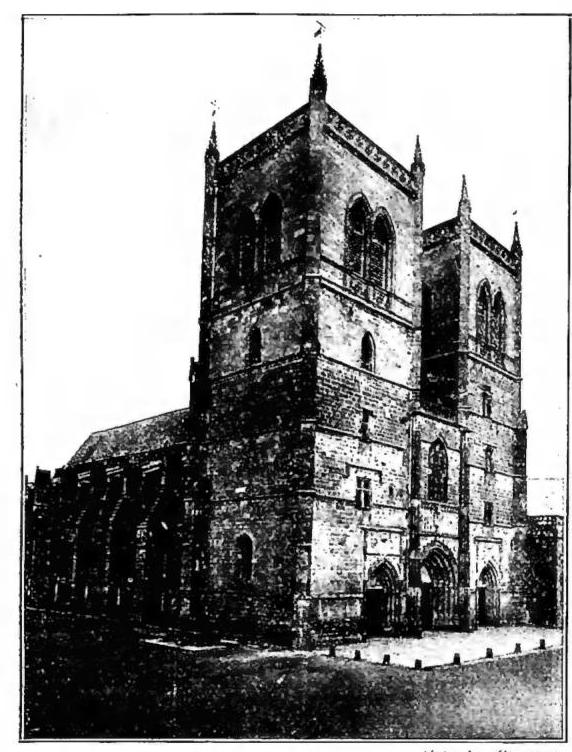
The cathedral of St-F. was erected between 1396 and 1466 on the site of an earlier building dedicated to s. Odilone, which had been consecrated by Pope Urbano II in 1095; it is a Gothic structure with a façade containing three portals and an interior with five naves and no transept. Particularly noteworthy is a large fifteenth-century wooden Christ known as the « Bon Dieu noir de St-F. ». A marble inscription records the bishops buried in the Cathedral; there is also the marble monument of Mgr De Pampignac (1877), represented kneeling. Beside the Cathedral is the episcopal palace (eighteenth century), now the town hall. The church of S. Vincenzo, with a single nave, dates from the fourteenth century; the former collegiate church of the Chapter of Notre-Dame is now occupied by the « halle au blé ». The church of S. Cristiana is modern. The diocese is very rich in Marian shrines, which are greatly venerated; among the most important are Notre-Dame de Claviers at Moussages, with an ancient statue of the Madonna; N.-D.-des-Miracles at Mauriac; N.-D.-de-Quézac; and N.-D.-de-la-Font-Sainte at St-Hippolyte.
The servant of God Caterina Jarrige (1754–1836), of the Third Order of S. Domenico, was born at Mauriac. Commonly called « Catinon Menette », she was known for the heroic zeal with which, during the French Revolution, she became a protector of the priests persecuted by the Jacobins,
hiding and saving them in a thousand ways; after the Revolution, she devoted herself to the poor, the sick, and prisoners. The cause of beatification was introduced on 12 June 1929 (cf. [A. P. Frutaz], Inquisitio super fontes historicos ad causam pertinentes circa vitam servae Dei auctore sac. J. B. Serres [S. R. C. sect. hist., 68], Città del Vaticano 1947).
Aurillac, the ancient « Aureliacum », is the seat of the prefecture of the department of Cantal; situated on the right bank of the Jordanne, it had a castle (S. Stefano, now a teacher-training school) in which s. Giraldo was born. In 856 he founded an abbey that bore his name, from which Gerberto, Silvestro II (v.), emerged; he was born in 940 at Belliac. The abbey church was consecrated in 1095 by Urbano II; it was visited by Callisto II. The city was sacked by the Huguenots. The former abbey church was rebuilt in 1643 in ogival style; it has a portico and a bell tower erected in 1868. Inside, the only noteworthy features are the chapel of the B. Vergine, several Romanesque sculptures, three wooden statues from the sixteenth century, the painting attributed to Zurbaran depicting the Morte di s. Francesco Saverio, and the monument of Mgr Bonange, bishop of Langres, born at Aurillac; in the sacristy is the area containing the relics of s. Giraldo. In the church of Notre-Dame-aux-Neiges, or of the Cordeliers, in the southern Gothic style of the late sixteenth century, there is the sixteenth-century statue known as the « Vierge noire », which is greatly venerated. At the place where the noble Guido di Veyre fell in 1581 while fighting against the Huguenots, the artistic chapel of Aurinques was erected at the end of the same century. In the square bearing his name stands the statue of Gerberto, the work of D. d’Angers, with bas-reliefs illustrating the life of Silvestro II. The former Jesuit College (1638) now houses the Museum of Painting and Sculpture, the drawing school, and the Library.