Machine translation of the 1948–1954 Italian original. The original text is authoritative.
VUNIBALDO (Wunnib., Wynnebaldus), saint. — Of Anglo-Saxon origin, in 720 he went with his brother Vilibaldo (v.) on pilgrimage to Rome, where he lived a monastic life.
In 739 his cousin St Bonifazio took him with him on his return journey to Germany and ordained him priest. He thus became a missionary in an area of Thuringia, residing at Sülzenbrücken. Subsequently sent to the region of the Vils (Oberpfalz), he worked there without result for three years. Mainz then became his missionary field, but, not finding himself at ease there, he went to Eichstätt to his brother, the bishop.
(phot. Alinari)
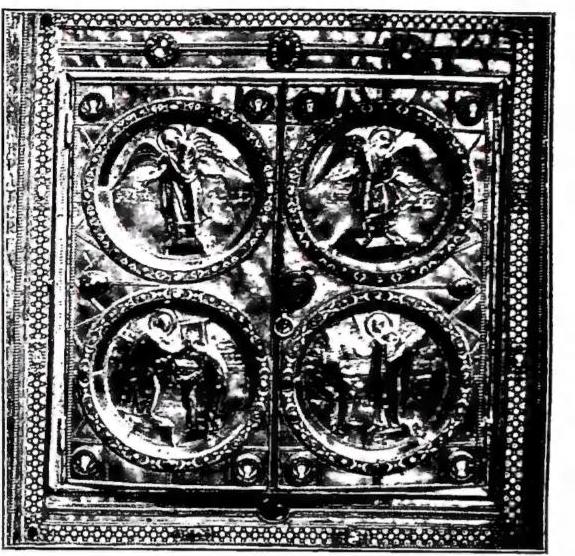
VUOLVINIO - Detail of the rear of V.’s golden altar. Note the two roundels with the donor Angilberto, provided with a square nimbus, and the artist, both crowned by St Ambrose (for the front of the altar V. vol. IX, tav. XLVII). Milan, basilica of S. Ambrogio.
The monastery of Heidenheim was the starting point of his new apostolate in the Sualafeld. He died on 18 Dec. 761 and was buried by his brother Vilibaldo in the choir of the church at Heidenheim. Feast day: 18 Dec.
BIBL.: the contemporary Vita (BHL, 8996) was written by a nun of Heidenheim, probably Hugeburg (ed. MGH, Script., XV, I, pp. 106-17); F. Heidingsfelde, Regesten der Bischöfe von Eichstätt, I, 1, Monaco 1915, p. 8 ff.; L. J. Braun, Sankt Wunibald, der Apostel des Sualafeldes, Gunzenhausen 1924; A. Zimmermann, Kalendarium Benedict., III, Metten 1937, pp. 450-54. Anscario Mundò Marcet
Cite this article
“VUNIBALDO (WUNNIB., WYNNEBALDUS), SANTO.” Enciclopedia Cattolica, vol. XII (1954), p. 1021. Azione Romana digital edition, https://azioneromana.com/article/vunibaldo-wunnib-wynnebaldus-santo.