
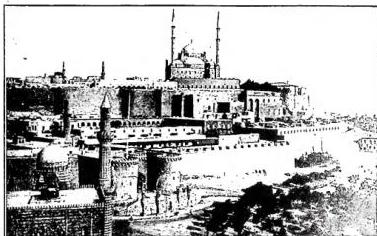
MINARETO. - A tower erected near the mosque, from which the muezzin (mu'addin) calls the faithful to prayer. Its character varies in different regions, according to the influence of pre-existing structures: bell towers of Christian churches of pre-Islamic age, or revenge towers, or defensive towers. One of the oldest surviving minarets, that of the great mosque of Kairouan (Tunisia) from the 8th century, seems to come close to the latter: a massive quadrangular structure, which reveals its defensive nature even in the enormous scarcity of openings.
The minaret with a square plan was spread by the Umayyads in Syria and throughout North Africa; in the most common type the tower is crowned by a Muslim crenellation.
and above it rise two or more receding stories, culminating in a pyramidal or onion-shaped spire; the brick walls, bare in ancient times, later have a picturesque facing of pierced lozenges. The minarets were greater in number according to the importance of the mosques. The great mosque of Damascus, in addition to the four minarets originally placed at the corners of the enclosure (the surviving ones are the eastern one, called that of Jesus, rebuilt in the 13th century, and the western one, rebuilt in the 15th), has a fifth, from the 10th-12th century, in the middle part of the northern portico, oriented toward Mecca, as was later frequently the custom. From Morocco (where the Hasan tower at Rabat is remembered, with highly ornate windows, single-light windows below, triple-light windows above), the minaret was imported by the Arab invaders into Spain, where, the one of the mosque of Cordoba having disappeared, the famous Giralda (12th century) survives at Seville, respected in the reconstruction of the Cathedral.
The type of minaret with a polygonal plan seems to have originated in the more eastern regions (Persia and Turkestan), where at the time of Seljuq domination the circular plan was also introduced. Slenderer than those with a square plan, these minarets, adorned with vertical striations or with bricks arranged to form geometric motifs, or later with vivid polychrome ceramics, are divided into stories by annular terraces projecting on corbels. These two types spread in India (for example, famous is the very tall minaret of the Qutb ad-din mosque of Delhi, from the 13th century) and in the western regions, particularly in Egypt. Here the singular minaret of the mosque of Tülün in Cairo had already arisen in the 9th century, whose structure (a square base surmounted by a cylindrical tower with an external spiral for the ascent) would derive, according to some, from the famous lighthouse of Alexandria; but the very numerous minarets that arose subsequently in the Mamluk era are predominantly polygonal or cylindrical. This type also penetrated into Turkey and from there into the Balkans.
Bibliography2 works
Cesare Botti