Machine translation of the 1948–1954 Italian original. The original text is authoritative.
EMPIRE STYLE. — Designation of the phase of the neoclassical style adopted and disseminated as the official aesthetic expression of the Napoleonic Empire; current usage, however, employs the term somewhat approximately, often applying it to neoclassicism in general, with a simplification justified by the fact that under the Empire the typical neoclassical elements that had been spreading throughout Europe since the excavations at Herculaneum and other manifestations of a revival of taste for classical antiquity (Winckelmann, Mengs, Piranesi, the style of Robert Adam based on the study of the Palace of Diocletian at Split, the Baths, the arabesques and stuccoes of the Vatican Loggias and Villa Madama, the style of Wedgwood ceramics, etc.) reached a mature, often rigid, formula.
The taste of the Empire oscillates between Egyptian-Etruscan-Roman monumentality and Greek grace, at times skilfully blending those styles, at others creating grotesque hybridisms. Its general characteristics are a certain rigidity of line, which lends grandeur and severity; a purity that is more or less academic and which to later generations appeared as coldness; and a lack of unpredictability and flexibility that produces a certain monotony. Typical is the work of Percier and Fontaine, the supreme expression of official art: inspired not only by classical models but also by our Renaissance, they codified Empire decoration in the Recueil de décorations intérieures, which, having begun to appear in instalments in 1801, was issued in its definitive edition in 1812. The ornamentation, often hackneyed and affected, of an elegant Alexandrianism (lyres, swans, palmettes, sphinxes, etc.), sometimes conceals what to modern eyes has seemed one of the most noteworthy contributions of e. s., its functionality and rationality: in furniture and buildings, where the predominance of ancient models (the Pantheon, the triumphal arch—
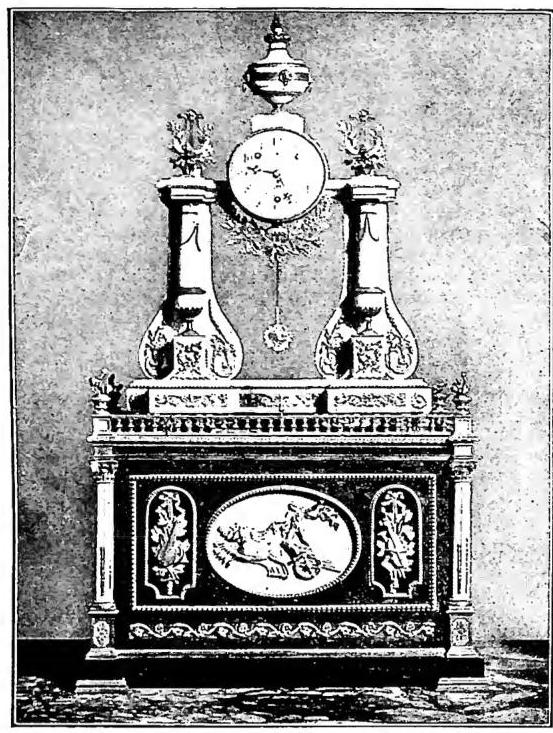
IMPERO, STILE — A table clock in the s. i. (ca. 1810). Florence, Palazzo Pitti.
fale, etc.) can at first sight mislead one as to the style’s actual original contribution. The latter, represented abroad by imposing buildings and urban developments (Paris, Petersburg, where the Italian genius had the opportunity to assert itself through Quarenghi and Carlo Rossi), has no outstanding monuments in Italy (the best-known architect active in Rome, Valadier, is mediocre; but noble buildings include the Teatro S. Carlo by Niccolini, and the church of S. Francesco di Paola by P. Bianchi in Naples, the Cisternone by Poccianti in Livorno, the Arco della Pace by Cagnola and several palaces in Milan, in the Emilian province, the Tempio canoviano at Possagno, etc.). In painting, our Appiani is not as representative a name as the French David, but in sculpture Italy can boast Canova, who was supreme in his time. — Vedi tav. CIII.
BIBL.: Examples of sacred art may be found in P. Ruga, Invenzioni diverse di mobili ed utensili sacri e profani, Milan [early nineteenth century], and in the Italian edition of Ch. Percier and P. F. L. Fontaine, Raccolta di decorazioni interne, with additions by G. Borsato, Venice 1843; for funerary monuments v.: G. Zecchi, Collezioni dei monumenti sepolcrali del cimitero di Bologna, 4 vols., Bologna 1825–27; Normand fils, Monuments funéraires choisis dans les cimetières de Paris, Paris 1832. In addition, J. Fohnesicz, Inenbume und Hausrat der Empire- und Biedermeierzeit in Österreich-Ungarn, Vienna 1918; P. Marmottan-J. Vacquier, Le style empire, architecture et décors d'intérieur, 5 vols., Paris 1920–30; F. Luthmer, R. Schmidt, Empire- und Biedermeiermöbel, Stuttgart 1922; H. Schmitz, Deutsche Möbel des Klassizismus, ibid. 1923; G. Pauli, Die Kunst des Klassizismus und der Romantik, Berlin 1925; A. Nekrasov, Russhij Ampir [in Russian], Moscow 1935; P. Francastel, Le style empire, Paris 1939; A. M. Brizio, Ottocento, Nonocento, Turin 1939; M. Praz, Gusto neoclassico, Florence 1940; E. Hessling, Empire-Möbel, Leipzig n.d.; E. Lo Gatto, Gli artisti in Russia (L'opera del genio italiano all'estero), Rome 1943, especially vol. III. For painting, see especially W. Friedländer, Hauptströmungen der französischen Malerei von David bis Cézanne, Leipzig 1930.
Cite this article
“IMPERO, STILE.” Enciclopedia Cattolica, vol. VI (1951), p. 993. Azione Romana digital edition, https://azioneromana.com/article/impero-stile.