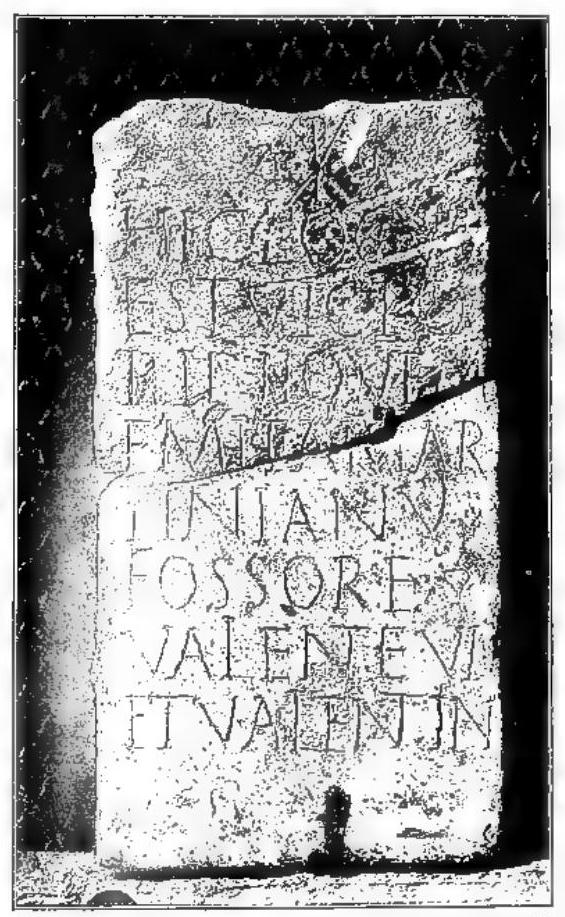
FOSSORI

FOSSORS. — Thus are they called, even by pagans, the workers tasked with digging burial pits. The people remember that the *fossor* was paid a wage “the price of bricks” (*Apostolica traditio*, 14). The *fossores* liked to have themselves represented in the cubicles of the underground cemeteries. Six are depicted in the Catacomb of Callistus.

The Cemetery ad duas lauros has as many as eight cubicles, in each of which two *fossores* are shown either at work, or with a sack and a lamp, or with a lamp and a pickaxe; besides these, two isolated *fossores* appear. In the Catacomb of Domitilla the well-known cubicle of the *fossor* Diogenes was ruined by Boldetti (Wilpert, *Pitture*, pl. 180). In the Cemetery of Giordani the scene was copied of the *fossor* Trofimus busy at work in the hypogeum (J. Wilpert, *Die Katakombengemälde und ihre alten Kopien*, Freiburg in Br. 1891, pl. 4, 2). Representations of *fossores* are also found elsewhere.

Article illustration

FOSSANOVA, ABBEY OF — Interior of the abbey church (1208). The church stands in a garden enclosure. The vast refectory and the chapter hall are in a transitional Romanesque-Gothic style. Taken as a whole, the features of this grand complex of buildings show the confluence in the region of various traditions.

FOSSORI — PHOTOMECHANICAL ARTS

FOTINUS — FOTINUS (PHOTINUS) was bishop of Sirmium in Pannonia, probably at the end of 343. Together with Marcellus he was first condemned by the Synod of Antioch in 344 (in the formula of faith called the *macrostich*), cf. Evagrius, *Hist. eccl.*, II, 19: PG 67, 228 C). The condemnation was accepted by the Westerners at Milan (345), but remained ineffective owing to the favour Photinus enjoyed among his people. A similar fate befell other condemnations pronounced against him by a second Milanese synod and by the bishops gathered at Sirmium in 347 (the chronology of these events is uncertain). At the Council convoked at Sirmium in 351 Photinus, in a public disputation with his adversaries, was convicted of heresy, deposed and exiled. Recalled by Julian the Apostate in 362, he was again driven out by Valentinian. He died in his native Galatia in 376.

Since all the works of Photinus have perished (St Jerome mentions the treatises *Contra gentes* and *Ad Valentinianum*), our knowledge of his doctrine depends on conciliar decrees and later summaries. Like Marcellus, Photinus denies the Word a personal subsistence; he calls God *λογιστής*, to exclude any hypostatic difference between the Father and the Word. Whereas, however, Marcellus’s conception is rather Sabellian, Photinus approaches the dynamic monarchianism of Paul of Samosata: according to Photinus, Christ is merely a man wonderfully born, endowed by God with operative energy (*δραστικὴ ἐνέργεια*), adopted as Son of God and the source of his miracles.

The followers of Photinus, called Photinians or also *homunculi*, were never numerous. It is unclear to what extent they survived in the sect of the Bonosians in the Danubian provinces.

Bibl.: A. Harnack, *Lehrbuch der Dogmengeschichte*, II, 2nd ed., Tübingen 1909, pp. 248 ff.; G. Bardy, *Paul de Samosate*, 2nd ed., Louvain 1929, pp. 407-414.