
CAMPEGGI, FAMIGLIA. – LORENZO, cardinal, born in Bologna in 1474, died in Rome on 19 July 1539. He taught law in Bologna, where he married and had children. Having been widowed in 1510, he entered the Roman Curia as an auditor of the Rota in 1511. As early as 12 November 1512 he was appointed bishop of Feltre, a diocese which he held until 1520. In 1514 Leo X sent him to Germany; then, on 1 July 1517, he created him a cardinal. In 1518 he sent him for the first time as legate to England, whence he returned the following year. On 2 December he received the bishopric of Bologna, which he held until 1525. Meanwhile, as the religious revolution in Germany had spread, Clement VII sent him there as legate on 8 January 1524, so that he might be present at the Diet of Nuremberg, where he encountered steadfast resistance from the princes who favored Luther; he gathered the Catholic princes at Regensburg, succeeded in forming a Catholic League in July, and worked very hard during the autumn and winter to improve the prospects of Catholicism. He returned to Rome in October 1525. In the meantime he had received the bishopric of Salisbury in England in commendam (2 December 1524), and when Henry VIII revealed his plans to divorce Catherine of Aragon, Clement VII appointed him his legate on 8 June 1528, so that, together with Cardinal Tommaso Wolsey, archbishop of York, he might investigate this difficult case and judge it according to justice. It then seemed advisable to prolong matters before reaching a decision, in the hope that the king might change his mind; the legate, who arrived in London on 8 October, began the regular proceedings the following May; but the queen produced Julius II’s legal dispensation for her marriage to the king and appealed directly to the Pope. Clement VII then reserved the case to himself, and the proceedings were suspended on 23 July; in September C. left England; he subsequently lost his bishopric of Salisbury.
When Charles V convoked a new diet at Augsburg to deal with the religious disturbances in Germany, Clement VII, on 9 March 1530, appointed C. as his legate alongside the emperor, entrusting him with special instructions on the matter. At that diet the Confessio Augustana was presented, which became the profession of faith of the Lutherans; Charles V saw his efforts toward religious unity frustrated and became convinced that by then only a council could put an end to the doctrinal conflicts.
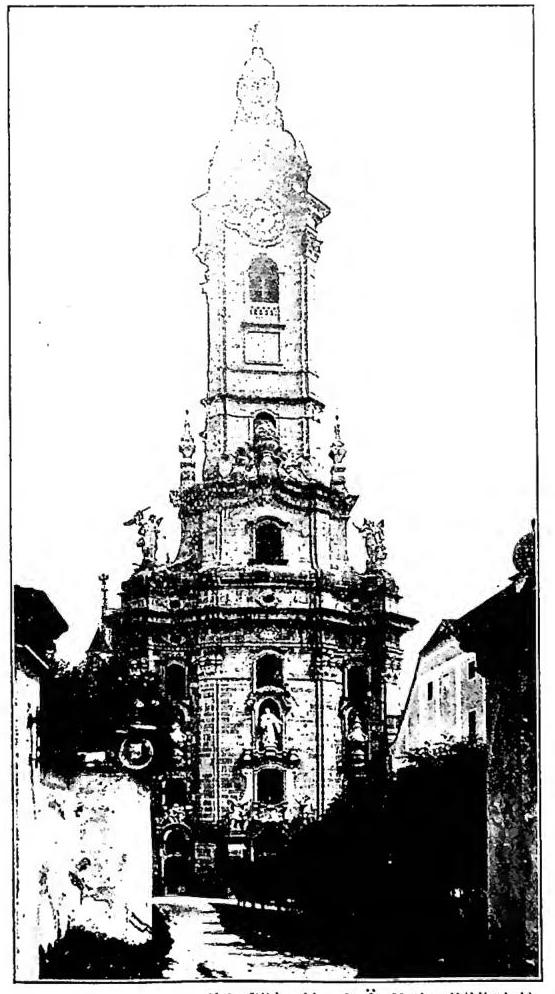
(phot. Bilderchio d. G. Nationalbibliothek)
CAMPANILE — Bell tower of the church of the monastery of Zwettl, Austria (1722–27).
Aleandro at the council that was to convene at Vicenza, and together with them he entered that city on 12 May; but the council was not held at that time, and C. returned to Rome, where he died, leaving a reputation as a shrewd and faithful diplomat, although not always a fortunate one.
The C. were truly a family of prelates. TOMMASO, brother of Cardinal Lorenzo, born in Pavia in 1481, was archdeacon of Bologna, then bishop of Feltre from 1 June 1520; he resigned on 6 April 1546. He was the first prelate to be present at Trent for the Council of 1545, and during the Council he compiled votes and consultations, some of which were printed. He went as nuncio to Venice and to Charles V. He died in Rome on 21 January 1564 (cf. Fantuzzi, op. cit., p. 65). The son of Cardinal Lorenzo was GIOV. BATTISTA, appointed bishop of Majorca through the designation of Charles V on 25 September 1531. He resigned in September 1561 and died in Bologna on 7 April 1583, where he had provided generously for the city’s religious institutions (Fantuzzi, op. cit., p. 36). ALESSANDRO, another son of Cardinal Lorenzo, born in 1504 and died in Rome on 21 September 1554, was bishop of Bologna from 19 March 1526 to 1553. Pro-legate at Avignon in 1541, he fought the Waldensian heresy there. In 1544 he was appointed cleric of the Apostolic Chamber; on 20 November 1551, he was created cardinal by Julius III (Fantuzzi, op. cit., p. 28).
Leaving aside other figures, the following may be mentioned: CAMILLO, a Dominican theologian, born in Bologna at the beginning of the sixteenth century and died in 1569. He taught theology in various convents of his Order. He was inquisitor at Faenza (1562), Ferrara, and Mantua, at a time (1567) when relations between the Duke and Pius V were extremely tense. Through his energy he restored the authority of the tribunal of the faith there. He took part in the Council of Trent (third period) as theologian to Pius IV. On 14 May 1568 he was appointed bishop of Nepi and Sutri.
In addition to his speeches at the Council of Trent, published in 1562, he wrote: De primatu Romani Pontificis contra M. Flacium Illyr. (ed. in Bibl. Max. Pont., VII, Rome 1697). He published, with his own commentary, Ugolino Zanchini’s treatise De Haereticis (Mantua 1567).