MACEIÒ, ARCHDIOCESE of. — Capital and archdiocese of the State of Alagôas in Brazil.
Over an area of 11,928 sq. km., it has 623,756 inhabitants, of whom 620,000 are Catholics, distributed among 28 parishes, served by 45 diocesan and 16 regular priests, assisted by 7 male and 10 female religious communities; it has a provincial seminary (N. Signora dell'Assunta) and a minor seminary; 41 educational institutions and 5 charitable and welfare works.
The diocese was created by the bull of Leo XIII, «Postremis hisce temporibus», of 2 July 1900, under the name of Alagôas (comprising the entire State), separating it from the archdiocese of Olinda e Refice; in turn, it ceded (3 April 1916) a group of parishes for the new diocese of Penedo; it changed its name to M. on 25 August 1917;
it was elevated to a metropolitan see on 13 February 1920. Its suffragan dioceses are Aracaju and Penedo.
The first bishop of the diocese was A. M. de Castilho-Brandao (d. in 1910); his successor, M. A. de Oliveira Lopez, who founded there the newspaper O Mensageiro de Fe, became its first archbishop.
The titular of the cathedral is N. Senhora dos Prazeres.
MACERATA,
DIOCESE of. — It is one of the least extensive dioceses of the Marches, but one of the most important, because it is situated in the middle of the region, of which it was the center of civil, intellectual, and administrative life, so as to be considered the capital of the Marca d'Ancona and to become the seat of the rectors and vicars of the Marca, of the Treasury, of the General Curia, and of the cardinal legates. The city lies on a hill, at approximately 300 m. above sea level, from which it is separated by little more than 20 km. as the crow flies, at almost equal distance from the Potenza and Chienti rivers, in extremely fertile territory. It has 32,000 inhabitants with 13 parishes.
I. HISTORY
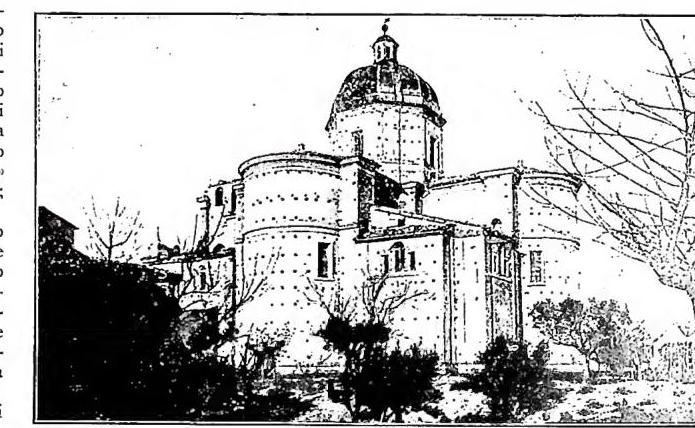
After the destruction of Helvia Ricina, a Roman colony situated on the left bank of the Potenza, in 553 the inhabitants dispersed among the surrounding hills, forming small communities: as early as the 8th century, on the hill of M. there were several population groups: Podium montis S. Iuliani, in the comitatus and diocese of Fermo, and Castellum de M. in the comitatus of Camerino, under a local lord. In 1116 the inhabitants of Podium, or Poggio, received a charter of privileges, confirmed in 1138, when the three groups had already united under the single name of M. In 1320, Giovanni XXII, having suppressed the diocese of Recanati, which had rebelled against the Church, raised M. to the rank of city and diocese in reward for its unfaltering loyalty. By this decision the territory of M. extended as far as the sea, also including the sanctuary of the S. Casa of Loreto. The first bishop of the new diocese was the same bishop of Recanati, who was succeeded by the blessed Pietro Mulucci, of the lords of M. In 1357, Innocent VI, having restored the diocese of Recanati, united it with M. The union lasted until 1586, except for a brief interruption from 1516 to 1546. Among the bishops of the two united dioceses, Angelo Correr (from 1415 to 1417) should be remembered; he had previously been the legitimate Pope Gregorio XII, and renounced the pontificate at the Council of Constance in order to put an end to the schism. Appointed legate of the Marca and bishop of M. and Recanati, he died in the latter city in 1417 and is buried in the Cathedral. Another bishop of great historical importance was Giovanni Vitelleschi of Corneto Tarquinia. Appointed to the sees of M. and Recanati and legate of the Piceno in 1431, he devoted all his efforts to restoring the pope’s authority in the dominions of the Church; he was honored with a statueMACERATA, DIOCESE of. — Church of S. Maria delle Vergini. Designed by Galasso Alghisi (1548) — Macerata.
in the Campidoglio and hailed as the third founder of Rome. In 1435 he was made a cardinal and appointed archbishop of Florence, then patriarch of Alexandria; he died tragically in Castel S. Angelo in 1442. The last bishop of the united sees was Galeazzo Moroni, nephew of s. Carlo Borromeo, who remained in the see of M. after its separation from Recanati in 1586. In that year Sixtus V, having restored the diocese of Tolentino, united it with M., to which the municipalities of Urbisaglia and Pollenza were assigned, having been taken from the diocese of Camerino.
In the two sees, 23 bishops have succeeded one another down to the present day, among them s. Vincenzo Maria Strambi (1801–24), Amedeo Zangari (1815–64), who died reputed to be a saint, and Sebastiano Galeati (1881–88), later cardinal and archbishop of Ravenna.
Principal patrons of M. and the diocese: Maria S. ma della Misericordia (first Sunday of September) and s. Giuliano l’Ospitatore (31 August).
II. ILLUSTRIOUS PERSONAGES
M. gave birth to many illustrious ecclesiastical and lay personages. Among the former are remembered the cardinals: Buonaccorso Buonaccorsi (1616–78), Prospero Marefoschi (created cardinal in 1724), Simone Buonaccorsi (1708–76), Mario Compagnoni Marefoschi (1714–80), Guglielmo Pallotta (1727–95), Giuseppe Ugolini (1783–1863); and also: Fr. Matteo Ricci (1552–1610), the greatest missionary and first geographer of China; the servant of God Fr. Giulio Mancinelli (1537–1618); the canon Gian Mario Crescimbeni (1663–1728), historian and man of letters, first custodian of the Arcadia; Fr. Giuseppe Asclepi (1706–76), physicist and astronomer; Fr. Cassiano Beligatti (1708–91), missionary in Tibet; Fr. Francesco De Vico (1805–48), distinguished astronomer; Fr. Orazio Civalli (1594–1621), author of a valuable account of the convents of the Marches. Numerous bishops and other ecclesiastics distinguished for learning and holiness were born in M., for example: Pompeo Compagnoni (18th century), bishop of Osimo and Cingoli, historian of the Church of Osimo, described by Muratori as «the most learned prelate in Italy and the exemplar of bishops»; Cardinal Gabriele Filippucci, a jurist who renounced the purple in 1706. In the secular sphere: Floriani Pompeo (1545–1600) and Pietro Paolo (1585–1638), military commanders and engineers; Pompeo Compagnoni (1602–75), historian of the Piceno; Diomede Pantaleoni (1810–1885), physician and politician; Lauro Rossi (1810–85), musician and composer.III. MONUMENTS
S. Maria della Porta: two churches one above the other, the lower dating from the 9th century and the upper from the 14th, with a richly decorated Romanesque-Gothic portal; S. Maria delle Vergini, designed by Galasso Alghisi da Carpi in the second half of the 16th century, with a Greek-cross plan and a high octagonal dome, rich in works of art; the Cathedral of G. Giuliano, a national monument, rebuilt by Cosimo Morelli da Imola at the end of the 18th century; the collegiate church of the S. Mo Salvatore (S. Giovanni), by Rosato Rosati, dating from the 17th century, who also designed the interior of S. Carlo a' Catinari in Rome; S. Paolo, by Ambrogio Mazzenta, who rebuilt the metropolitan church of Bologna; the modern church of the Immaculate Conception, by G. Rossi; especially worthy of mention is the basilica-shrine of the Madonna della Misericordia: first built in 1447, it was renovated and enlarged in the mid-18th century by Vanvitelli; it preserves canvases and frescoes by F. Mancini, S. Conca, and B. Biagetti, and the miraculous image of the Blessed Virgin, principal patroness of the city and diocese, is venerated there.IV. CIVIL BUILDINGS
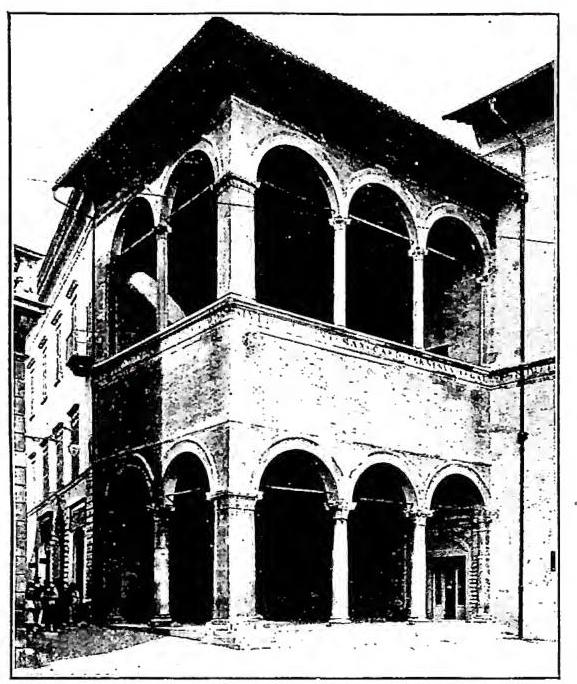
Remains of the theater of Helvia Ricina; the Fonte Maggiore of 1325; the Palazzo della Prefettura, formerly the residence of the cardinal legates (13th–16th centuries); the Loggia dei Mercanti, from 1505, attributed to Giuliano da Maiano; numerous private palaces, including: the Palazzo Floriani by Pellegrino Tibaldi (16th century), the Palazzo dei Diamanti, the Torre del Comune by G. Alghisi da Carpi, the Palazzo Ugolini by Valadier, the monumental Sferisterio by Ireneo Alcandri, etc.V. ISTITUZIONI BELIGIOSE
Numerous in the past and the present, with educational institutions, nurseries, hospitals, and convalescent homes. Among the confraternities, once very numerous,mention should be made of that of the Most Blessed Sacrament in the Cathedral, established as early as 1496, one of the first in the entire world to receive the highly singular privilege, from the first years of the sixteenth century, of obtaining on Good Friday the liberation of those condemned to death. This privilege, reduced by Paolo V in 1614 to a single condemned person, was exercised without interruption until 1860; and the Confraternity of the Most Holy Trinity in the sanctuary of Mercy, established as early as 1577. Of the ancient corporations of “arts and trades” and the numerous confraternities, only the Congregation of Merchants and Artists remains. Moreover, in M. the practice of exposing the Most Blessed Sacrament during Carnival originated in 1566, as reparation for the offenses committed against the Lord.
VI. UNIVERSITY
The earliest record of a school of law dates to 1290; in 1540, Paul III established the Universitas studiorum, with all the papal and imperial privileges of the Universities of Bologna and Padua, and with faculties of theology, philosophy, law, moral philosophy, natural physics, and medicine. Before ascending to the pontificate, Sixtus V and Gregory XVI taught there; so did Annibal Caro and the most distinguished doctors of the religious Orders present in M. In 1810 it was suppressed by Napoleon and restored with its former privileges by Pius VII in 1816; in 1826, Leo XII declared it pontifical, with faculties of theology, jurisprudence, medicine, and mathematics, subject to the authority of the bishop, with the title of chancellor; when the Marches were annexed to Italy, it became a royal university; the faculties were gradually reduced, and at present only the faculty of jurisprudence remains, though it is very well attended.VII. SEMINARY
Established in accordance with the Council of Trent in 1615, but already conceived by Bishop Galeazzo Moroni as early as 1584, it had various locations: one was built by St. Vincenzo Strambi; the present one dates from the first half of the nineteenth century. Until 1912, it retained the faculty of conferring academic degrees in theology.VIII. LIBRARIES
The most important library of the city and region is the municipal Mozzi-Borgetti Library; it contains more than 200,000 volumes, numerous incunabula, and approximately 1,600 manuscripts, many of them of great value and particular interest; the Seminary Library, formed largely from the books left by s. Vincenzo Strambi, contains more than 6,000 volumes, including valuable ecclesiastical works, «Aldine» editions, and a notable incunabulum: Biblia cum concordantiis in margine, published at Bressanone in 1486; the University Library, specializing in legal studies, is also noteworthy.IX. ARCHIVES
At the Municipal Library, the Prioral Archive of the municipality of M. is arranged in perfect order, containing 949 parchments, dating from 1176 to 1804, and 1,084 codices, dating from 1278 to 1808. Of the greatest importance is the Archive of the S. Rota maceratese, comprising 3,259 volumes dating from 1589 to 1798. The S. Rota maceratese, established, as has been mentioned, by Sisto V on 15 March 1588, extended its jurisdiction over the provinces of Ancona, Ascoli, Fermo, M., and Pesaro, and over the Duchies of Urbino and Camerino; and, sitting on appeal, adjudicated all the sentences of the ecclesiastical, civil, and criminal tribunals; by agreement, an auditor of the S. Rota of Perugia resided in M., and vice versa. It was suppressed by Napoleon; Pio VII restored the tribunal in 1816 with appellate jurisdiction.X. ACADEMIES
The Accademia dei Catenati, founded in 1574; its members included the most learned men from every part of Italy. It devoted itself to the study of belles-lettres, poetry, eloquence, philology, history, and criticism; after a period of inactivity in the last century, it has resumed considerable activity, promoting highly esteemed cultural courses.XI. MINT
The existence in M. of a mint may also be recalled; it is mentioned as early as 1337, in a letter from Pope Benedict XII to the rector of the city. Copper, silver, and gold coins were minted there, bearing the pope’s coat of arms and images of the Lord, the Madonna, and various saints; it operated with occasional interruptions until 1799.XII. DIOCESES
The following municipalities belong to M.: Urbisaglia (pop. 5,000), on the ruins of the eponymous Roman city, destroyed in 408 by Alaric, king of the Visigoths. Noteworthy are: the collegiate parish church of S. Lorenzo, the fifteenth-century fortress, perhaps the finest in the Marche, and the Maestà, a small church dating from 1429, with votive frescoes from the fifteenth and sixteenth centuries. In