
DOCUMENT. — From the etymological meaning of “instruction” (from doceo, “that from which one learns, obtains proof”), the word d. came to denote any testimony (written, verbal, monumental) to a fact, and especially, to paraphrase Sickel’s definition, “the written attestation of a fact of a juridical nature and content, drawn up according to certain principles so that it may command credence and have probative value”: in this sense it is also called an “instrument” and in the Middle Ages was designated by the generic terms charta, litterae, scriptura, etc. Its origin is to be sought in the ancient Roman d., both in its testimonial form and in that of the chirograph and the epistle. The d. in itself, that is, setting aside whatever historical or juridical value it may possess, constitutes the subject of a particular science called “diplomatics” (v.).
I. CLASSIFICATION
Since not all documents serve the same purpose, originate with the same author, or appear in a single form, diplomatics has had to begin by classifying the document, a classification that varies according to the standpoint from which the act is examined. A first distinction concerns the moment of the attested legal fact: thus there are evidentiary documents (notitiae) and dispositive documents (chartae), depending on whether the documented legal action had already been completed and was valid before the drafting of the document, or whether the document itself brings it to completion and validity. A second distinction is based on the nature of the act, which may be political, legal, or administrative: the document differs accordingly both in wording and in its diplomatic characteristics, and one distinguishes precepts, privileges, diplomas, placita, letters, mandates, and the various types of chartae and memoratoria (venditionis, offerionis, conventionis, locationis, pignoris, etc.). Finally, the most important distinction, which constitutes the first foundation of special diplomatics, is based on the authority from which the act proceeds and divides documents into two broad categories: public and private. Public documents, that is, those issued in public form by public authorities, are themselves subdivided into ecclesiastical (papal, episcopal, etc.), sovereign (imperial, royal, princely, etc.), communal, and judicial documents. Papal documents, whose distinctive diplomatic characteristics began to emerge toward the end of the eighth century, the period to which the oldest surviving originals date, are divided into bulls (v.), briefs (v.), PROPRIETÀ (v.). Episcopal documents often conform to the characteristics of the papal document, especially in the more important sees (Ravenna, Constance, Reims, etc.), or imitate the forms of the princely document; at times, however, they appear devoid of any chancery formalities. Sovereign documents consist essentially of privileges, letters, and mandates; communal documents of reformationes (minutes of the sessions of the Municipal Council), statuta, brevia ambaxiatorum (drafts of preliminary agreements), bonni (public notices), mandata, and litterae rectorum; judicial documents of procedural acts and, generally, of all documents connected with judicial proceedings (libelli, mandates, letters of summons, witness depositions, placita). The private document, on the other hand, is one that concerns matters of private law and is generally drawn up by the notary, though sometimes (as in the case of the chirograph [v.]) also by one or more contracting parties: it encompasses a very great variety of acts, among which contracts of various kinds are especially important.II. GENESIS
Various persons contribute to the formation of the d., acting at two chronologically or logically distinct moments: that of the actio, which concerns the juridical fact attested, and that of the conscriptio, that is, its documentation. The persons absolutely necessary for the creation of the d. are the author, namely, the person who performs the documented action; the recipient, that is, the person to whom the d. is addressed; and the rogatorio, namely, the person who draws up the act at the request of the author or the recipient. The following take part in the actio: the request made to the author by the recipient (petitio); the recommendation of that request by an influential person (intercessio);the participation of certain persons whose intervention was required (intervenientes), their consent (consentientes), or even simply their testimony (testes). The following, instead, pertain to the conscriptio: the order given by the sovereign to the chancery (inissio), or the mandate given by a private individual to the notary (rogatio) to draw up the act; the preparation of the draft (imbreviatura); the final drafting (mundum); verification in the case of chancery d. (recognitio); and finally authentication (completio).
III. DIVISION
The d., whatever its type, is divided into determinate parts identified by particular formulae, which may appear in their entirety or not, depending on the period, the nature, and the authority from which the act proceeds. Their order may also vary within certain limits, but the typical sequence is indicated here, which will make it possible to distinguish the various parts even when they are arranged differently. The fundamental subdivision of a d. is that distinguishing the protocol, text, and eschatocol (also improperly called the final protocol).1. The protocol is the totality of the initial formulae and comprises: invocation, intitulature, inscription, and salutation. The invocatio is a pious appeal to the divinity and derives from the Christian custom of invoking divine assistance before any action of a certain importance: it may be verbal, when expressed literally through certain formulae (in nomine Domini, in nomine sanctae et individuae Trinitatis, etc.), or monogrammatic (v. CHRISMON), and it may also occur in both forms; it is entirely absent from pontifical privileges from Leo IX (1049–54) onward. The intitulatio consists in the mention of the author’s name accompanied by his titles and qualities; the inscriptio, on the other hand, consists in the name, titles, and qualities of the recipient; the salutatio is an expression of greeting in pontifical d. (salutem in Domino; salutem et apostolicam benedictionem), and of grace in royal and imperial letters (gratiam suam et omne bonum, etc.): it is absent from other sovereign d. as well as from private ones. In privileges, its place is occupied by the formula of perpetuity (in perpetuum; ad aeternam rei memoriam).
2. The text constitutes the central part of the d., the part that explains the content of the act and therefore varies according to it both in length and in wording. It is divided into arenga, publication, narration, disposition, sanction, and corroboration.
The arenga (or exordium, or proemium, or prologus) is a rhetorical introduction in which general principles or dogmatic truths are set forth that bear some relation to the nature of the documented act: it is not essential, and after the twelfth century it gradually tends to disappear, at least in the less solemn d. The publicatio (or promulgatio or notificatio) is the formula that introduces the expository part of the d., making it known (notum sit omnibus; pateat omnibus, etc.). The narratio (or expositio) consists in recalling the circumstances that gave rise to the act; the dispositio consists in describing the act itself, in its details of time, place, and person, and in its consequences: it constitutes the essential part of the d. from the standpoint of historical criticism, whereas for diplomatic criticism it is of little interest. The sanctio comprises a set of expressions by which the legal character of the d. is consecrated and certain obligations are established to guarantee observance of the juridical act. The corroboratio indicates the formalities followed for validating the d.
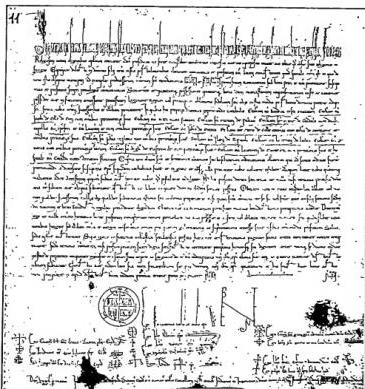
3. The eschatocol comprises dating, apprecatio, and subscription: the first two, however, may also be found in the protocol. The datatio consists of the topical date and the chronological date, normally preceded by the formula «actum» or «datum», which, according to the most common interpretation, refer respectively to the moment of the juridical act and to that of the traditio of the d. (concerning the manner of expressing the chronological date V. ANNO; CALENDARIO; ERA). The appreccatio is a wishful expression that follows the datatio (feliciter; in Dei nomine feliciter; amen): it is linked to a classical usage and, after the eleventh century, gradually tends to disappear. The «benevalete» of pontifical d. does not belong to it; despite its similarity in meaning, it has a different origin and different diplomatic characteristics. The subscriptiones are of three kinds: those of the author; of the consenting parties and witnesses; and of the chancery or notaries. Setting aside the other d., it may be noted here that in pontifical ones the pope initially used to append in his own hand to the letters a formula of greeting; in privileges, the personal subscription is autograph only in the time of Paschal II (1099–1118) and his immediate successors: thereafter the personal intervention of the pontiff is manifested in the formula «bene valete» (v.) and then in the «rota»
(courtesy of Prof. G. Battelli)
DOCUMENTO – Bull of Innocent III in favor of the monastery of S. Leucis, Diocese of Todi (13 Oct. 1207) – Vatican, archive Instr. Tudertina 6.
(v.). The subscriptions of consenting parties are rare in papal documents, since the issuing authority possesses such power that it has no need for validation by witnesses; nevertheless, in privileges, very rarely until Paschal II and with some regularity only from Innocent II (1130–43), the subscriptions of the cardinals appear, though they are almost never autograph. Finally, the participation of chancery officials is evident in privileges from the autograph subscription of the drafter of the document, from the design of the « rota » and the « benevalete », and from the mention of the datary; in briefs, from the secretary’s subscription.
IV. ILLUSTRATION
The d. does not ordinarily present illustrations, and only in certain documents drawn up with particular solemnity do the chancellery flourishes around the initials or the various « signa » acquire an ornamental character. Nevertheless, examples are not lacking of illuminated d. with genuine illustrations: but these are private d., for which the author also wished to achieve an aesthetic effect.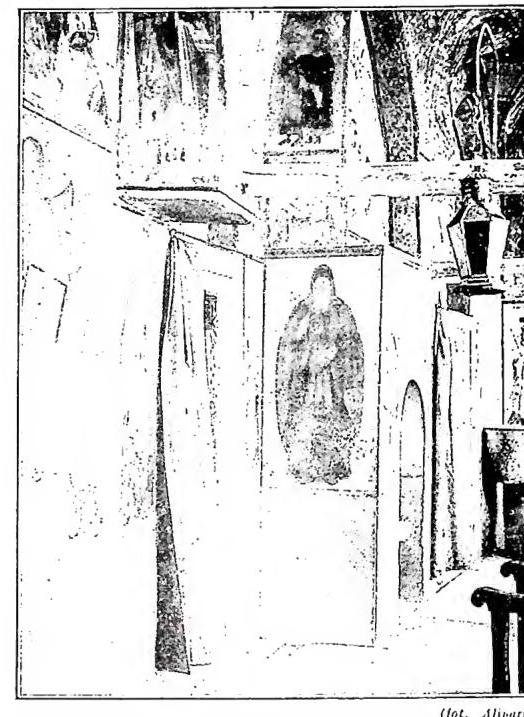
V. DOCUMENT IN CANON LAW
A document may be used in court as a means of proof.It is necessary, however, in order for a document to fulfill the function of a means of proof, that it bear the author’s signature, since only by virtue of such signature does it assume the nature of a certifying instrument. And the probative value of the document, that is, its effectiveness as a means of proof, depends strictly upon the reliability of its author.
With reference to judicial proceedings, various distinctions may be made among documents. There are, in fact, instruments drawn up by the parties to the case and those originating with third parties; the latter count as evidence only insofar as they constitute evidence of a legal act or of a fact concerning the third party that is relevant to the decision. Moreover, instruments are original or reproduced, according as they proceed directly from their author or are transcribed from the corresponding original; true or false, according as they contain the truth or falsehood; authentic or apocryphal, according as they actually originate or do not originate from the author to whom they are attributed; defective or intact, according as they have or have not been altered by interpolation, erasure, or correction; valid or invalid, according as they have or have not been drawn up in observance of the legal rules concerning the conditions prescribed for them to possess their full legal value; public or private, according as they have been received by a public official or instead originate from a private person (or even from a public official acting outside the exercise of his functions). And this is the most important distinction in procedural law. As a rule, the lex fori, that is, the law in force in the place where the proceedings take place, governs the probative value of documents; the form of the document, on the other hand, is governed by the law of the place where the document was written.
The public documents of greatest importance in canon law are listed in can. 1813 § 1 of the CIC (acts of the Pontiff, of the Roman Curia, and of the Ordinaries, instruments of no-
(photo Alineri)
DODECANESO – Interior of the church of the monastery of Patmo.
ecclesiastical registers, judicial acts, inscriptions or certificates of Baptism, Confirmation, Orders, religious profession, Matrimony, and death).
From the standpoint of the evidentiary assessment of the document, the following principles must be kept firmly in mind: 1) public documents are presumed genuine until proven otherwise (can. 1814); 2) such documents constitute full proof of what is their direct and principal content (can. 1816), whereas elements extraneous to that content have merely evidentiary value; 3) both these presumptions, based on the fact that, since public documents are drawn up through the work of a public official, they must be held to correspond to the truth insofar as they attest to events occurring in the presence of the public official, may be rebutted by judicial challenge to the document (action alleging forgery).
Private documents, on the other hand, have probative value equivalent to that of an extrajudicial confession (v. CONFESSIONE) only if they have been acknowledged by the party against whom they are used in court or by the judge (can. 1817), if the judge has established their authenticity (can. 1817). Moreover, private documents—unlike public ones—have no effect with regard to third parties unrelated to the proceedings.
With regard to both public and private documents, the interested party may request in court—incidentally, at any stage and level of the proceedings—or in a separate action, their recognition and challenge (can. 1816).
The action alleging forgery is properly the remedy granted by law for obtaining a declaration that a document, whether public or private, is false (v. FALSO; QUERELA).
Finally, as regards the submission of documents in court, the following principles, in force in ecclesiastical proceedings, should be considered (cann. 1819–24): a) it may take place voluntarily or compulsorily, in the latter case generally being the object of a special action, called actio ad exhibendum; b) the appropriate period for submitting documents is the evidentiary phase extending from the litis contestatio to the conclusio in causa; c) particularly with regard to the actio ad exhibendum, the sole condition imposed by law, in its evident and proper intention of preventing one party from benefiting in court from arguments and evidence belonging exclusively to the opposing party, for the admissibility of that action, is that the documents be common or in any event concern a common juridical transaction (instruments relating to succession, partitions, etc.); d) in deference to the principle nemo cogitur edere contra se, no one is required to produce documents, even common ones, where their production would entail a danger of serious harm. – Vedi tav. CIV.
Fernando Della Rocca