
LEONE, bishop of VERCELLI. — He lived between the 10th and 11th centuries. He is first encountered at the court of the emperor Otto III. His birthplace and how he came to the court are unknown. The first certain information shows him in September 996 among the courtiers at Mainz, where he distinguished himself by his eloquence and interpreted a prophetic dream for Adalbert of Prague, foretelling his martyrdom (Brunonis vita Adalberti, 20, in MGH, Scriptores, XV, p. 605). In 997 he met the great scholar Gerbert of Reims, whose reports inspired his ideas concerning the universal dominion of the Empire; equally familiar with the Emperor and with Gerbert, he worked toward this end in the autumn of 997 (Lettres de Gerbert, 183, ed. J. Haver, Paris 1869, p. 168). The Emperor’s trusted man was elected bishop of Vercelli, where the Empire needed vigorous and loyal support against the violent attacks of the marquis Arduino d'Ivrea. The title episcopus palatii, found in the life of Adalbert written in 1004 by Brunone di Querfurt, is merely an epithet that L. received because of his frequent residence at court and his interest in imperial affairs.
It is not known when he took possession of the see. According to Canetti (Della serie cronologica dei vescovi di Vercelli, Vercelli 1886, p. 24 ff.), L. could have become Adalbert’s successor no earlier than the summer of 998. In the spring of the same year L. was accompanying the Emperor and Pope Gregory V in Rome, taking an active part in the Council at which the antipope Giovanni Philagathus was deposed. On that occasion he composed a poem dedicated to Pope Gregory V, celebrating his return and praising the common universal dominion of the Emperor and the Pontiff.
In Vercelli L. restored order; he worked to ensure that Arduino would give an account of his policy hostile to the Emperor at the Roman Synod of 999. The title of logotheta, which L. included in the signatures of two placita of 1001, seems to indicate that at that time he held the office of chancellor, in place of Eriberto, who had been promoted to the archiepiscopal see of Cologne. The most precious surviving monument of L.’s activity is the diploma by which Otto III granted eight counties to the Church of Rome, thus concluding peace with the Pontiff. According to this authentic document, drawn up by L. himself, as well as according to other capitularies and diplomas, he appears, in relation to the Church of Rome, as the Emperor’s close adviser and a supporter of his policy.
An intimate friend of the emperor Otto III, he shared his ideas concerning the Empire and universal supremacy. He did not, however, share his mysticism, which instead portrays him as excessively concerned with the affairs of this world (MGH, Scriptores, XV, p. 725). At Otto’s death, which he sincerely mourned, he worked with his successor, Enrico II of Bavaria, to persuade him to descend into Italy against Arduino. His letters and other information show that L. was in fact the driving force behind the party loyal to the Emperor in northern Italy.
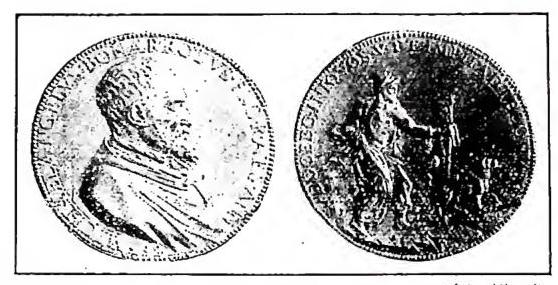
(Alinari photograph)
LEONI, LEONE — Medal with the portrait of Michelangelo at the age of 88; on the reverse, an allegorical representation alluding to Faith, designed by Michelangelo himself — Florence, Medical Medal Collection, Bargello.