
BIBLICHE, SOCIETÀ – The most important are the following:
I. BRITISH AND FOREIGN BIBLE SOCIETY (B.F.B.S.). – Before 1804, several Protestant societies had been founded in England and Scotland to disseminate the Bible, religious pamphlets, and leaflets. Such were the S.P.C.K., or Society for Promoting Christian Knowledge (1698), the S.P.G., or Society for the Propagation of the Gospel (1701), the R.T.S., or society for disseminating religious leaflets (1799), and several others. But the idea of publishing inexpensive Bibles in all languages, and of founding a special society devoted exclusively to this purpose, arose only in 1804 among some members of the R.T.S. (Religion Tract Society) and was supported by the aforementioned societies.
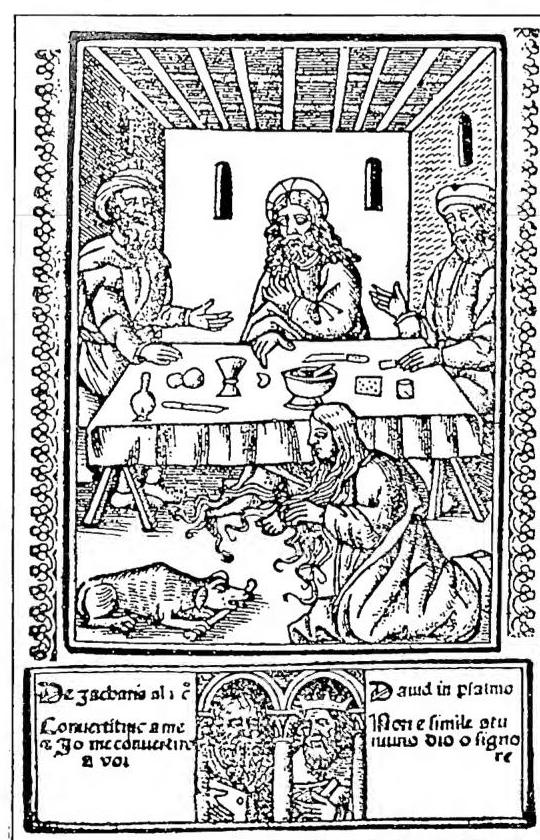
(courtesy of Dr. B. Degenhart)
BIBLIA PAUPERUM – Woodcut from the Venice edition (1510).
Scottish Bible Society, which, in 1861, took the name of National Bible Society of Scotland.
II. AMERICAN BIBLE SOCIETY (A.B.S.). — When the founding of the English Bible Society became known in the United States, several similar Bible societies were immediately formed; these united in 1816 to constitute the American Bible Society.
Like the English society, it too encountered the question of the deuterocanonical books, which led to a schism. In 1822, when the A. B. S. learned that in Latin America only the Catholic translation made by Fr. Scio would be accepted, it decided to print this translation, and continued to do so until 1827. In that year, owing to observations made by some members, the general board ordered that Fr. Scio’s Bible continue to be printed, but that its deuterocanonical books be suppressed. This caused some division among Latin American Catholics: some accepted such Bibles, although incomplete, because the translation had been made according to Catholic principles, while others rejected them because they were incomplete. In 1841 the A. B. S. definitively replaced the translation of the Protestant Cipriano Valera with that of the Catholic Fr. Scio, and in 1885 it also began publishing the Version Moderna of the Protestant H. B. Pratt. Another question, which led to a schism with the Baptists, was the following: a Baptist missionary in India requested a subsidy from the A. B. S. to print a translation of the Bible that he had made in the language of Bengal, stating that the English Bible Society had refused to help him because the word “baptize” had been translated by the corresponding Bengali term for “to immerse.” The directors of the A. B. S. likewise refused to assist the undertaking. The Baptists then founded the American and Foreign Bible Society independently.
III. OTHER BIBLE SOCIETIES
In addition to the four mentioned, among the principal ones we shall cite the English Scripture Gift Mission (1880), or Mission for Giving the Scriptures; and its American sister organization, the American Scripture Gift Mission, which send parts of Sacred Scripture free of charge to colleges and schools, and distribute them among rural populations, etc. The passages they consider most important against the Catholic Church or favorable to Protestant doctrines are underlined. Another American Bible society, which flooded Latin America with translations of the New Testament, was “The Campaign for Distributing One Million Testaments in Latin America.” Also important is the “Bible House” of Los Angeles (California), established to send Bibles to Protestant missionaries and distributors who request them. To those already mentioned, belonging to England and the United States, may be added six German Bible societies and two French ones; Denmark, Holland, Sweden, Norway, and Switzerland have one each. In 1917 a universal Bible Alliance was established.The characteristics of the Bibles printed by Protestant Bible societies are these: they are not preceded at the beginning by any preface or pontifical authorization; they do not contain the deuterocanonical books, and they have no explanatory notes.