
BEATON. - There are three principal Scottish figures of this name: 1) James, archbishop of Glasgow, uncle of 2) David, cardinal and archbishop of St.-Andrews, who was uncle of 3) James, also archbishop of Glasgow.
1. JAMES
Born in 1473 and died in 1539. He studied at the University of St. Andrews, where he received the degree of «magister artium» in 1493. Elected bishop of Galloway in 1508, even before being consecrated, he was elevated to the archbishopric of Glasgow in 1509. During the minority of King James V (1513-42) he was one of the regency’s councillors, and in the struggles between the two regents, Angus and Arran, B. supported the latter, to whom he was related. In 1522 he was transferred to the primatial see of St.-Andrews and showed himself an opponent of English policy, resisting the schemes of Henry VIII, who wished to dominate Scotland, intervening in the marriage of the young king with the daughter of the king of France, and, after her death, with Mary of Guise, against the marriage with the daughter of the king of England, Mary Tudor.Shortly after the marriage he obtained the appointment of his nephew, Cardinal David B., as his coadjutor with the right of succession. He was a great benefactor, first of his diocese of Glasgow and later of the University of St.-Andrews, where he founded a new college (St.-Mary's) for the study of theology, civil and canon law, medicine, etc. By mandate of Pope Clement VII and with the support of the king, he proceeded energetically against the Protestants, striving, as far as he could, to avert the great troubles that heresy brought upon Scotland.
2. DAVID
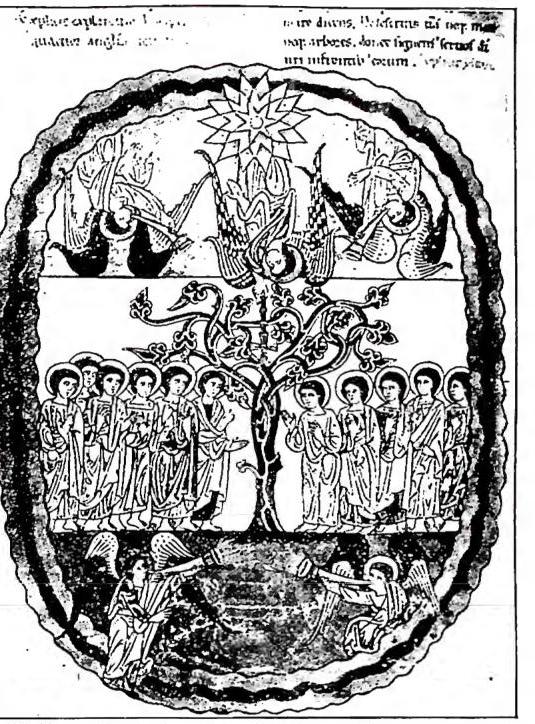
Born in 1494, died in 1546. He was the son of Giovanni B. of Balfour, brother of Giacomo B., archbishop of Glasgow. After completing his first studies at St.-Andrews, he moved to Glasgow to live with his uncle Giacomo,(from W. Neuss, Die Apokalypse des hl. Johannes, Monaco 1931, pl. 12) BEATO DI LIÉBANA - The Five Angels, mentioned in chap. 7, 1-4 of the Apoc. Illuminated page from B.’s manuscript (late 12th century) in the John Rylands Library, Manchester.
and subsequently went to Paris to continue them. In 1519 the king of Scotland, James V, appointed him his ambassador to the court of France. Returning to Scotland in 1525, he became one of the members of Parliament; but in 1533 he had to return to France, sent there by the king and by his uncle to negotiate an alliance with that nation and the marriage of the young king with Madeleine, daughter of Francis I, king of France, whom he subsequently accompanied to Scotland. When the queen died in 1537, shortly after the marriage, he returned to France to arrange the widowed king’s marriage with Mary of Guise, and on this occasion King Francis I granted him the bishopric of Mirepoix. Created cardinal in 1538 with the title of S. Stefano al Celio, he returned to Scotland, where he was appointed coadjutor or auxiliary to his uncle the archbishop, whom he succeeded in the primatial see in 1539. Meanwhile the schismatic Henry VIII of England was striving to separate James V also from the Holy See.
In this grave danger the king was effectively assisted by the cardinal. When war broke out with the English, in 1542, after the defeat at Solway Moss, the king died of a broken heart, leaving a daughter, Mary Stuart, who had been born only recently, under the regency of B. and other Scottish nobles. The nobles who had been won over by Henry VIII and were turning Protestant refused to recognize him as regent and imprisoned him. Their Protestant attitude and anti-Catholic conduct affected the sentiments of the Scottish people, who were Catholic at that time, so deeply that, in order to avoid disturbances, it became necessary to release him. With great energy B. immediately provided for the independence of his country and the defense of religion. Appointed legate a latere by Pope Paul III, in 1544 he proceeded with even greater energy and had condemned to death, among others, the Protestant preacher George Wishart, guilty of having plotted to assassinate him (1546). Two months later he himself was killed by Wishart’s partisans, who were subsidized by England. Cardinal B. was not free from defects, but he was a great and genuine lover of religion and of his country and did all he could to prevent the Protestant avalanche, the cause of so many disasters in Scotland.
3. JAMES
Born in 1517, died in 1603 in Paris, while King James was going to London to be crowned king of England. Son of a brother of Cardinal B. After completing his studies, and at the age of only 34, he was elected archbishop of Glasgow (1551). Since he was not yet a priest, he received priestly ordination and episcopal consecration in Rome in 1552. Returning to his homeland, during the regency of Mary of Guise, he assisted her against the Protestant Scottish nobles, who, having enriched themselves with stolen ecclesiastical property, saw in the pseudo-Reformation the only means of being able to enjoy it in peace. When the regent died in 1560, B. withdrew to Paris, taking with him many documents, which he subsequently left to the Scottish college in that city and which, for the most part, were unfortunately scattered or lost during the French Revolution. Queen Mary Stuart appointed him her ambassador to the court of France. He was also her adviser and sincere friend throughout her life, reproaching her for her mistakes as well, and remaining faithful to her even after her forced abdication in 1567. In 1574 the Scottish privy council declared him a rebel and outlaw, but King James VI of Scotland and I of England retained his confidence and appointed him his ambassador to the court of France in 1586.His friendship with the Guise family connected him with the league against Henry IV, and when the league was dissolved he was in danger of being expelled from France, but Henry IV himself opposed this. His conduct was so noble throughout all these events that, in 1598, that is, almost 40 years after the suppression of the Catholic religion in Scotland, the Scottish Parliament restored his property to him, together with all the honors and dignities he had possessed, «although he had never recognized the new religion of the kingdom».