
STEVENSON, ROBERT LOUIS. – Scottish narrator, b. in Edinburgh on 13 November 1850, d. in Samoa on 3 December 1894.
He is one of those rare writers in whom learning is joined to inventive flair, thereby bringing out his native originality all the more clearly. His astonishing imagination does not prevent his admirable prose from being solidly and skilfully constructed. S. was an original continuator of Walter Scott in his novels set in the historical Scottish milieu, among which the following should be remembered above all: Kidnapped (1886), Catriona (1893), The master of Ballantrae (1889), and finally the unfinished Weir of Hermistone (1896), regarded by some critics as his masterpiece. Alongside these stand the stories inspired by the South Seas, where he settled for reasons of health: the highly popular Treasure Island (1883), and various collections of exotic tales and sketches. For these he took his initial impetus from reading the American Melville, but he was inspired above all by his vivid impressions of the landscape, which he captured with an artist’s eye and represented in pages admirable for their consummate mastery of style. He also wrote verse, especially for children: A child's garden of verse (1885)
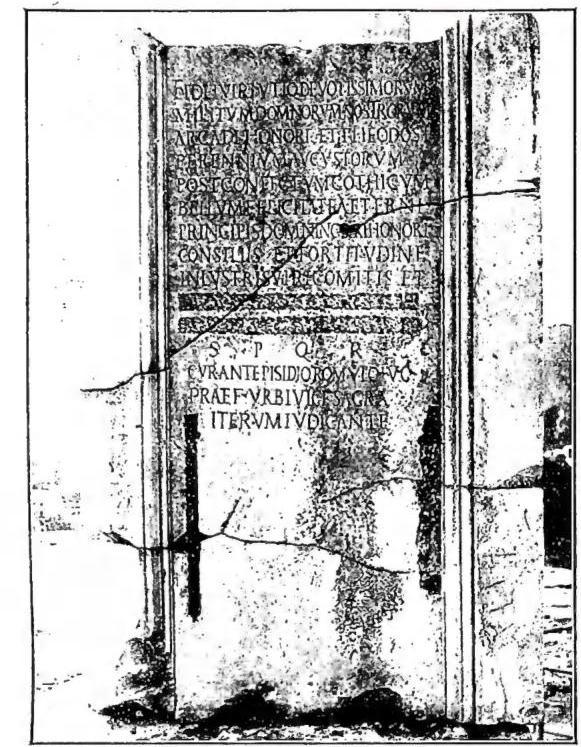
STILICONE, FLAVIO — Base of an equestrian statue, discovered in 1880, with an inscription referring to the victory over Radagaisus (405); S.’s name was erased following the «damnatio memoriae» of 408 (cf. CIL, VI, 4 Addenda II, no. 31987) — Rome, Roman Forum.
and a sensational and symbolic tale: The strange case of dr. Jekyll and mr. Hyde (1886), based on a splitting of the personality and reflecting his tormented faith as a Puritan believer. The same religious unease can be discerned in some of his Scottish novels, particularly in Weir of Hermistone. Cecchi rightly identified among the sources of S.’s fantastic and symbolic tale, together with Melville’s novels, Coleridge’s Ancient mariner and, further back in history, De Foe’s Robinson Crusoe. When the memory of the heroic Catholic missionary Giuseppe Damian de Veuster, who died of leprosy at Molokai, where he cared for those afflicted by the disease, was attacked by a fanatical Calvinist, S. responded with a most noble open letter in defense of Fr. Damiano. The letter is a masterpiece of English apologetic literature, worthy of standing beside Newman’s Apologia, and undoubtedly one of the writer’s loftiest and finest works (1890).