
VENEGONO INFERIORE, SEMINARY AND THEOLOGICAL FACULTY by. — A modest municipality in the province of Varese, it attained renown in Italy and abroad when (1927) the Church of Milan built there, as a tribute to Pius XI, an important building (see aerial view at V. SEMINARIO), serving jointly as the home of the secondary-school seminary, transferred from Monza, and of the theological seminary, transferred from the ancient establishment built in Milan by s. Carlo himself.
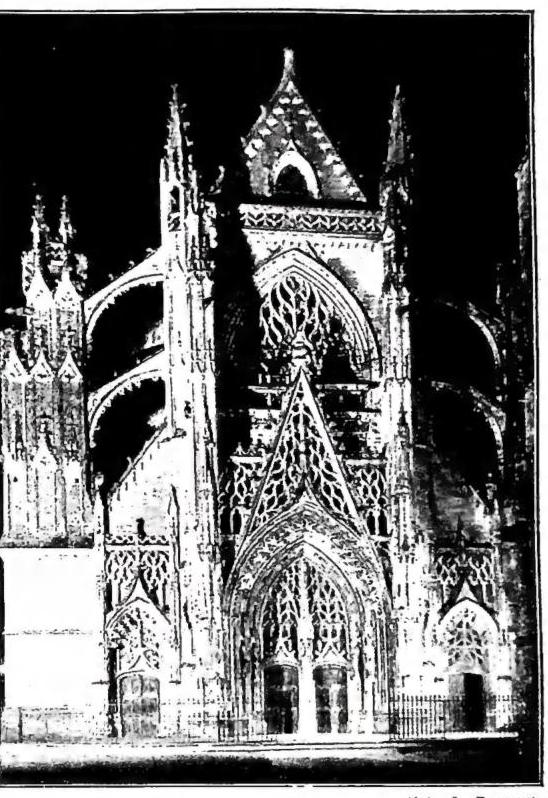
(photograph by J. Damaye)
VENDÔME – Façade of the abbey church of the Most Holy Trinity, illuminated at night (15th century).
It would have given it broader development and scope of action; but this project, having so far failed for various reasons, remains only a possibility for the future. Confined within the Seminary, the Faculty of Theology was therefore obliged, in its new statutes, approved by Pius XI in 1938, to reconcile two aims which, if not opposed, were certainly very different: the aim of a faculty, namely, to train scholars, and that of a diocesan seminary, however large, namely, to provide professional training for pastors devoted to the care of souls. For this twofold purpose, the Curriculum studiorum in the new statutes was divided into two periods: the first, lasting four years, although having most of its chairs distinct from those of the seminary courses, was predominantly institutional in character and concluded with the « licenza »; the second, lasting two years, was monographic in character and was compulsory for anyone intending to obtain the « laurea ». Thus the Faculty of Theology of V. acquired the distinctive feature of having six courses. From 1902, the College of Professors of the Faculty had undertaken the preparation and direction of the journal La scuola cattolica (v.).