Machine translation of the 1948–1954 Italian original. The original text is authoritative.
MAŞŞEBHĀH. – A pillar, a large stone set upright (from the verb nāṣab “to set upright”; Septuagint: στήλη, λίθος σκοπός, ὑπόστασις, Ez. 26:11; Vulgate: titulus, lapis, statuae). In the Bible it commemorates a divine benefit (Gen. 28:18, 22; 31:13; 35:14), or a covenant (between Giacobbe and Laban: Gen. 31:45, 51 ff.; of the Sinai covenant: Ex. 24:4); it is a symbol of the worship of the true God (Is. 19:19). As a funerary stele (II Sam. 18:18; Gen. 35:20), it is still in use today among Muslims. The m. was often an idolatrous stele, beside the 'āferāh and the altar, in Canaanite sanctuaries or sacred high places (Ex. 32:24; 34:13; Deut. 7:5; 12:3; Ier. 43:13; in Ez. 26:11 “protective columns,” like those at the entrance to the temple of Melkart in Tyre).
The m. were arranged at equal intervals, on a line often oriented north-south. The number varied: at Gezer 10 remain in one sanctuary, 4 in another; at Thanac only 2; in rural sanctuaries it is probable that there were
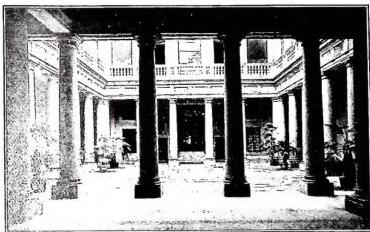
(Alinari photograph) MASSARI, GIORGIO — Courtyard of the Palazzo Grassi-Stucky — Venice.there was probably only one. The more ordinary ones had the proportions of a man; at Gezer there are some approximately 3 metres high; some have been polished by the kisses and anointings they have received over the centuries; others are rough. Their relation to the divinity is unclear: whether they were its dwelling or its symbol. The Law therefore prohibited them (Lev. 26:1; Deut. 16:22). Nevertheless, they are found in the bānāth, or sanctuaries in honour of Jahweh (I Reg. 14:23; II Reg. 17:10; 18:4; 23:14; II Par. 14:2; 31:1; Os. 3:4; 10:1 ff.; Mi. 5:12); and also in honour of Baal (II Reg. 3:2; 10:26 ff.). In Is. 6:13 the m. is a tree trunk devoid of branches. Distinct from the m. are the solar stelae in honour of Baal: hammānim (Lev. 26:30; Is. 17:8; 27:9; Ez. 6:4, 6; II Par. 14:4; 34:4, 7), placed above the altar.
BIBL.: M.-J. Lagrange, Études sur les religions sémitiques, 2nd ed., Parigi 1905, pp. 201–205, 211 ff.; H. Vincent, Canaan d'après l'exploration récente, there 1907, pp. 96, 102 ff., 140; L. Desnoyres, Histoire du peuple hébreu, I, there 1922, pp. 231–36; A. Clamer, La Ste Bible, ed. L. Pirot, II, there 1940, pp. 192 ff., 197 ff., 263 ff.; F. Spadafora, Ezechiele, Torino 1948, pp. 63 ff., 204 ff. Francesco Spadafora
Cite this article
“MAŞŞEBHĀH.” Enciclopedia Cattolica, vol. VIII (1952), p. 199. Azione Romana digital edition, https://azioneromana.com/article/massebhah.