
SABA, saint, martyr. — He is commemorated in the Latin and Greek Martyrologies on 24 April as a Roman martyr who perished under Aurelian; he is, however, unknown to the earliest hagiographical sources.
He is probably a duplicate of the homonymous S. called the Goth (v.), whose deeds were distorted by ignorant hagiographers. There existed a fabulous Pastio, now lost, from which the entry in the Roman Martyrology was derived.
SABA, Saint. - Palestinian monk. He is commemorated on December 5 in the Constantinopolitan Synaxarion and in the Roman Martyrology.
According to his biographer Cyril of Scythopolis (Vita, BHG 1608), he was born in Mutalaska, near Caesarea in Cappadocia, in 439, and died on December 5, 512. As an adolescent, he entered a monastery in his native province. In 456 or 457, he traveled to Palestine, where he led a monastic life in various monasteries until he obtained permission to withdraw into eremitical life. He spent a quinquennium among the ruins of a tower on Gebel el-Muntar, then moved to the valley of the Cedron. However, the growing number of his disciples forced him to gather them and, reluctantly, to build huts and adapt natural caves. Thus began the "Great Laura," which became the most famous in Palestine (478). Sallustius, Patriarch of Jerusalem, conferred priesthood upon Saba and also took the opportunity to consecrate the monastery church (491). Due to disputes, he voluntarily went into exile (593-598); during this period, he founded the "New Laura" of Thecua (508). As archimandrite of Palestine, he twice (in 512 and 531) intervened at the imperial court—after an unsuccessful letter—to abolish the chrysargyron (a kind of odious tax) and to defend the faith against the Monophysites. Cyril of Scythopolis hails Saba and his monks as "the strongest bulwark of the Catholic faith in Palestine." He died at the age of 93.
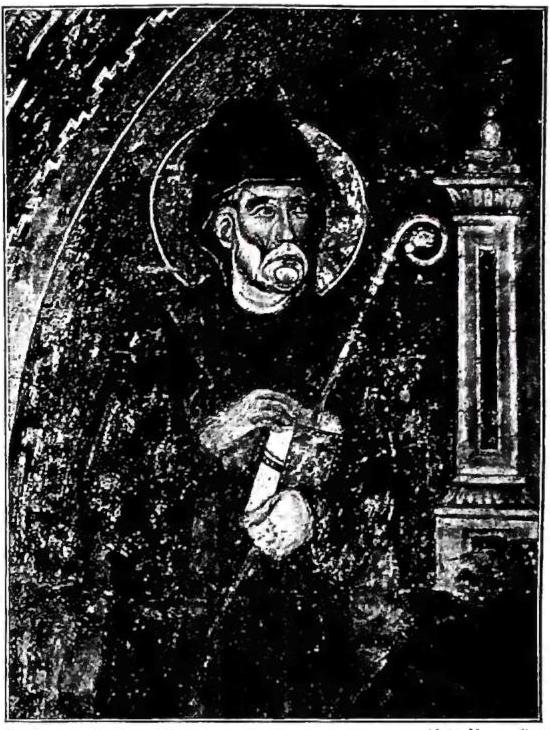
(photo: Mercuri)
SABA, Saint - 13th-century fresco - Rome, Church of S. Saba, 12th or 13th century. His influence was considerable in the organization of later monasteries.
The burial chapel of Saint Saba is located in the homonymous monastery in Palestine, but his relics are in Venice; in Rome, a church was erected in his honor in the 9th century.