
SANTA MARIA DI GROTTAFERRATA, GREEK ABBEY of. — It stands among the Tuscolan and Alban Hills at the foot of Monte Cavo, approximately 18 km from Rome on the ancient Via Latina.
Its foundation dates to 1004 and was the work of s. Nilo di Rossano, who, after organizing the Eastern cenobitic life in his native Calabria, traveled up through Campania and then came to Latium, where he was received by Count Gregorio di Tuscolo, who granted him that vast tract of land which constituted Cicero’s Tusculanum. There stood, and in part still stand, imposing remains of a Roman villa from the republican period. The most important for the history of the abbey is a double chamber in opus quadratum, which originally constituted a funerary cell of the villa. Transformed into a Christian oratory as early as the early Middle Ages for the use of the few inhabitants of the area, as is shown by traces of Greek decoration and graffiti, it acquired the characteristic name of « Crypta ferrata » from the Roman windows with double iron grilles, still extant, in every wall. The oldest document to record this name is a bull of Benedict IX from 1037. Around that modest country oratory, and making use of the remains of other Roman buildings, arose the cenobium and the church, which was completed by s. Bartolomeo, the third successor of s. Nilo, and consecrated by Pope Giovanni XIX of the Counts of Tusculum on 17 December 1024; it is dedicated to the Virgin Mary under the title of S. M. di G., whose ancient icon presides over the sanctuary, attracting numerous faithful. The Supreme Pontiffs granted the abbey privileges and donations, always viewing with benevolence this Greek monastic institution, which arose at the gates of Rome precisely during the period in which Byzantium was spiritually drawing away from II.
(phot. Anderson)
The first two centuries of the abbey’s life, despite the Tuscolan-Roman conflicts, were marked by intense liturgical and literary activity, as attested by the numerous and precious manuscripts that still exist. In imitation of the founders, the monks transcribed and composed works, keeping alive the Italo-Greek iconographic tradition and the calligraphic tradition begun by s. Nilo himself. But the intensification of the conflicts, which later culminated in the destruction of the ancient city of Tusculum (1191) by the Romans, forced the community of Grottaferrata to find temporary shelter in the monastery of the S. Speco at Subiaco. Upon their return, activities resumed, and the church was given renewed splendor, both inside, with mosaics such as that of the triumphal arch, still in excellent condition (representing the twelve Apostles on either side of an empty throne, in the lower part of which the apocalyptic lamb is depicted), and with frescoes on the walls, of which only a small part was spared by time and human beings; and outside, with the opening of mullioned windows on the sides and of the rose window on the façade, as well as with the construction of the massive bell tower, accentuating the Romanesque character of the building over the Byzantine motifs of the first period. Later the abbey was troubled by the disturbances of the Avignon period of the papacy and of the Western Schism, and also suffered considerable devastation during the baronial struggles of the first half of the fifteenth century, until Eugenio IV entrusted its administration to the energetic ab. Pietro Vitali, who also took part in the Council of Florence for the union of the Greeks with the Catholic Church.
With Bessarione begins the series of commendatory cardinals, who succeeded one another until the post-Napoleonic period. Card. Bessarione materially and morally reorganized the abbey and encouraged Greek studies and liturgy there. His successor Giuliano della Rovere (later Giulio II) surrounded it with moats, battlemented walls, and towers, constructed, it seems, by Sangallo or Baccio Pontelli, giving it the characteristic appearance it still preserves of a large medieval fortress. Of the abbey palace he managed to complete only one side, on whose inner façade one admires the portico known as that of Sangallo. Then three successive members of the Colonna family held Grottaferrata in commendam, followed by members of the Farnese family. For more than a century, from 1626 to 1738, the Barberini held the abbey, leaving behind only one worthy memorial, the so-called «macchina berniniana», built in 1665 to support the prodigious icon of the Virgin and subsequently adapted as a Greek iconostasis. Card. Giannantonio Guadagni, who succeeded them, transformed the interior of the church and decorated it with stucco, causing irreparable damage to the marble columns and the paintings of the thirteenth century and almost entirely removing its Romanesque-Byzantine character. During the same period the monastic community provided for the construction of a new spacious residence for the monks and of the monumental Library. The last commendatory cardinal was Ercole Consalvi; Leone XII abolished the commendam.
The Napoleonic storm, despite the almost total dispersal of the monks, spared the abbey, which was declared a national monument. The Italian government granted it the same status after 1870, and it remained entrusted to the Basilian monks, who were thus able to avoid the complete suppression of the Order. From that time onward, the history of the abbey of S. M. di G. is identified with that of the Basilian Congregation of Italy (v. BASILIANI D'ITALIA (ITALO-GRECI)). Benedict XIV, with the apostolic constitution Inter multa of 24 April 1747, and Leone XII, with the apostolic letter Inter coeterae of 12 November 1824, had already established that the Latin rite should be followed for the care of souls by one of the monks and an assistant. Pope Leone XIII, by a decree dated 12 April 1882 of the Sacred Congregation of Propaganda for Eastern-rite affairs, restored the Greek rite to new life in the abbey. The same Sacred Congregation, by the decree Zamudum on the same date, established that the Latin parish should be entrusted to a priest of the Latin rite, and by the decree Quanta Romanorum of 19 May 1929 separated the Greek parish from the Latin one (AAS, 22 [1930], pp. 134-137). Pius XI, with the apostolic constitution Pervetustum Cryptaeferratae coenobium of 26 September 1937, created the abbey nullius, detaching its territory from the suburban diocese of Frascati, and established that the ordinary should be the archimandrite «pro tempore» of the Congregation of Italy of the Basilian Monks (AAS, 30 [1938], pp. 183-85). In recent decades, with the renewal of the abbey’s moral direction, oriented with particular attention toward Eastern studies and apostolate, important restoration work has also been carried out on the bell tower and the church, restoring to its exterior all its original splendor, and the narthex has been reconstructed, where the ancient marble baptismal font was placed, much admired for the bas-reliefs and the symbolism of the sculptures from the year 1000. In addition to the church, the attention of scholars has always been, and still is, directed toward the Library, because of its valuable collection of Greek manuscripts, especially liturgical manuscripts and those of Byzantine music, from which the monks draw the chants for the divine offices. The illuminated codices are also of particular interest, as are the autograph manuscripts of s. Nilo, written in the tachygraphic script proper to the Saint, which was subsequently followed by his disciples; the Eucho-logio used by the Fathers of the Council of Florence; the codex of Manuele Paleologo bound in blue velvet, with the Byzantine double-headed eagle and the monogram of the Paleologi embroidered in silver; the collection of poems by Cristoforo Mitileneo; the epic poem Digenis Abritas; etc. Connected with the Library is the workshop for the restoration of antique books, established in 1930.
Important, moreover, for the ancient and medieval history of the area are the collections of inscriptions, boundary stones, sculptures, and architectural and decorative elements from the Roman and Christian periods, arranged in the ground-floor rooms of the Roverian Palace; and, for the origins of Christianity in the Tuscolano, the catacombs of the 4th century at the tenth mile of the ancient Via Latina, excavated in 1912–13 under the direction of the monks and in 1918–19 by the Pont. Commission of Sacred Archaeology.
71 (1943–45), pp. 45–51; C. Cecchelli, L'etimania criptoferratense, Rome 1946. Teodoro Minisci
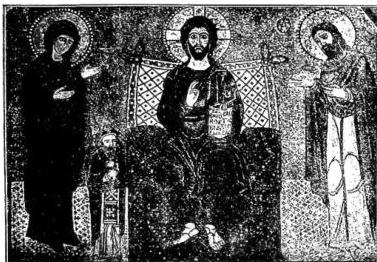
ART. — The building is a work of Romanesque-Roman architecture, permeated by elements evident, among other things, in the external decoration with small arches, featuring motifs of Byzantine taste, as in the magnificent reliefs of the marble framing of the Porta Aurea. The interior, apart from its structural framework, has undergone a complete transformation. Cardinal Alessandro Farnese built the wooden coffered ceiling (1575), and around 1610 Cardinal Odoardo Farnese completely transformed the Chapel of SS. Nilo and Bartolomeo. But the most disastrous alteration took place in 1754, when Cardinal Guadagni enclosed the columns within pillars and covered the ancient paintings with medallions and stucco ornaments. Finally, in 1843, Cardinal Mattei attached the Latin church to the atrium. The bell tower, of the type of the Romanesque Roman campaniles, rises above a small room that is perhaps the oratory of the fifth-sixth centuries, remembered as the original nucleus of the Sanctuary; erected in the twelfth century, it was radically restored in 1910–1913. Notable works are found in the narthex: the baptismal urn with reliefs of fishing scenes (eleventh-twelfth centuries); the aforementioned Porta Aurea with wooden doors (eleventh-twelfth centuries) and, on the tympanum, the mosaic with Christ enthroned, the Virgin, s. Giovanni, and a donor (the abbot Bartolomeo), dated to the eleventh century; inside, within the marble pulpit of the Berninian school (1665), is the Madonna di Grottaferrata, a panel painting in rather late Byzantine forms (thirteenth century). On the triumphal arch is the mosaic of the Pentecoste, Byzantine in style and iconography, probably executed by mosaicists who came from Venice at the beginning of the thirteenth century (Toesca). Above it is the fresco of the Trinità, discovered beneath the coffered ceiling in 1904, together with the few surviving fragments of the Storie di Mosè on the side walls (late thirteenth century). Finally, there is the Chapel of SS. Nilo and Bartolomeo, with scenes from the lives of the two saints, frescoed by the young Domenichino (1610) and restored in 1819 by G. Candida under the direction of V. Camuccini. On the altar is the Madonna fra i SS. Nilo e Bartolomeo, a late work by Annibale Carracci.
The church of S. Maria, the nucleus of the Abbey of S. Nilo, stands at the center of a powerful bastioned enceinte erected on behalf of Giuliano della Rovere, commendatory abbot, said to have been designed by Bramante, but more probably by Sangallo or Baccio Pontell