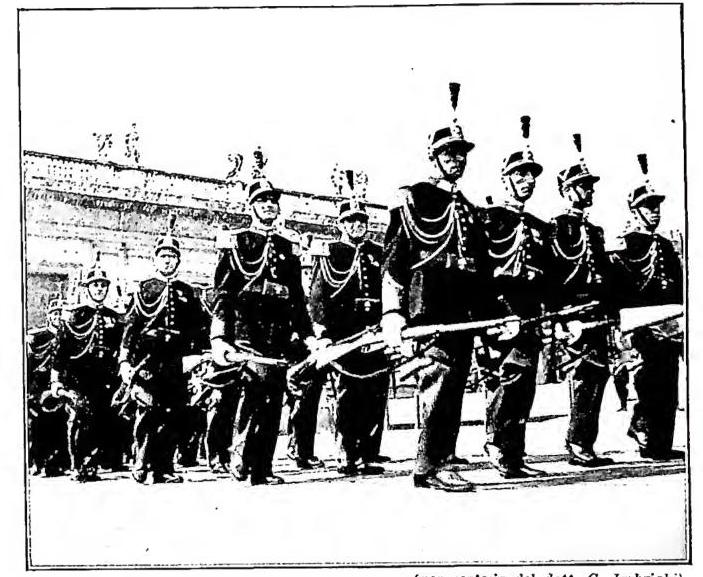
SWISS GUARD, PONTIFICAL. — It is a corps of Swiss soldiers serving in the Vatican City (*Cohors pedestris Helvetiorum a sacra custodia Pontificis*).
From the 14th century onwards, some Swiss soldiers were already in the service of the Holy See in the Papal States, as in other states. In the 15th century, mention is made of them in the various possessions of the Supreme Pontiffs.
Sixtus IV (1471–1484) appears to have attempted on several occasions to reach agreements with the federal states or individual Swiss cantons to regulate recruitment.
Julius II then conceived the idea of forming a stable and disciplined corps of Swiss soldiers directly dependent on the Holy See for the immediate protection of the Sacred Person of the Supreme Pontiff and the Apostolic Palaces. Indeed, on 21 June 1501, he informed the “con-federated Superior Alemannic States” that he had entrusted Pietro von Hertenstein, “our chamberlain,” with the task of bringing 200 men to the Apostolic Palace in Rome, discreetly.
The appointment of the commander (who may also be chosen from outside the corps) and the promotion of officers are made with sovereign consent. The appointments of the guards are made by the Cardinal Secretary of State, after they have taken the prescribed oath.
The Pontifical Swiss Guard depends directly on the Cardinal Secretary of State, is tasked with the service of the Supreme Pontiff, and takes up position in the antechamber, after the Noble Guard, with a detachment of six guards under the command of a sergeant or corporal. The duty officer, instead, occupies another room together with the officer of the Swiss Guard. The Pontifical Swiss Guard provides service during papal ceremonies and in the pontifical chapel with a detachment proportional to the place it is to occupy. For such services, it is at the disposal of the Master of the Chamber.
During a sede vacante period, it is at the disposal of the Cardinal Camerlengo and the Marshal of the Conclave (art. 2 of the current regulations).
The Pontifical Swiss Guard has its own white and yellow fringed and gold-ornamented flag, which is the sole surviving regimental standard, given by Pius IX in 1859 to the Papal army; at its center is placed the coat of arms of the reigning pontiff. It is the only armed pontifical corps to have a military band.
**SWISS GUARD (PONTIFICAL).**
The Swiss Guard (Pontifical) is a body of Swiss soldiers serving in the Vatican City (*Cohors pedestris Helvetiorum a sacra custodia Pontificis*).
From the 14th century onwards, Swiss soldiers were already in the service of the Holy See in the Papal States, as in other states. In the 15th century, mention is made of them in the various possessions of the Supreme Pontiffs.
Sixtus IV (1471–1484) appears to have attempted several times to reach agreements with the federal states or individual Swiss cantons to regulate recruitment.
Julius II then conceived the idea of forming a stable and disciplined body of Swiss soldiers directly under the Holy See for the immediate protection of the Sacred Person of the Supreme Pontiff and the Sacred Apostolic Palaces. Indeed, on 21 June 1501, he informed the "Confederated Upper German States" that he had entrusted Pietro von Hertenstein, "our chamberlain," with bringing 200 men to the Apostolic Palace in Rome, discreetly.
The appointment of the commander (who may also be chosen from outside the corps) and the promotion of officers are made with sovereign consent. The appointments of the guards are made by the Cardinal Secretary of State, after they have taken the prescribed oath.
The Pontifical Swiss Guard is directly under the Cardinal Secretary of State, is tasked with serving the Supreme Pontiff, and takes its place in the antechamber, after the Noble Guard, with a detachment of six guards under the command of a sergeant or corporal. The duty officer, instead, occupies another room, together with the officer of the Swiss Guard. The Pontifical Swiss Guard provides service during pontifical ceremonies and in the pontifical chapel with a detachment proportional to the space it must occupy. For such services, it is at the disposal of the Master of the Chamber.
During a sede vacante period, it is at the disposal of the Cardinal Camerlengo and the Marshal of the Conclave (art. 2 of the current regulations).
The Pontifical Swiss Guard has its own white and yellow fringed and gold-ornamented flag, the only surviving regimental standard given by Pius IX in 1859 to the Papal army; at its center is placed the coat of arms of the reigning pontiff. It is the only Pontifical armed corps to have a military band.
The G. p. d'ò. has its white and yellow gold-fringed and gold-ornamented flag, which is the only surviving regimental flag given by Pius IX in 1859 to the papal army; at the center is placed the coat of arms of the reigning pope. It is the only papal armed corps to have a military band.
GUARDIA SVIZZERA PONTIFICIA
It is a corps of Swiss soldiers in service in the Vatican City (*Cohors pedestris Helvetiorum a sacra custodia Pontificis*).
As early as the 14th century, some Swiss soldiers were in the service of the Holy See in the Papal States, as in other states. In the 15th century mention is made of them in the various possessions of the Supreme Pontiffs.
Sixtus IV (1471-1484) seems to have attempted several times to reach agreements with the Swiss federal states or cantons for the regulation of recruitment.
Julius II then conceived the idea of forming a stable and disciplined corps of Swiss soldiers directly dependent on the Holy See for the immediate custody of the Sacred Person of the Supreme Pontiff and the Sacred Apostolic Palaces. Indeed, on 21 June 1501, he informed the "Confederated Upper German States" that he had entrusted Peter von Hertenstein, "our chamberlain," with the task of bringing 200 soldiers to Rome for the Apostolic Palace, quietly.
The appointment of the commander (who may also be chosen from outside the corps) and the promotion of officers are made with sovereign consent. The appointment of the guards is made by the Cardinal Secretary of State and after they have taken the prescribed oath.
The G. p. d'ò. is directly dependent on the Cardinal Secretary of State, is destined for the service of the Supreme Pontiff, and takes its place in the antechamber, after the Noble Guard, with a detachment of 6 guards under the command of a sergeant or corporal. The duty officer, instead, occupies another room, together with the officer of the Swiss Guard. The G. p. d'ò. performs service at papal ceremonies and in the papal chapel with a detachment proportional to the place it is to occupy. For such services it is at the disposal of the Master of the Chamber.
During the period of sede vacante it is at the disposal of the Cardinal Camerlengo and the Marshal of the Conclave (art. 2 of the current regulations).
The G. p. d'ò. has its white and yellow gold-fringed and gold-ornamented flag, which is the only surviving regimental flag given by Pius IX in 1859 to the papal army; at the center is placed the coat of arms of the reigning pope. It is the only papal armed corps to have a military band.
cape (v.). All the aforementioned officers and the chaplain are part of the papal household (v.).
Benedict XV, by a dispatch of the Cardinal Secretary of State dated 20 May 1919, decided that the Swiss Guard should take precedence over the Palatine Guard of Honour.
The Swiss Guard is entrusted with the custody of the Sacred Person of the Supreme Pontiff. It then guards the pope’s residence day and night, especially at the external entrances. It performs service in all papal chapels and at other functions, and for this it also receives orders from the Monsignor Majordomo. During a sede vacante it is under the orders of the Cardinal Camerlengo until the cardinals enter the Conclave, which it guards. From that moment until the election of the new Supreme Pontiff, the Swiss Guard has as its superiors the cardinals of the order of deacons and the Marshal of the Conclave.
In the Fundamental Law of the State of the

Vatican City (7 June 1929) the direct dependence of the Swiss Guard on the Supreme Pontiff was reconfirmed (art. 2), but it was also established that the Governor of the Vatican City State, for the purposes of security and police, may also request the assistance of the Swiss Guard insofar as necessary (art. 7).
The Swiss Guard still wears the characteristic uniform attributed to Michelangelo.